

Viriksha HR Solution
New Labour Law Updates Every Employer Should Know in the New Financial Year
29-04-2026 Wednesday
Table of Contents
ToggleNew Labour Law Updates Every Employer Should Know in the New Financial Year
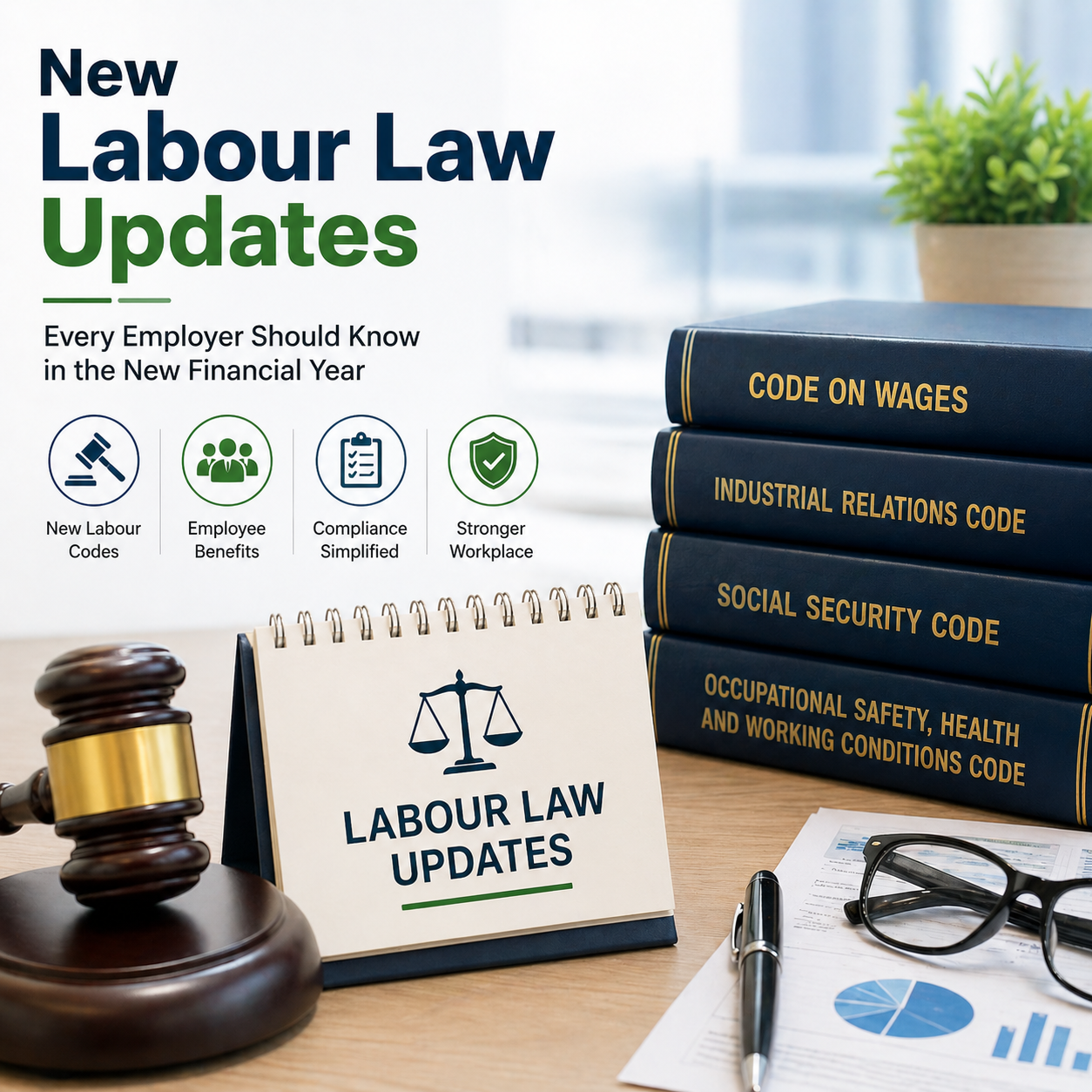
India’s labour law framework is in the middle of its most significant structural overhaul in decades. The consolidation of 29 central labour laws into 4 Labour Codes — the Code on Wages, the Industrial Relations Code, the Code on Social Security, and the Occupational Safety, Health and Working Conditions Code — has been legislated and notified. While full enforcement is still pending at the central and state levels, several provisions are already in effect, others are being adopted by states progressively, and the compliance implications of the full implementation are significant enough that every employer in India — in Chennai, across Tamil Nadu, and Pan India — should be preparing now.
This article covers every key labour law update your business needs to know entering the new financial year, what changes in practice, and how Viriksha HR Solutions helps businesses in Chennai and across India stay ahead of every update.
“Compliance is not a cost center. It is a trust signal — to your employees, your investors, your bank, and
your clients. In Chennai’s competitive business landscape, the companies that comply consistently are the ones that scale consistently.”
— VIRIKSHA HR SOLUTION, CHENNAI
1. The Four Labour Codes — Where Things Stand
India’s four Labour Codes consolidate and replace 29 existing central labour laws. The current status as of the new financial year is this: all four codes have received Presidential assent and been notified. Most states have published draft rules. Several states have finalised their rules. But the Central Government has not yet notified a unified implementation date — which means the legacy laws remain in force until notification.
What this means for employers: the old laws still apply. The Employees’ Provident Fund Act, ESI Act, Minimum Wages Act, Payment of Wages Act, Payment of Bonus Act, Factories Act, and Contract Labour Act are all still in full effect. But the new codes define the direction of compliance — and businesses that understand what is coming will transition without disruption when implementation is notified.
The four codes at a glance:
Code on Wages, 2019
Consolidates the Minimum Wages Act, Payment of Wages Act, Payment of Bonus Act, and Equal Remuneration Act. Introduces a universal minimum wage floor for all workers across India — a significant change from the current state-specific system. Redefines "wages" in a way that directly affects PF and ESI contribution calculations and salary structure design.
Code on Social Security, 2020
Consolidates the EPF Act, ESI Act, Maternity Benefit Act, Payment of Gratuity Act, and others. Extends social security coverage to gig workers, platform workers, and unorganised sector workers — a major structural expansion. Changes to gratuity eligibility and fixed-term employment provisions are particularly significant for employers.
Industrial Relations Code, 2020
Consolidates the Industrial Disputes Act, Trade Unions Act, and Industrial Employment (Standing Orders) Act. Introduces the concept of fixed-term employment directly in the code — allowing employers to hire workers on fixed terms with all statutory benefits, without prior notice period obligations, but with full access to gratuity from day one.
Occupational Safety, Health and Working Conditions Code, 2020
Consolidates 13 laws including the Factories Act, Contract Labour Act, and Mines Act. Standardises working hour limits, mandates annual leave with wages, and extends safety obligations to a broader range of establishments.
2. The Redefined Definition of "Wages" — The Change That Affects Every Payroll
Of all the provisions in the new codes, the redefinition of “wages” in the Code on Wages has the most immediate and material impact on payroll processing and salary structure design.
Under the Code on Wages, total wages must not be less than 50% of the total remuneration paid to an employee. In plain terms: the sum of basic pay and dearness allowance — the components on which PF, ESI, gratuity, and bonus are calculated — cannot be structured below 50% of CTC.
This directly challenges the salary structures many Indian companies currently use — where basic pay is kept artificially low to minimise PF contribution liability, with the balance paid through allowances that are excluded from the statutory wage base.
What changes in practice: When this provision is enforced, businesses with low-basic salary structures will face significantly higher PF employer contributions, higher ESI liabilities on the corrected wage base, higher gratuity provisioning, and higher bonus calculations. For many mid-size businesses in Chennai, this will require a complete review and restructuring of salary components across the workforce.
Employers who restructure proactively — before enforcement — avoid the back-calculation liability that comes from non-compliance discovered retrospectively.
3. Fixed-Term Employment — A Significant Flexibility Addition
The Industrial Relations Code introduces fixed-term employment as a statutory concept available to all employers — not just those in specific sectors. A fixed-term employee is hired for a defined period, is entitled to all statutory benefits including ESI, PF, and proportionate gratuity from day one, and exits at the end of the term without any notice period obligation on either side.
What this means for businesses in Chennai and Pan India: Fixed-term employment provides a legally clean model for project-based hiring, seasonal workforce requirements, and capacity expansion — without the ambiguity of contract labour arrangements or the notice period exposure of permanent employment. Businesses that currently use contractor arrangements for roles that don’t qualify as genuine contracting should review whether fixed-term employment under the new code is the appropriate model.
4. Gratuity for Fixed-Term and Gig Workers — Extended Eligibility
Under the Code on Social Security, gratuity eligibility is extended to fixed-term workers on a proportionate basis from the first year of service — removing the existing five-year continuous service requirement for this category. Additionally, the Code extends social security obligations to gig and platform workers — a category that is growing rapidly across India’s digital economy.
For businesses in Chennai’s growing EdTech, logistics, and food delivery adjacent sectors, the extension of social security to gig and platform workers creates new compliance obligations that will need to be operationalised when the Code is enforced.
5. Working Hours, Leave, and Occupational Safety Updates
The Occupational Safety, Health and Working Conditions Code standardises maximum working hours at 8 hours per day and 48 hours per week — consistent with existing law — but introduces clearer provisions on overtime limits (maximum 125 hours per quarter), mandatory rest intervals, and annual leave accrual (1 day for every 20 days worked, consistent with current Shops Act provisions in Tamil Nadu).
The Code also mandates that every worker be issued a written appointment letter — a requirement that many small establishments in Chennai still do not meet in practice. Non-compliance with the appointment letter requirement will become a straightforward inspection finding when the Code is enforced.
6. State-Level Updates Employers in Tamil Nadu and Chennai Must Track
Beyond the central Labour Codes, Tamil Nadu has seen several state-level compliance updates that affect businesses in Chennai directly:
Tamil Nadu Minimum Wages revisions
Minimum wages in Tamil Nadu are revised periodically by the state government across scheduled employment categories. Businesses must verify that current salary structures — particularly for manufacturing, construction, and retail establishments — meet the latest applicable minimum wage rates for every employee category.
Contract Labour regulations
Tamil Nadu's rules under the Contract Labour (Regulation and Abolition) Act continue to require principal employer registration and contractor license maintenance for all establishments engaging contract labour above the threshold.
Tamil Nadu Shops & Establishments Act compliance
The working hours, overtime, leave, and register maintenance requirements under the TN Shops Act remain fully in force. Labour inspections in Chennai have continued with the same frequency and inspection scope. Businesses that assume pending labour code implementation means reduced inspection risk are mistaken — the current laws are being enforced actively.
7. What Employers Must Do Right Now
Waiting for the Labour Codes to be formally enforced before preparing is the approach that leads to rushed, expensive restructuring under pressure. Here is what every employer should be doing now:
Audit your current salary structures against the incoming 50% wages definition. Identify which employee categories will require restructuring and model the PF, ESI, and gratuity impact.
Review your contract labour and gig worker arrangements against fixed-term employment provisions and the extended social security obligations under the Code on Social Security.
Ensure current compliance is airtight under the laws that are in force right now — because a business that is non-compliant under the current framework has no defence when the new framework arrives.
Train your HR and payroll teams on the incoming provisions — or engage a labour law consultant who tracks these changes and can implement them correctly when notified.
How Viriksha HR Solutions Keeps Your Business Ahead of Every Labour Law Update
Staying current with India’s labour law landscape is not a one-time project. It is an ongoing compliance function — and for businesses in Chennai and across India, it is one of the most time-consuming and technically demanding parts of running an HR function.
Viriksha HR Solutions tracks every central and state-level labour law update — minimum wage revisions, new code notifications, ESI and PF regulatory changes, and Tamil Nadu-specific amendments — and implements them into client payroll and compliance frameworks before they create liability.
For our statutory compliance clients, every applicable law change is reflected in payroll processing, salary structure reviews, statutory filings, and register maintenance — without the client having to monitor government notifications or identify what has changed.
For businesses that are not yet working with a compliance partner — or whose current payroll vendor handles filings but does not track law changes — our free statutory compliance review identifies every gap between what your business currently does and what the law currently requires.
The best time to prepare for new labour law changes is before they are enforced — not after.
Get a labour law compliance review
Get a labour law compliance review from Viriksha HR Solutions — available for businesses in Chennai and across India.
Key Labour Law Updates at a Glance
Update |
Current Status |
Business Impact |
|---|---|---|
Code on Wages — wages redefinition
|
Notified, enforcement pending
|
Salary structure review required
|
Fixed-term employment provisions
|
Notified, state rules progressing
|
Alternative to contract labour
|
Gratuity for fixed-term workers
|
Notified, enforcement pending
|
Liability from day one
|
Gig worker social security
|
Notified, enforcement pending
|
New contribution obligations
|
Working hours and leave standardisation
|
Notified, enforcement pending
|
Appointment letter compliance
|
TN Minimum Wages revisions
|
In force — current law
|
Immediate salary structure check
|
TN Shops Act compliance
|
In force — active inspections
|
Register and filing compliance
|