

Viriksha HR Solution
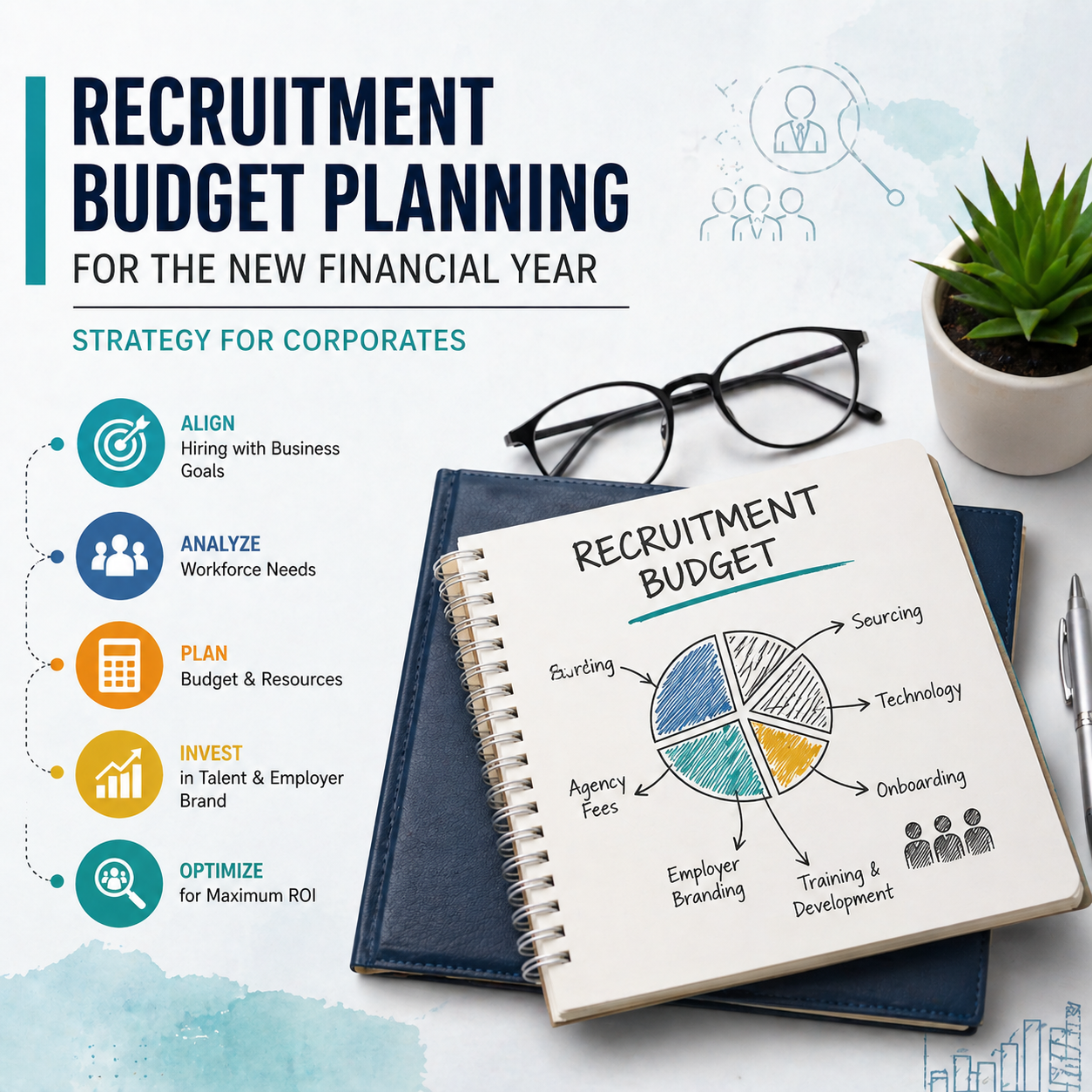
Recruitment Budget Planning for the New Financial Year: Strategy for Corporates
29-04-2026 Wednesday
Table of Contents
ToggleRecruitment Budget Planning for the New Financial Year
The new financial year is the most important moment in the recruitment calendar — and the most underused. Most corporate HR and talent acquisition teams spend April finalising last year’s attrition numbers, chasing approvals for open headcount, and reacting to departures that were predictable six months ago. The businesses that consistently hire well are doing something different in April: they are planning.
A well-structured recruitment budget for the new financial year does not just estimate what hiring will cost. It determines how the organisation will compete for talent, where it will invest in building capability, and how it will move faster than competitors when critical roles open. This guide covers how to build that plan — and how Viriksha HR Solutions helps corporate HR teams in Chennai and across India execute it.
“Compliance is not a cost center. It is a trust signal — to your employees, your investors, your bank, and
your clients. In Chennai’s competitive business landscape, the companies that comply consistently are the ones that scale consistently.”
— VIRIKSHA HR SOLUTION, CHENNAI
Why Most Corporate Recruitment Budgets Are Built the Wrong Way
Before building the right recruitment budget, it helps to understand why most corporate recruitment budgets fail to deliver.
The most common approach is historical — take last year’s recruitment spend, adjust for headcount growth, and present the number to finance. The problem with this approach is that it optimises for what recruiting cost, not what recruiting should cost to achieve the organisation’s actual talent goals. A team that spent ₹80 lakhs on recruitment last year and averaged 55 days to fill roles is not a benchmark to repeat — it is a baseline to improve on.
The second most common mistake is not accounting for the full cost of hiring. Direct recruitment costs — agency fees, job portal subscriptions, advertising — are the visible line item. But the total cost of a hire includes interviewer time across multiple rounds, the productivity gap during vacancy, the onboarding investment, and most significantly, the cost of a bad hire who exits within six months. Research across Indian markets consistently shows that the true cost of a mid-level hire is 1.5 to 3 times the annual salary of the role.
A recruitment budget that doesn’t account for quality — not just volume — will consistently underspend on the things that produce good hires and overspend on the things that don’t.
The foundation of any effective recruitment budget is a workforce plan — a structured assessment of what the organisation needs from its people over the next 12 months, not just how many people it needs.
A workforce plan for the new financial year asks: Which functions are growing and need to add headcount? Which roles are likely to open due to attrition based on historical patterns? Which capability gaps need to be addressed through hiring? Which locations are expanding? Which roles are hard to fill and need proactive sourcing rather than reactive posting?
For corporate HR teams in Chennai and Pan India, the answers vary significantly by function. Technology and IT roles in Chennai’s OMR corridor have average time-to-fill of 45 to 60 days for experienced professionals — meaning a role that opens in September needs sourcing to begin in July. Manufacturing roles in Ambattur and Sriperumbudur have seasonal availability patterns that affect when talent is most accessible. Leadership roles across any function have 8 to 14-week search timelines that cannot be compressed without compromising quality.
A recruitment budget built from a workforce plan allocates spend in advance of need — not in response to it.
Once the workforce plan is defined, cost per hire must be calculated by role category — not as a single average across the business.
Entry and junior level roles
typically lower direct recruitment cost but higher volume, higher attrition risk, and significant onboarding investment. Budget for portal advertising, bulk sourcing support, and structured onboarding programmes.
Mid-level professional roles
the most significant category for most corporate HR budgets. Agency fees typically range from 8% to 12% of annual CTC for contingency placement. Direct sourcing through internal recruiters reduces this cost but increases time-to-fill. The budget trade-off between agency speed and internal cost needs to be explicit — not assumed.
Senior and leadership roles
the highest cost per hire and the highest cost of an error. Retained executive search for Director-level and above typically runs from 12% to 20% of annual CTC. But the cost of a failed senior hire — including the search restart, the vacancy period, and team impact — consistently exceeds the search fee many times over. Senior hiring budgets should be built around quality and specialist capability, not cost minimisation.
The sourcing channel budget determines where recruitment spend goes — and this is where most corporate budgets are misallocated.
Job portal subscriptions — Naukri, LinkedIn Talent Solutions, Indeed — are the largest single line item for most corporate recruitment budgets. They are also the channels with the highest competition and the least access to passive candidates — the people performing well in their current roles and not actively looking.
A balanced sourcing channel budget for Indian corporates should include:
Employee referral programme investment
referral hires have shorter time-to-fill, lower cost-per-hire, and significantly higher 12-month retention rates than portal hires. A structured referral incentive programme is consistently one of the highest-ROI recruitment investments available to any corporate HR team.
Recruitment agency and RPO partnerships
for roles where internal capacity or speed is insufficient, agency partnerships provide access to pre-screened candidates and passive talent pools. Budget for agency fees by role category and prioritise partners with genuine sector specialisation over generalist agencies.
Employer branding
LinkedIn company page investment, Glassdoor management, and content that communicates what working at the organisation actually looks like. In competitive hiring markets like Chennai's IT corridor and Mumbai's BFSI sector, employer brand is a direct determinant of offer acceptance rates.
Campus and fresher hiring
for organisations with structured trainee or graduate entry programmes, campus hiring has a fixed annual calendar with predictable costs. Budget for campus visits, pre-placement presentations, and the internal onboarding investment that converts a fresher into a productive contributor within 90 days.
Every corporate recruitment budget must include a realistic attrition buffer — and most don’t.
India’s average voluntary attrition rate across industries in 2024 ranged from 14% in manufacturing to 28% in IT services. In Chennai specifically, IT sector attrition has remained elevated — meaning a 200-person IT team should budget for 40 to 55 replacement hires annually before accounting for any growth headcount.
Building attrition replacement into the budget forces an honest assessment of where attrition risk is highest — and allows proactive sourcing investment in those functions before the vacancy opens, rather than reactive hiring under pressure after it does. The organisations that react to attrition always pay more to fill the same roles than the ones that plan for it.
A recruitment budget without performance metrics is not a plan — it is an estimate. Every corporate recruitment budget should define the metrics it will be measured against at quarter and year end:
Time to fill
by role category and function, benchmarked against industry averages for Chennai and Pan India markets.
Cost per hire
total recruitment spend divided by total hires, tracked by role category and sourcing channel to identify where the budget is working and where it isn't.
90-day retention rate
the percentage of new hires still employed at 90 days. This is the metric that most directly reflects hiring quality rather than hiring speed.
Offer acceptance rate
the percentage of offers made that are accepted. A declining rate is the earliest signal of an employer brand or compensation positioning problem — and the most actionable early warning indicator a recruitment budget can track.
Sourcing channel efficiency
which channels produce the most hires at the lowest cost and highest retention rate. This metric drives the sourcing budget reallocation each quarter and prevents the annual mistake of renewing the same portal subscriptions because they were last year's budget line.
How Viriksha HR Solutions Supports Corporate Recruitment Planning
For corporate HR and talent acquisition teams in Chennai and across India, Viriksha provides two levels of recruitment budget support.
Strategic planning support — for HR heads and talent acquisition leaders building the financial year workforce plan and recruitment budget, our team provides market intelligence on current hiring timelines by function and location, compensation benchmarks across Chennai’s major industry sectors, and sourcing channel recommendations based on role category and urgency.
Execution partnership — as a recruitment agency, executive search firm, and RPO partner, Viriksha integrates with corporate HR teams as the external delivery arm for roles and functions where internal capacity or specialist knowledge is insufficient. Our fees are structured to provide cost certainty for budget planning — not variable surprises at the point of hire.
For businesses across Chennai — IT in OMR and Sholinganallur, manufacturing in Ambattur and Oragadam, BFSI across the city’s financial services corridor, healthcare and logistics — our recruitment consultants provide local market intelligence that makes the difference between a 30-day fill and a 90-day vacancy.
If your recruitment budget for the new financial year is still a number rather than a plan — speak to Viriksha.
Get a recruitment planning consultation
Get a recruitment planning consultation — available for corporate HR teams in Chennai and across India.
Recruitment Budget Planning — Key Metrics Reference
Metric |
Track By |
Why It Matters |
|---|---|---|
Cost per hire
|
Role category + channel
|
Identifies sourcing efficiency gaps
|
Time to fill
|
Function and level
|
Reveals capacity and process bottlenecks
|
Offer acceptance rate
|
Role and location
|
Signals compensation or brand issues
|
90-day retention
|
Sourcing channel
|
Measures hiring quality not just speed
|
Attrition rate
|
Department
|
Drives replacement headcount budget
|
Agency vs direct ratio
|
Role category
|
Optimises channel spend allocation
|