
Viriksha HR Solution
Top HR Consultancy Trends in 2026
Top HR Consultancy Trends in 2026 — What Every Business in India Needs to Know
08-06-2026 Monday
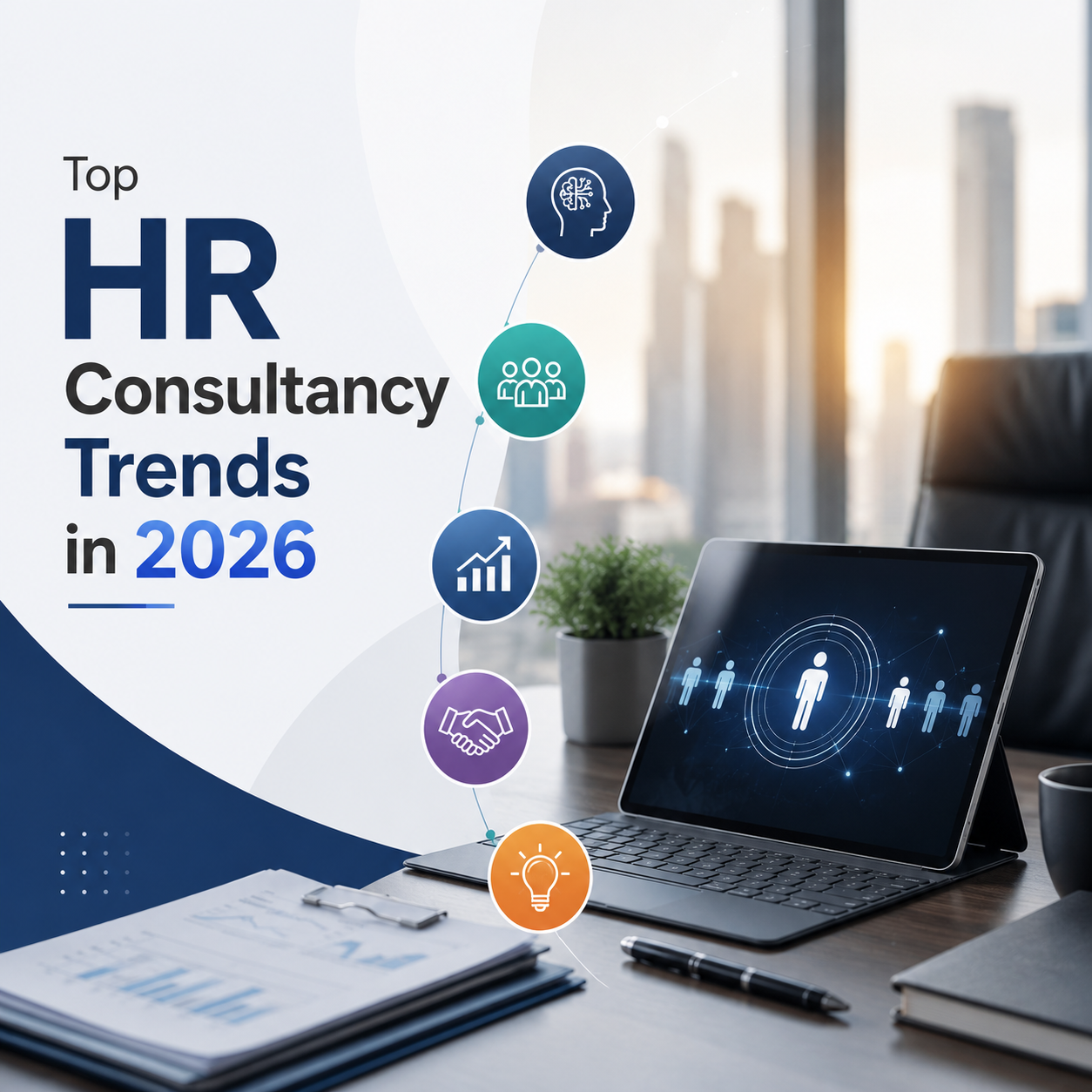
Table of Contents
ToggleTop HR Consultancy Trends in 2026 — What Every Business in India Needs to Know
HR consultancy is not what it was five years ago. The businesses that engaged HR consultants in 2021 wanted help with compliance basics and recruitment. The businesses engaging HR consulting services in 2026 want something significantly more strategic — workforce planning that connects to business targets, compliance frameworks that hold up to investor and regulatory scrutiny, talent acquisition models that compete in markets where the best candidates have four offers before they reply to a message, and HR technology that actually integrates with how the business operates.
The shift is not cosmetic. It reflects a fundamental change in how Indian businesses — from Chennai-based startups to Pan India corporates to MNCs building GCC centres — think about HR. HR is no longer a back-office function that processes payroll and files PF returns. It is a business-critical function that determines whether the organisation can hire, retain, and manage the people it needs to grow. And the HR consultancy industry in India is evolving to match that expectation.
These are the ten most significant HR consultancy trends shaping 2026 — and what they mean for businesses in Chennai and across India.
“Compliance is not a cost center. It is a trust signal — to your employees, your investors, your bank, and
your clients. In Chennai’s competitive business landscape, the companies that comply consistently are the ones that scale consistently.”
— VIRIKSHA HR SOLUTION, CHENNAI
1. Compliance as a Business Risk Function — Not a Filing Exercise
The single biggest shift in how Indian businesses approach HR consultancy in 2026 is the elevation of statutory compliance from an administrative function to a board-level risk management discipline.
The trigger is simple. The Labour Codes — Code on Wages, Code on Social Security, Industrial Relations Code, and Occupational Safety Code — are notified and moving toward enforcement. EPFO and ESIC inspection frequency has increased. POSH enforcement is more active than at any point since the Act was passed. And investor due diligence now routinely includes a deep HR and payroll compliance review — meaning non-compliance is not just a penalty risk. It is a valuation risk and a deal risk.
The HR consultancy trend in 2026 is the movement from reactive compliance — fixing problems when notices arrive — to proactive compliance architecture — building a framework that prevents notices from arriving. Businesses are investing in annual compliance audits, monthly compliance retainers, and dedicated labour law consultants in ways they simply did not two years ago.
What this means for your business: if your compliance framework is still managed informally — registers updated occasionally, PF and ESI filed by whoever is available, minimum wage reviews done never — 2026 is the year that approach becomes visibly costly.
2. AI-Assisted Payroll and HR Processing — With Human Expertise Still Required
Artificial intelligence is entering every HR process — payroll calculation, leave management, attendance reconciliation, TDS computation, and statutory filing. HRMS platforms in 2026 use AI to flag anomalies in payroll data, identify employees approaching ESI wage ceiling crossovers, automate ECR generation, and prompt compliance calendar actions before deadlines.
But here is what the trend actually reveals: AI-assisted HR processing is only as good as the compliance knowledge that configures and monitors it. An AI system that calculates PF on the wrong wage base calculates it wrongly at scale — faster and more consistently than a human making the same error. The HR consultancy value in 2026 is not in replacing technology with human process. It is in combining both — technology for speed and consistency, human expertise for interpretation, exception management, and department liaison.
Businesses that invest in HRMS platforms without investing in the compliance expertise to configure and monitor them are creating a false sense of compliance security. The platform files the ECR. Nobody is verifying whether the wage base is correct.
3. Integrated HR and Payroll — The End of the Fragmented Vendor Model
In 2026, the clearest HR consultancy trend among growing businesses in Chennai and across India is the consolidation of HR functions under integrated service providers — moving away from the fragmented model where payroll is managed by one vendor, compliance by another, recruitment by a third, and HR advisory by a consultant who does not speak to any of them.
The fragmented model creates mismatch risk at every boundary. The payroll vendor does not know about the salary revision the HR team approved. The compliance vendor does not know about the new joiners the recruitment agency placed. The result is ECR filings that do not match wage registers, ESI enrollments that happen months late, and registers that do not reflect actual headcount.
The 2026 trend is integration — one HR consulting services partner managing payroll, compliance, recruitment, and advisory as a coordinated function — where every output from one process feeds correctly into the next, and where accountability for the complete HR function rests with one partner rather than being spread across three vendors who each blame the others when something goes wrong.
4. Data-Driven Talent Acquisition — Replacing Gut Feel With Market Intelligence
The talent acquisition model that most businesses in Chennai used in 2022 and 2023 — post the role, screen whoever applies, make an offer — is not competitive in 2026. The candidates who are right for critical roles are employed, receiving competing approaches, and making decisions based on employer reputation and offer quality rather than availability.
HR consulting services in 2026 increasingly include talent market intelligence — compensation benchmarking for key role types, time-to-fill analysis by function and level, candidate availability mapping by skill set and location, and employer brand assessment that tells businesses why candidates are choosing competitors over them.
Businesses that make hiring decisions based on market data — knowing what the market pays for a senior data engineer in Chennai’s OMR corridor, knowing that a 90-day notice period requires a search brief three months before the intended joining date, knowing which sourcing channels actually produce hires for specific role types — consistently outperform businesses that operate on assumption and historical precedent.
5. The Four Labour Codes — Preparation Is Now the Strategy
Every HR consultancy engagement in India in 2026 includes a Labour Code readiness component — because the businesses that are not preparing now will face a scramble when implementation is notified that will be significantly more expensive than preparing proactively.
The Code on Wages redefines wages in a way that affects every salary structure in India — requiring basic wages and DA to constitute at least 50% of total remuneration. For businesses with artificially low basic pay structures, the impact on PF contribution liability, ESI contribution, gratuity provisioning, and bonus calculation is material and immediate.
The Code on Social Security extends gratuity to fixed-term employees from day one and extends social security to gig workers — creating new liability categories that many businesses have not modelled.
The HR consultancy trend is proactive restructuring — salary structure review, fixed-term employment framework design, and gig worker classification assessment — done before enforcement, not after.
Speak to Viriksha HR Solutions
Speak to Viriksha HR Solutions today and make HR a strategic advantage for your business.
6. Remote and Hybrid Workforce Compliance — A New Compliance Frontier
The normalisation of remote and hybrid work has created compliance complexity that India’s labour law framework has not yet fully addressed — and that businesses are increasingly bringing HR consultants in to navigate.
When an employee works from home in Tamil Nadu for a company registered in Maharashtra, which state’s Shops Act applies? Which state’s minimum wage rate is applicable? Which state’s Professional Tax is deducted? These are not theoretical questions. They are real compliance questions that businesses with remote workforces in Chennai and across India are asking in 2026.
HR consulting services in 2026 include remote workforce compliance mapping — identifying the applicable laws for every remote employee’s location, ensuring correct statutory registration in each state, and maintaining compliant records for a workforce that no longer sits in one place.
7. POSH Compliance — From Checkbox to Culture
POSH compliance has been a legal obligation since 2013. In 2026, it is becoming a cultural expectation — driven by investor scrutiny, employee awareness, and enforcement action that is significantly more active than in previous years.
The HR consultancy trend is the shift from checkbox POSH compliance — constituting an ICC and writing a policy — to genuine POSH culture building — regular awareness training, structured inquiry processes, ICC member development, and annual reporting that reflects a real commitment to safe workplace practices.
For businesses in Chennai and across India, POSH compliance in 2026 means ICC constituted with valid member terms, a POSH policy that employees have actually read and understood, regular awareness sessions conducted, annual reports filed, and an inquiry process that is procedurally fair and legally defensible.
8. GCC and Global HR Consulting — India as a Global Workforce Hub
India’s role as a global capability centre hub is the most significant structural HR trend of the decade — and Chennai is one of the primary beneficiaries, with GCC investments across the city’s IT corridors creating demand for HR consulting services that span international compensation benchmarking, cross-border payroll management, global mobility compliance, and India-specific statutory compliance for internationally structured organisations.
HR consultancy in 2026 increasingly means advising GCC clients on the Indian talent market, the Indian compliance framework, and the India-specific HR practices that differ materially from global HR standards. Notice periods, gratuity, statutory bonus, the ESI and PF framework, the POSH Act, and the Labour Codes all require expert local interpretation for global employers entering the Indian market.
9. Employee Experience as a Retention Strategy — HR Consultancy Expanding Its Scope
Retention is the HR problem that costs businesses the most in 2026 — in recruitment spend, institutional knowledge loss, productivity disruption, and the compounding effect of high attrition on employer brand. And retention is no longer a compensation problem alone. It is an employee experience problem.
HR consulting services in 2026 include employee experience design — structured onboarding frameworks, manager effectiveness programmes, stay interview processes, career development pathways, and exit analysis that identifies the real reasons people leave rather than the polite answers they give in exit interviews.
Businesses that invest in the employee experience between joining and leaving lose fewer people — and the HR consultancy trend in 2026 is the extension of the consultant’s scope from compliance and payroll into the full employee lifecycle.
10. Outcome-Based HR Consultancy — From Hours Billed to Results Delivered
The final and perhaps most important HR consultancy trend in 2026 is the shift in how businesses measure and purchase HR consulting services. The traditional model — hours billed, retainer maintained, reports produced — is being replaced by outcome-based engagement — specific compliance objectives delivered, time-to-fill targets met, audit findings remediated, payroll accuracy measured.
Businesses in 2026 want HR consultants who own outcomes, not just activities. Not “we filed the ECR” but “your compliance record is clean across every applicable Act.” Not “we sourced 50 candidates” but “we placed 12 engineers with an average time-to-fill of 38 days.” Not “we conducted a POSH training session” but “your ICC is constituted, your policy is displayed, your annual report is filed, and your employees know what to do.”
How Viriksha HR Solutions Is Leading These Trends in Chennai and Across India
Viriksha HR Solutions is not a compliance filing service or a recruitment agency that also handles payroll. It is a complete HR consultancy — aligned to every trend identified in this article and delivering against every one of them for businesses across Chennai, Tamil Nadu, and Pan India.
On compliance as a risk function
Viriksha's statutory compliance service provides annual compliance audits, monthly compliance retainers, and dedicated labour law consultancy that treats compliance as a strategic business function — not a monthly filing task.
On integrated HR and payroll
Viriksha manages payroll, PF and ESI compliance, statutory register maintenance, recruitment, and HR advisory as a coordinated function — eliminating the mismatch risk that fragmented vendors create.
On Labour Code readiness
Viriksha advises clients on salary structure review, fixed-term employment framework design, and gig worker classification assessment — proactively, before enforcement creates retrospective liability.
On talent acquisition
Viriksha's recruitment and executive search practice uses market data — compensation benchmarks, sourcing channel analysis, and time-to-fill modelling — to build hiring strategies that are grounded in reality, not assumption.
On GCC and global HR
Viriksha provides India-specific HR consultancy for GCC organisations and MNCs entering the Indian market — covering compliance, payroll, and talent acquisition from a single integrated partner.
On POSH and employee experience
Viriksha manages POSH compliance from ICC constitution through to annual reporting, and provides HR policy and employee experience consulting for businesses that want retention to be a managed outcome rather than a hoped-for result.
On outcome-based engagement
very Viriksha engagement is defined by specific deliverables, measured by specific outcomes, and reported against specific compliance and performance metrics — so clients know exactly what they are getting and can measure whether they are getting it.
2026 is the year that HR consultancy in India becomes a strategic business function for every organisation — not just the largest ones. The businesses that make that transition will hire better, retain longer, comply cleaner, and grow faster than those that do not.