
Viriksha HR Solution
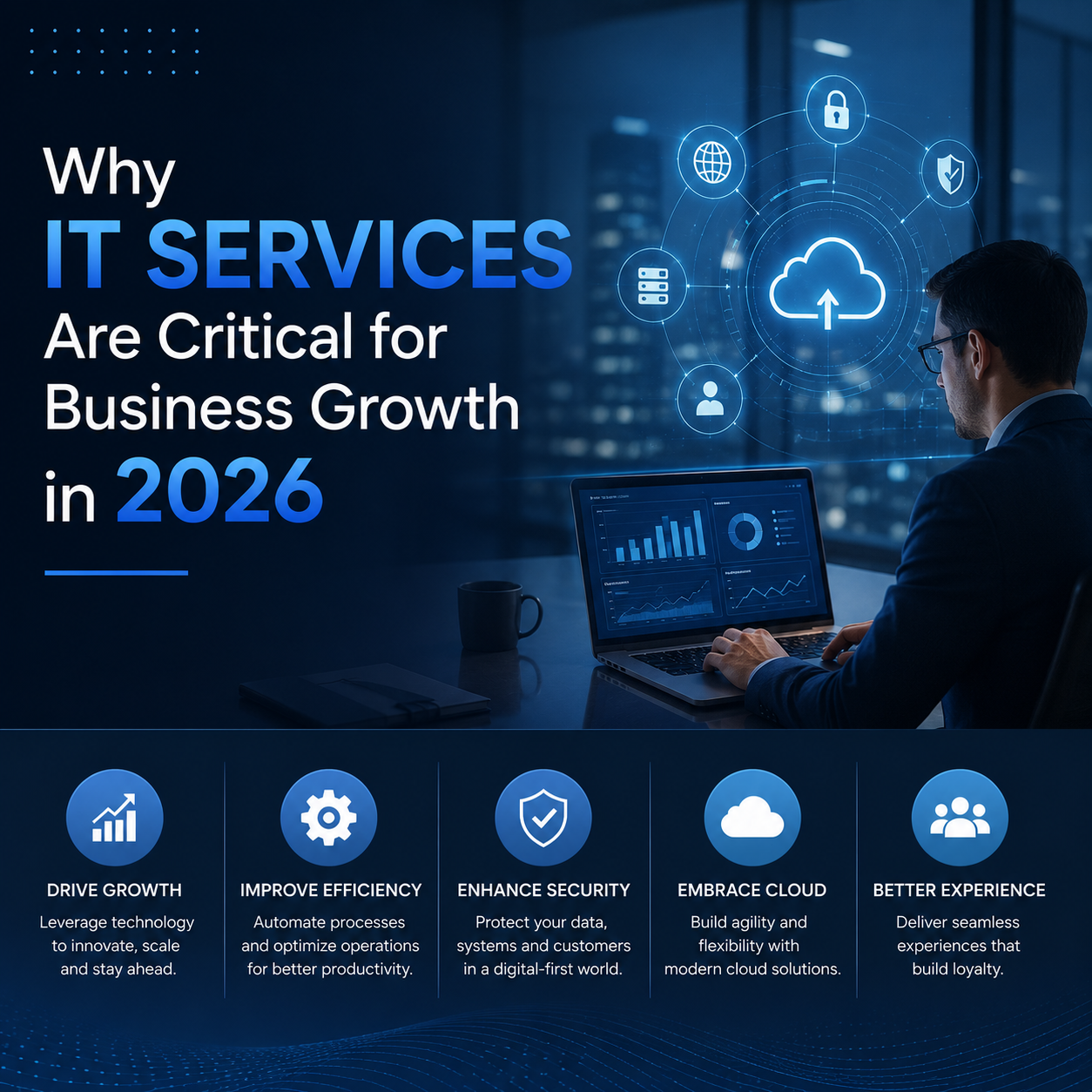
Why IT Services Are Critical for Business Growth in 2026
08-06-2026 Monday
Table of Contents
ToggleWhy IT Services Are Critical for Business Growth in 2026
Every business in India is now a technology business — whether it knows it or not. The manufacturer in Ambattur running production on an ERP system. The BFSI firm in Chennai processing transactions on cloud infrastructure. The logistics company in Oragadam tracking fleet movement through a real-time platform. The healthcare organisation managing patient records on a digital system. The startup in OMR building its entire business model on a software product.
Technology is not a support function for these businesses. It is the operational backbone. And the IT services and managed IT solutions that keep that backbone functional, secure, and scalable are not discretionary investments. They are business-critical infrastructure — as essential to daily operations as the people who run them.
In 2026, the businesses that grow are the ones that treat IT services strategically — not reactively. This article explains why IT services have become central to business growth in India, what the most critical IT service categories are, how they connect to business outcomes, and how Viriksha HR Solutions helps businesses build the IT teams that make all of it work.
The Shift — From IT as Support to IT as Strategy
For most of the last two decades, IT in Indian businesses was a support department. It fixed computers, managed email servers, maintained the network, and handled software installations. Business leaders ran the business. IT kept the systems running.
That model is obsolete in 2026.
The reason is not technology for its own sake. It is the convergence of three forces that have made IT capability the primary determinant of competitive advantage in every industry.
Digital customer expectations
customers in every sector now expect digital-first interactions. Banks without robust mobile apps lose customers. Retailers without e-commerce capability lose revenue. Healthcare providers without digital appointment and records management lose patients. The IT service layer that enables digital customer experience is not optional — it is the product.
Operational efficiency pressure
businesses that automate manual processes through technology — payroll systems, ERP, CRM, supply chain platforms, HR management systems — operate at lower cost and higher speed than those that do not. The efficiency gap between digitally mature and digitally immature businesses in the same industry is widening every year. IT services for business are the mechanism through which operational efficiency is built and maintained.
Data as a competitive asset
every business generates data. The businesses that collect, store, process, and act on that data faster and more accurately than their competitors make better decisions, identify opportunities earlier, and respond to market changes more effectively. Cloud infrastructure, data integration platforms, and analytics capabilities are IT services — and they are the infrastructure on which data-driven competitive advantage is built.
IT Services and the Talent Challenge — Why Recruitment Is the Critical Link
Every IT service category described in this article depends on one thing — the people who design, build, operate, and maintain the technology. And in 2026, finding those people is harder than it has ever been.
India’s IT talent market is simultaneously the largest and the most competitive in the world. Chennai alone has over 500,000 technology professionals — and demand exceeds supply across every specialised category. Cloud engineers, cybersecurity professionals, data engineers, DevOps specialists, ERP consultants, and senior IT project managers are in continuous demand from Indian IT services companies, product companies, GCC centres, and global organisations hiring remotely.
For businesses that need IT professionals — whether to build an internal IT team, staff a GCC centre, or fill specialist roles in a technology transformation programme — the talent challenge is as significant as the technology challenge.
The businesses that win the IT talent competition in 2026 are the ones that move fast — shortlisting within days, not weeks — that brief accurately — knowing what they need and why — and that work with a recruitment partner who has genuine relationships in the Chennai IT talent market, not just access to job portals.
The Most Critical IT Service Categories for Business Growth
Cloud Infrastructure and Migration
Cloud computing is the foundation of modern IT for business. In 2026, businesses in Chennai and across India are migrating from on-premise infrastructure to cloud platforms — AWS, Microsoft Azure, Google Cloud — or building cloud-native from the start.
The business case for cloud is straightforward: lower capital expenditure on hardware, higher reliability through built-in redundancy, faster scalability when the business grows, and access to enterprise-grade technology capabilities — AI, machine learning, data analytics — that would be prohibitively expensive to build independently.
Managed IT solutions for cloud infrastructure include cloud architecture design, migration planning and execution, ongoing cloud operations management, cost optimisation, and security configuration. Businesses that migrate without expert IT services support frequently over-provision — paying for capacity they do not use — or under-secure — exposing sensitive data to risks they have not modelled.
The IT talent that makes cloud work — cloud architects, DevOps engineers, cloud security specialists, and platform engineers — is among the most competitive in India’s technology job market. Building and retaining this capability is both a technology challenge and a talent acquisition challenge.
Cybersecurity
Cybersecurity is the IT service category that most businesses underinvest in until they have a reason not to. A ransomware attack that encrypts production data. A data breach that exposes customer financial information. A phishing attack that compromises payroll systems. A supply chain attack through a vendor’s software.
In 2026, cybersecurity is not a large-enterprise concern. Small and mid-size businesses in Chennai are actively targeted — because they typically have weaker defences than large enterprises while holding the same categories of valuable data.
Managed IT security solutions cover security architecture design, vulnerability assessment and penetration testing, endpoint protection, identity and access management, security information and event management (SIEM), incident response planning, and compliance with data protection regulations — DPDP Act 2023 in India, GDPR for businesses with European customers, and PCI-DSS for businesses processing payment data.
The cybersecurity talent gap in India is among the largest of any IT function. Certified security professionals — CISSP, CEH, CISM, and cloud security specialists — are in significantly higher demand than supply, making cybersecurity recruitment one of the most competitive hiring challenges in the IT services market.
Enterprise Resource Planning and Business Systems
ERP systems — SAP, Oracle, Microsoft Dynamics, Zoho, and others — are the operational nervous system of mid-size and large businesses. They integrate finance, procurement, production, sales, HR, and supply chain into a single data environment — eliminating the silos, the spreadsheets, and the manual reconciliation that characterise businesses operating without integrated systems.
IT services for ERP include system selection and implementation, customisation for business-specific requirements, integration with other business systems, user training, ongoing support and maintenance, and upgrade management.
The businesses that get the most from ERP investment are those with strong internal IT capability — functional consultants who understand both the system and the business process, technical consultants who can configure and customise, and project managers who can coordinate implementations without disrupting operations.
Building this capability requires a combination of recruitment — finding the right ERP professionals in a competitive market — and managed IT solutions that supplement internal teams with specialist expertise on demand.
Data and Analytics Infrastructure
In 2026, data infrastructure is a growth service — not a reporting service. Businesses that invest in data warehouses, business intelligence platforms, and analytics capabilities do not just produce better reports. They make faster decisions, identify customer behaviour patterns before competitors do, optimise pricing in real time, predict supply chain disruptions before they occur, and measure the actual ROI of every business initiative.
The data infrastructure stack in 2026 includes data engineering — pipelines that collect, clean, and integrate data from every business system. Data warehousing — centralised storage that makes data accessible for analysis. Business intelligence — dashboards and reporting tools that translate data into decisions. Machine learning — predictive models that identify patterns and opportunities in data that human analysis cannot find at scale.
IT services for data and analytics include platform selection, architecture design, data pipeline development, BI tool implementation, and analytics team support. The data professionals who build and operate this infrastructure — data engineers, data analysts, ML engineers, and analytics managers — are among the most sought-after in India’s technology talent market.
IT Support and Service Desk
IT support is the service category that affects every employee in the business every day — and the one whose quality is most directly felt as a productivity input.
An employee who cannot access their system for three hours has lost three hours of productive work. A team that cannot access a shared application during a critical delivery window loses the delivery. A finance team whose payroll system is inaccessible on salary processing day faces a compliance crisis.
Managed IT support services — service desk management, Level 1, 2, and 3 support, SLA-driven incident resolution, change management, and proactive system monitoring — ensure that IT issues are resolved before they become business disruptions.
For businesses in Chennai with geographically distributed teams — offices across OMR, Sholinganallur, Ambattur, and beyond — managed IT support provides consistent service quality across every location without the cost of deploying dedicated IT staff at each site.
Digital Transformation — The Service That Connects All Others
Digital transformation is not a single IT service. It is the strategic programme through which a business systematically replaces manual, paper-based, and fragmented processes with integrated digital systems — changing not just the technology but the way the business operates.
In 2026, digital transformation in Indian businesses includes HR digitalisation — replacing paper registers and spreadsheet payroll with integrated HRMS platforms. Customer experience digitalisation — CRM systems, digital onboarding, self-service portals. Operations digitalisation — production management systems, quality management platforms, IoT-connected machinery. Finance digitalisation — automated accounting, real-time financial reporting, digital procurement.
The IT services that support digital transformation span every category — cloud, cybersecurity, ERP, data, and support — coordinated by a transformation strategy that prioritises business outcomes over technology for its own sake.
Speak to Viriksha HR Solutions today
Speak to Viriksha HR Solutions today — for IT recruitment, contract IT staffing, payroll management, or complete HR consulting services for your technology business.
The Connection Between IT Services and HR — Why Viriksha Is Uniquely Positioned
IT services and HR might appear to be separate business domains. In practice, they are deeply connected — because every IT service is delivered by people, and finding, onboarding, managing, and retaining the right people for IT functions is an HR challenge as much as a technology one.
Viriksha HR Solutions sits at this intersection. As a full-service HR consultancy and specialist IT recruitment agency in Chennai and across India, Viriksha provides two distinct but complementary services for businesses with IT workforce requirements.
IT recruitment and talent acquisition — Viriksha’s IT recruitment practice places technology professionals across every category — cloud and infrastructure, cybersecurity, data and analytics, software development, ERP and enterprise systems, DevOps, product management, and IT leadership — for businesses in Chennai’s OMR and Sholinganallur corridors, for GCC centres across Tamil Nadu, and for technology organisations across Pan India.
Our IT recruitment consultants have genuine relationships in Chennai’s technology talent community — not just database access. When a business needs a senior cloud architect or a cybersecurity team lead, Viriksha’s first call is to a professional they know — not a search query on a job portal. That relationship-based approach is what delivers evaluated candidates in days rather than weeks.
HR and compliance for IT businesses — for IT companies and technology-driven businesses that need payroll management, statutory compliance, PF and ESI consultancy, HR policy development, and contract staffing — Viriksha manages the complete HR function. Contract software engineers and IT specialists deployed through Viriksha are employed and managed compliantly — with payroll processed on time, statutory contributions made accurately, and registers maintained for every deployed professional.
For GCC centres and MNCs building IT teams in Chennai, Viriksha provides the end-to-end people solution — talent acquisition to find the right IT professionals, and HR management to employ and retain them compliantly under Indian labour law.
IT recruitment across every technology vertical Viriksha covers:
core banking professionals, fintech developers, payment systems engineers, risk and compliance technology specialists, and digital banking product managers for Chennai's growing BFSI technology sector.
hospital information systems specialists, healthcare data analysts, telemedicine platform developers, and medical technology product managers for Chennai's large healthcare technology ecosystem.
cloud architects, data engineers, ETL developers, integration specialists, and platform engineers for businesses migrating to cloud or building data infrastructure.
project managers, delivery managers, business analysts, and technical leads for IT services companies managing client delivery across Chennai and Pan India.
product managers, UX designers, software engineers, and QA professionals for product companies building technology platforms.
cloud architects, data engineers, ETL developers, integration specialists, and platform engineers for businesses migrating to cloud or building data infrastructure.
How Viriksha Helps IT-Driven Businesses Grow in Chennai and Across India
The business that grows in 2026 is the one that can build and manage the IT capability it needs — quickly, compliantly, and sustainably. That means hiring the right technology professionals, managing them correctly under Indian employment law, and ensuring that the compliance obligations attached to every IT employee and contract professional are met without consuming the HR bandwidth that the business needs for everything else.
Viriksha HR Solutions provides everything an IT-driven business needs on the people side — IT recruitment across every technology vertical, contract staffing for project and flexible technology requirements, payroll and statutory compliance for IT workforces of every size, and HR consultancy for the people challenges that come with fast-growing technology organisations.
For businesses in Chennai’s technology corridors — OMR, Sholinganallur, Perungudi, Tidel Park — and for technology-driven businesses across Pan India and internationally, Viriksha is the HR and recruitment partner that understands both the technology world and the compliance obligations that govern it.