
Viriksha HR Solution
Key Differences and Why Talent Acquisition Matters for Business Growth
Table of Contents
ToggleTalent Acquisition vs Recruitment
Many business leaders use Talent Acquisition and “recruitment” interchangeably, treating them as two words for the same activity. But for companies serious about building strong, sustainable teams, the distinction is far more than semantic. Understanding the difference between Talent Acquisition and recruitment — and knowing when your business needs a Talent Acquisition approach over standard recruitment — directly impacts hiring quality, retention, and long-term organizational strength.
This distinction matters most to founders, plant heads, HR leaders, and senior decision-makers who are scaling teams across functions like manufacturing, IT, healthcare, finance, or design. Getting Talent Acquisition right shapes whether your hiring strategy solves today’s vacancy or builds tomorrow’s workforce.
What Is Recruitment?
Recruitment is the tactical, transactional process of filling an open position. It’s reactive by nature — a role becomes vacant, and the recruitment process kicks in to source, screen, interview, and select a candidate to fill that specific gap as efficiently as possible.
Recruitment typically involves:
- Posting job openings and sourcing applicants
- Screening resumes against role requirements
- Conducting interviews for a specific vacancy
- Extending offers and closing the position
- Moving on to the next open role
The defining characteristic of recruitment is its short-term, role-specific focus. It answers the immediate question: “We have an empty seat — who can fill it, and how fast?” This is where recruitment differs fundamentally from Talent Acquisition.
What Is Talent Acquisition?
Talent Acquisition is a broader, strategic function that looks beyond individual vacancies toward long-term workforce planning. Talent Acquisition involves understanding where the business is heading, what skills will be needed months or years from now, and building pipelines, employer branding, and sourcing strategies well before a position even opens.
Talent Acquisition typically includes:
- Workforce planning aligned with business growth projections
- Employer branding and market positioning to attract quality talent
- Building talent pipelines for hard-to-fill or future roles
- Succession planning for critical and leadership positions
- Continuous relationship-building with passive candidates
- Data-driven hiring strategy tied to business outcomes
Where recruitment asks “who can fill this role now,” Talent Acquisition asks “what talent will this business need to achieve its goals, and how do we build access to it ahead of time.” This forward-looking quality is what makes Talent Acquisition a strategic function rather than an operational task.
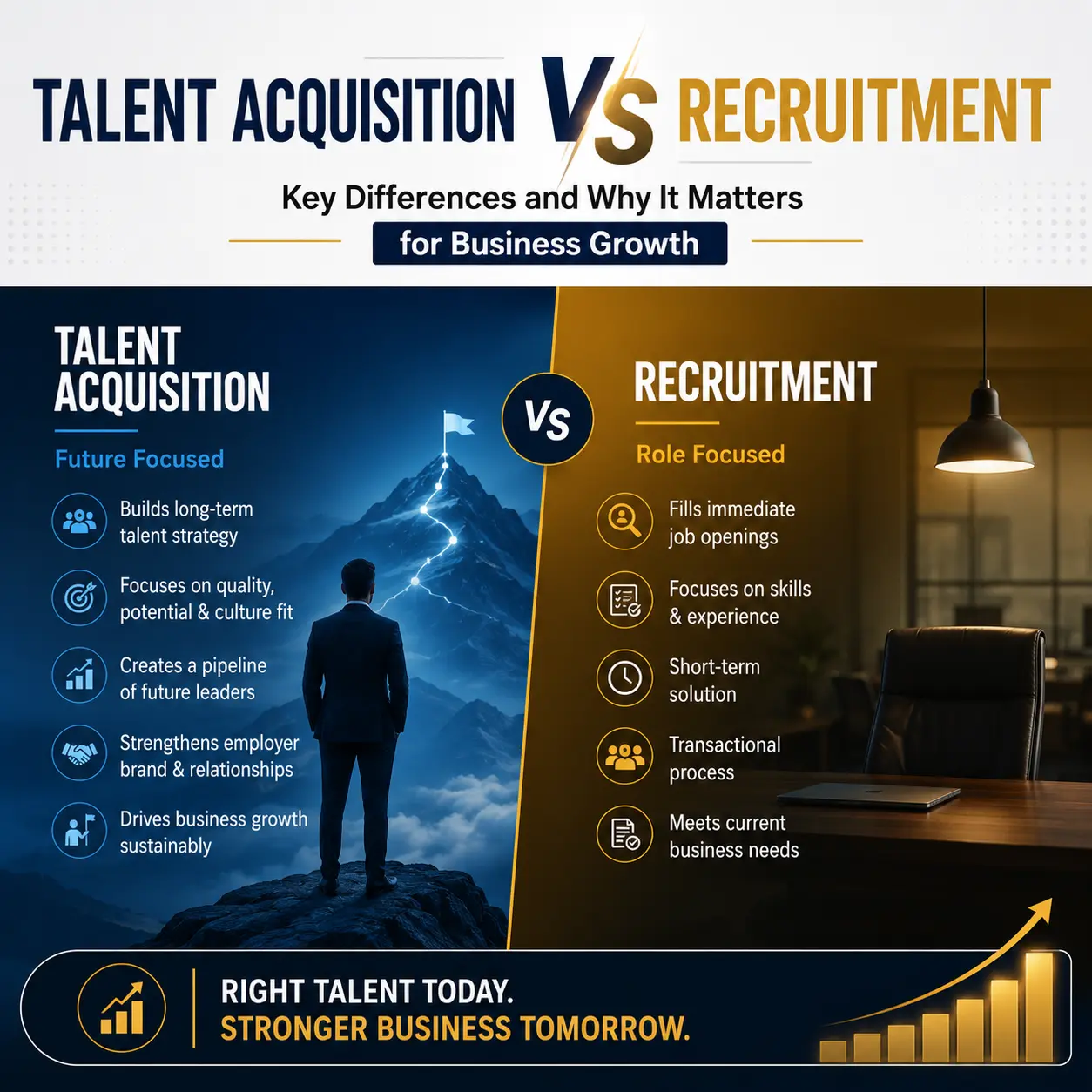
Talent Acquisition vs Recruitment: The Core Differences
Aspect |
Recruitment |
Talent Acquisition |
|---|---|---|
Focus
|
Filling immediate vacancies
|
Long-term workforce strategy
|
Approach
|
Reactive
|
Proactive
|
Timeline
|
Short-term
|
Ongoing, future-focused
|
Scope
|
Role-specific
|
Organization-wide
|
Candidate pool
|
Active job seekers
|
Active and passive talent
|
Success metric
|
Time-to-fill
|
Quality of hire, retention, business impact
|
Relationship to business strategy
|
Operational task
|
Strategic function
|
This table captures the practical reality: recruitment is a component within Talent Acquisition, not a replacement for it. A business that only “recruits” is constantly putting out fires. A business that invests in Talent Acquisition builds a pipeline that reduces those fires from happening in the first place.
Why Talent Acquisition Matters for Business Growth
1. Reactive Hiring Creates Recurring Costs
Businesses that rely purely on recruitment — hiring only when a position opens — consistently face longer vacancy periods, rushed decisions, and higher turnover. Without a Talent Acquisition pipeline already in motion, every hire starts from zero: sourcing, screening, and onboarding under time pressure. This cycle is expensive, and it compounds as a business scales.
2. Talent Acquisition Reduces Time-to-Hire Over Time
When a business invests in Talent Acquisition, it builds relationships with potential candidates before a need arises. This means that by the time a role actually opens — whether it's a plant supervisor, a senior developer, or a finance leader — there's already a warm pipeline to draw from, dramatically reducing time-to-hire compared to starting a search cold.
3. Quality of Hire Improves with Strategic Talent Acquisition
Recruitment-only approaches often select from whoever applies within a limited window. Talent Acquisition expands the pool to include passive candidates — experienced professionals who aren't actively job-hunting but are open to the right opportunity. This consistently produces stronger, better-fit hires across technical, operational, and leadership roles.
4. Workforce Planning Supports Business Expansion
As businesses grow — opening new facilities, entering new markets, scaling technology teams — hiring needs shift quickly. A Talent Acquisition approach anticipates these shifts, mapping future skill requirements against business plans, rather than scrambling to recruit only after expansion is already underway.
5. Employer Branding Becomes a Competitive Advantage
Talent Acquisition strategies invest in how a business is perceived in the talent market. Strong employer branding makes it easier to attract quality candidates organically, reducing dependency on aggressive, costly recruitment campaigns when urgent vacancies arise.
6. Succession and Leadership Continuity
Recruitment rarely addresses leadership continuity. Talent Acquisition does — by identifying and developing internal and external pipelines for critical roles, reducing the disruption caused by sudden leadership departures.
Does Your Business Need Recruitment, Talent Acquisition, or Both?
In practice, most growing businesses need both functions working together. Recruitment handles the operational reality of filling current vacancies efficiently. Talent Acquisition ensures the business isn’t perpetually starting from scratch every time a role opens.
Businesses that are scaling rapidly, entering new industries or locations, or building specialized teams — in sectors like manufacturing, IT, healthcare, architecture, or finance — benefit significantly from a Talent Acquisition lens layered on top of standard recruitment execution. This combination ensures urgent roles get filled without sacrificing the long-term quality and stability of the workforce being built through effective Talent Acquisition.
How an Experienced Hiring Partner Bridges Both Functions
Businesses without dedicated in-house Talent Acquisition teams often struggle to balance both functions simultaneously — urgent hiring needs tend to consume all available bandwidth, leaving no room for strategic pipeline-building. This is where experienced hiring partners add significant value: combining fast, reliable recruitment execution with Talent Acquisition principles like market mapping, passive candidate engagement, and workforce planning.
The result is a hiring approach that solves immediate vacancies while simultaneously building the Talent Acquisition pipeline needed for future growth — giving businesses the best of both functions without having to choose one over the other.
Final Thoughts
The difference between Talent Acquisition and recruitment isn’t just terminology — it reflects two fundamentally different approaches to building a workforce. Recruitment fills seats. Talent Acquisition builds capability. Businesses focused purely on the former often find themselves in a constant hiring loop, while those that adopt a Talent Acquisition mindset position themselves for more sustainable, strategic growth.
For companies navigating expansion, scaling teams, or building specialized capabilities across any industry, understanding and applying both functions — recruitment for speed, Talent Acquisition for strategy — is one of the most important shifts in building a resilient, future-ready organization. Investing in Talent Acquisition today is what positions a business to hire well, retain talent, and grow with confidence tomorrow.