
Viriksha HR Solution
Hire to Retire: Managing the Complete Employee Lifecycle
Table of Contents
ToggleHire to Retire
Most businesses think about HR in fragments. Recruitment happens when a role opens. Payroll runs monthly. Compliance gets attention when a notice arrives. Performance reviews happen once a year — or not at all. Exit formalities are figured out when someone resigns.
This fragmented approach to HR isn’t just inefficient. It creates compounding risk at every stage of the employee journey — compliance gaps that accumulate silently, performance issues that aren’t caught early enough, compensation structures that quietly erode retention, and exit processes that leave businesses exposed to disputes and documentation failures.
The businesses that consistently build stronger, more stable workforces take a fundamentally different approach: they manage the complete employee lifecycle as one connected, structured process — from the moment a candidate accepts an offer to the day an employee retires or exits the organization.
This is the hire-to-retire model. And for growing businesses across Chennai and pan-India — in manufacturing, IT, healthcare, finance, architecture, and professional services — it is the difference between reactive HR management and a workforce function that actively supports business growth.
What Does "Hire to Retire" Actually Mean?
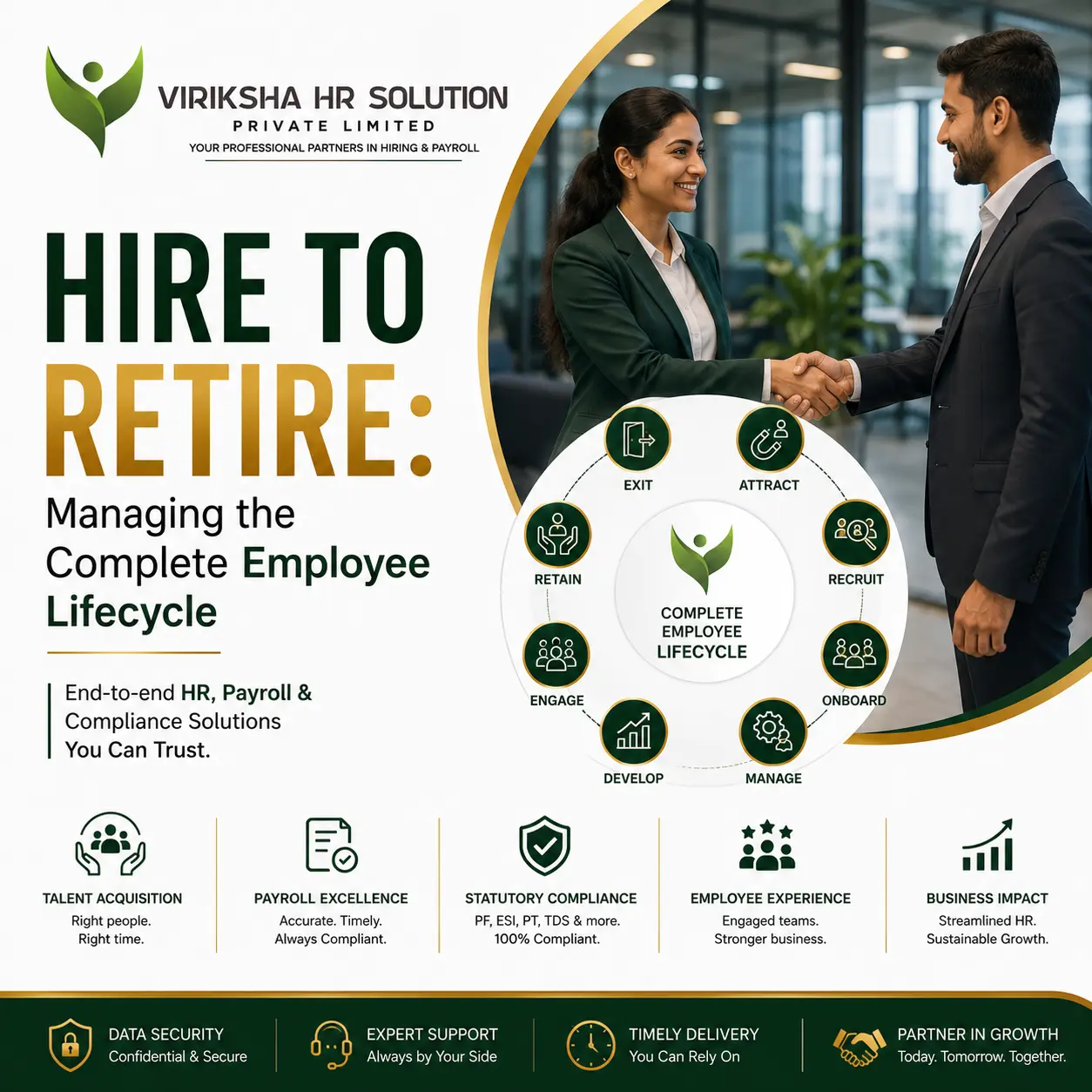
The hire-to-retire model refers to end-to-end HR management that covers every stage of an employee’s professional journey within an organization:
- Joining and onboarding
- Performance management and development
- Compensation, salary reviews, and career growth
- Statutory compliance and employee benefits
- Retirement planning and exit management
- Full and final settlement
Each of these stages connects to the next. Poor onboarding undermines performance. Weak performance management makes compensation decisions arbitrary. Compliance gaps at the payroll stage create problems at exit. A disorganized full and final settlement process turns a professional departure into a dispute.
The hire-to-retire model treats these not as separate HR tasks but as a single, integrated employee journey — one that the business is responsible for managing with consistency, accuracy, and care from beginning to end.
Stage 1: Employee Onboarding — Starting the Journey Right
Onboarding is the first HR process an employee experiences — and the impression it creates shapes engagement, productivity, and early retention in ways that are difficult to reverse if the experience is poor.
Structured onboarding covers far more than an induction presentation and a laptop handover. A complete onboarding process includes:
- Joining formalities and documentation — offer letter acceptance, appointment letter issuance, identity and qualification document collection, and background verification where applicable.
- Statutory registrations — UAN generation and PF enrollment, ESI registration for eligible employees, professional tax enrollment, and TDS declaration collection. These must be completed before the first payroll run — delays here create compliance gaps that require retroactive correction.
- Company policy orientation — leave policy, attendance requirements, code of conduct, IT and data security policies, and HR escalation processes communicated clearly at joining, not discovered gradually over months.
- Role clarity — documented Key Responsibility Areas (KRAs), reporting structure, performance expectations, and 30-60-90 day objectives established from day one, giving new employees a clear framework for early contribution.
When a manufacturing client in Chennai engaged Viriksha HR Solutions to restructure their onboarding process, new joiner statutory registrations — previously completed inconsistently and often delayed — were brought into a structured workflow that completed all PF, ESI, and professional tax enrollments within the employee’s first week. The result was cleaner payroll from day one and significantly fewer first-month payroll corrections.
A well-structured onboarding process doesn’t just create a positive first impression — it builds the HR foundation that every subsequent stage of the employee lifecycle depends on.
Contact Viriksha HR Solution today
Contact Viriksha HR Solution today and let’s build the HR foundation your workforce needs.
Stage 2: Performance Management — Aligning People with Business Goals
Performance management is one of the most underinvested areas of HR in growing businesses. Many organizations rely on annual appraisals as their sole performance mechanism — a single conversation per year that attempts to cover twelve months of contribution, development gaps, and future planning simultaneously. The result is rarely useful for the employee or the business.
Effective performance management is an ongoing process built on four elements:
- Goal setting — KRAs and KPIs defined at the beginning of each performance cycle, aligned with department objectives and the broader business direction. Employees who understand what they are being measured against perform more consistently than those working without defined targets.
- Regular feedback — structured feedback conversations that identify challenges, recognize contribution, and course-correct early — before performance gaps become performance problems.
- Development planning — identifying skill requirements and growth opportunities that motivate employees and build organizational capability simultaneously.
- Performance improvement frameworks — structured, documented processes for addressing underperformance that protect both the employee and the business, with clear timelines, support mechanisms, and outcome criteria.
Stage 3: Quarterly and Half-Yearly Reviews — The Cadence That Makes Performance Management Work
The frequency of performance conversations determines their usefulness. Annual reviews are too infrequent to be corrective — by the time problems are formally discussed, they have typically been operating for months without intervention.
- Quarterly reviews focus on short-term goal progress — what has been achieved, what is behind, what obstacles exist, and what immediate corrective actions are needed. They are forward-looking conversations, not retrospective judgments.
- Half-yearly reviews take a broader lens — evaluating overall performance trajectory, identifying development requirements, assessing skill improvement against plans established at the beginning of the year, and setting objectives for the second half of the cycle.
Together, quarterly and half-yearly reviews create a performance rhythm that identifies issues early, supports continuous development, and gives employees regular, structured engagement with their growth within the organization — one of the most consistent drivers of retention that businesses frequently undervalue.
Stage 4: Skill Mapping and Competency Development
As businesses grow, the skills that built them are not always the skills that will scale them. Skill mapping addresses this gap systematically — giving organizations a clear picture of existing employee capabilities, where those capabilities align with current and future role requirements, and where gaps exist that need to be addressed through development or hiring.
A structured skill mapping process covers:
- Current capability assessment — identifying what each employee can demonstrably do, not just what their job title implies.
- Role-to-skill alignment — mapping documented capabilities against what each role actually requires, identifying misalignments that affect performance and deployment decisions.
- Gap identification — understanding where the workforce lacks capabilities that current or future business requirements demand.
- Training and development planning — converting skill gaps into structured development plans, not generic training programs disconnected from actual business needs.
- Future workforce planning — using skill mapping data to anticipate what capabilities the business will need as it grows — and building toward them proactively rather than scrambling to hire reactively.
- For businesses in manufacturing, IT, and GCC sectors particularly, skill mapping is a critical mechanism for maintaining technical currency — ensuring that the workforce’s capabilities keep pace with the technology and process requirements of a rapidly evolving operating environment.
Stage 5: Compensation Management — Making Salary Reviews Work for Retention
Compensation management is one of the most direct levers businesses have on retention — and one of the most frequently mishandled. Ad hoc salary revisions, inconsistent increment timing, and compensation decisions made without market data or internal equity consideration consistently produce two outcomes: underpaid employees who leave, and overpaid outliers who create internal resentment.
A structured compensation management process covers:
- Performance-based salary revision — increments tied to documented performance outcomes from the review cycle, not to tenure alone or informal negotiation.
- Market benchmarking — salary revisions informed by current market data for comparable roles, ensuring offers remain competitive in the talent market the business is hiring from.
- Internal equity assessment — reviewing compensation across comparable roles within the organization to identify and correct inequities before they create team-level dissatisfaction.
- Promotion and role change management — structured compensation adjustment processes for employees whose responsibilities have changed, ensuring compensation reflects actual contribution rather than historical salary momentum.
- CTC structuring — ensuring that compensation packages are structured to be tax-efficient for employees and compliance-aligned for the business — particularly important as headcount and seniority levels increase.
A transparent, well-structured compensation process doesn’t just manage cost — it communicates to employees that their contribution is recognized and valued, which is one of the most effective retention mechanisms available to any business.
Stage 6: Statutory Compliance Throughout the Employee Lifecycle
Statutory compliance is not a year-end exercise or a response to notices. It is an ongoing obligation that runs through every stage of the employee lifecycle — from the PF and ESI registrations completed at joining, through monthly payroll compliance, to gratuity processing and PF settlement at exit.
Key compliance obligations across the employee lifecycle include:
- Provident Fund (PF/EPF) — monthly contributions, ECR filing, UAN management, annual returns, and claim processing support throughout employment and at exit.
- Employee State Insurance (ESI) — monthly contributions, return filing, and employee claim support for eligible workforce categories.
- Tax Deducted at Source (TDS) — monthly computation and deposit, quarterly returns, and annual Form 16 issuance.
- Gratuity — accurate provisioning throughout employment and correct calculation and payment at exit for employees with five or more years of continuous service.
- Professional Tax — state-specific compliance managed month by month without exception.
- Labour law adherence — Shops and Establishments Act, Factories Act where applicable, Maternity Benefit Act, and Contract Labour Act obligations managed as integrated compliance requirements, not isolated tasks.
Viriksha HR Solutions has managed payroll and statutory compliance for 3,600+ employees across client organizations in Chennai and pan-India over five years — with zero compliance issues across PF, ESI, TDS, and professional tax obligations. This track record is the output of treating compliance as a structured, proactive function, not a reactive one.
Stage 7: Retirement Planning and Employee Exit Management
Retirement is the least-prepared-for stage of the employee lifecycle in most organizations — despite being entirely predictable. Employees approaching retirement deserve the same level of structural care and process clarity that onboarding provides at the beginning of their journey.
Structured retirement management includes:
- Retirement planning communication — proactive conversations with employees approaching retirement age, covering timeline, benefit entitlements, and documentation requirements well in advance of the retirement date.
- Documentation preparation — service records, employment certificates, and statutory documentation prepared accurately and in advance, not scrambled at the last moment.
- Benefit coordination — PF settlement, pension scheme coordination, and gratuity processing initiated early enough to ensure benefits reach the employee without unnecessary delay.
- Exit formalities — clearance processes, knowledge transfer planning, and retirement acknowledgment handled with the professionalism that a career of contribution deserves.
Managing retirement well is not just a compliance obligation — it reflects the organization’s values toward its long-serving employees, and it shapes the culture that current employees observe and internalize.
Stage 8: Gratuity Processing — Getting the Numbers Right
Gratuity is a statutory entitlement under the Payment of Gratuity Act, 1972 — payable to employees who have completed five or more years of continuous service at the time of retirement, resignation, or termination (except in cases of dismissal for misconduct).
Accurate gratuity processing requires:
- Service period verification — confirming exact dates of joining and separation to establish continuous service duration accurately.
- Eligibility confirmation — verifying that the employee meets the statutory threshold and that no disqualifying conditions apply.
- Calculation accuracy — gratuity is computed at 15 days’ salary (last drawn basic + dearness allowance) per completed year of service, subject to the statutory maximum. Errors in basic salary data or service period calculation directly affect the amount payable.
- Timely payment — the Payment of Gratuity Act prescribes timelines for payment after separation. Delays beyond the prescribed period attract interest, and disputes arising from incorrect calculations or delayed payment create legal exposure.
- Documentation — Form I (employee application), Form L (employer acknowledgment), and Form M (payment confirmation) maintained accurately as part of the settlement record.
Gratuity disputes are among the most common employee-employer legal conflicts in India. Accurate, timely, and documented gratuity processing is the most effective way to prevent them.
Stage 9: PF and Pension Scheme Support at Exit
For employees exiting after long tenures, PF settlement and pension scheme coordination are among the most consequential financial processes of their working lives. Errors, delays, or inadequate guidance at this stage create significant employee distress — and avoidable disputes.
PF exit support covers:
- PF withdrawal or transfer — processing Form 19 for PF withdrawal or Form 13 for PF transfer to the new employer’s account, depending on the employee’s post-exit circumstances.
- EPS pension claim — employees with ten or more years of service and above the pension eligibility age can claim monthly pension under the Employees’ Pension Scheme. Form 10D submission and EPFO coordination require accurate service and contribution records.
- KYC verification — ensuring UAN-linked KYC (Aadhaar, PAN, bank account) is verified and active before withdrawal or transfer is initiated, avoiding processing delays at the EPFO level.
- Employee guidance — clear, accurate communication to exiting employees on their entitlements, the process timeline, and what is required from them — reducing anxiety and preventing misinformation-driven disputes.
Stage 10: Full and Final Settlement — Closing the Lifecycle Professionally
Full and final settlement is the last HR interaction an employee has with the organization — and it carries disproportionate weight in how they remember their employment experience and what they communicate externally about the organization as a workplace.
A complete full and final settlement covers:
- Pending salary — salary for days worked in the final month, computed accurately to the last working day.
- Leave encashment — accumulated earned leave balance paid out at the applicable rate as per company policy and applicable labour law provisions.
- Gratuity — calculated and processed as described above, where applicable.
- Variable pay and incentives — any outstanding performance bonuses, commissions, or incentives computed and paid per the applicable policy.
- Deductions — notice period shortfall recovery, any outstanding advances, or other contractual deductions applied correctly and transparently, with clear documentation provided to the employee.
- PF and ESI coordination — final contribution processing and initiation of PF withdrawal or transfer as applicable.
- Clearance documentation — NOC from relevant departments, return of company assets, and system access revocation coordinated as part of the exit process.
- Experience and relieving letters — issued accurately and promptly, confirming designation, dates of employment, and the nature of departure.
When a professional services client in Chennai engaged Viriksha HR Solutions to manage their full and final settlement process — previously handled inconsistently by an overstretched internal HR team — settlement timelines reduced from an average of 45 days to under 15 days, and employee exit disputes dropped to zero within the first six months of structured process implementation.
A smooth, accurate full and final settlement is not just a compliance requirement. It is the last opportunity to demonstrate organizational integrity to a departing employee — and it directly shapes how that employee represents the organization in the talent market afterward.
Why End-to-End HR Support Changes Everything
Managing the hire-to-retire lifecycle as one connected process — rather than a series of disconnected HR tasks — produces outcomes that fragmented HR management cannot:
- Cleaner compliance records — statutory obligations managed continuously rather than reactively, with zero gaps across PF, ESI, TDS, and labour law from joining to exit.
- Better performance outcomes — structured review cadences, skill mapping, and development planning that identify and address issues before they affect business performance.
- Stronger retention — transparent compensation management, regular feedback, and career development support that give employees reasons to stay.
- Reduced administrative burden — integrated HR processes that eliminate duplication, reduce errors, and free internal teams from administrative firefighting.
- Professional exits — full and final settlements processed accurately and on time, retirement managed with care, and PF and gratuity handled correctly — protecting the organization’s reputation in the talent market.
- One accountable partner — instead of managing recruitment through one vendor, payroll through another, compliance through internal staff, and exit processes ad hoc, a single HR partner managing the complete lifecycle with end-to-end accountability.
One Employee Journey. One Complete HR Solution.
The hire-to-retire model is not an aspiration — it is a structured, implementable approach to HR management that growing businesses across every industry can adopt. For businesses in Chennai and pan-India — whether in manufacturing, IT, healthcare, finance, or professional services — the question is not whether end-to-end HR management matters. It is whether the current approach is actually delivering it.
Viriksha HR Solutions partners with businesses across industries to manage the complete employee lifecycle — from structured onboarding and payroll setup through performance management, compliance, and professionally handled exits. With 1,250+ placements, 3,600+ employees managed on payroll and compliance, and a five-year record of zero errors and zero compliance issues, Viriksha HR Solutions brings the structure, expertise, and accountability that the hire-to-retire model requires.
If your business is ready to manage the complete employee lifecycle with the consistency and care it deserves — contact Viriksha HR Solutions today and let’s build the HR foundation your workforce needs.