
Supply Chain Payroll and Compliance Services

Home› Blogs Viriksha HR Solution Supply Chain Payroll and Compliance Services Get a Consultation Talk to an Expert A Missed PF Deposit at One Warehouse Can Undo Years of Vendor Trust Few functions run on as mixed a workforce as supply chain operations. A single company’s supply chain payroll might cover corporate-office demand planners, procurement executives, warehouse supervisors on fixed salary, inventory staff on shift rotations, and contract labour engaged through third-party manpower agencies for peak-season warehouse operations — often across multiple distribution centers in different states, all inside the same monthly payroll cycle. This mix makes supply chain payroll structurally harder than standard office payroll. Get it wrong, and the fallout isn’t abstract. A delayed PF deposit for warehouse staff triggers penalties and damages morale in roles that already see high turnover. An unregistered distribution hub in a new state creates a compliance gap that surfaces during a client’s vendor audit — increasingly common as large manufacturers and retailers scrutinize their supply chain partners’ labour compliance before renewing contracts. And undocumented contract labour at a warehouse exposes the principal employer to liability the moment a labour inspector walks in. Viriksha HR Solution provides dedicated payroll outsourcing and HR statutory compliance services built specifically for supply chain, warehousing, procurement, and distribution companies across India. Explore Our Recruitment Why Supply Chain Payroll Is Structurally Different A Workforce Spread Across Employment Categories Supply chain companies typically run payroll simultaneously for corporate planning and procurement staff, warehouse supervisors and inventory teams, contract labour for loading and stock movement, and third-party manpower deployed at distribution hubs — each carrying different statutory obligations. Multi-Location Distribution Operations Companies operating distribution centers, regional warehouses, and procurement offices across multiple states each trigger separate Professional Tax, Shops and Establishment, and labour welfare obligations that must be tracked location by location, not centrally assumed. Seasonal and Demand-Driven Headcount Fluctuation Supply chain operations scale headcount up sharply around demand peaks — festive season, quarter-end dispatch pushes, new product launches — requiring rapid onboarding, UAN generation, and statutory registration without compliance shortcuts. High Contract and Third-Party Labour Dependency A significant share of warehouse and distribution center staff — loaders, packers, material handlers — are frequently engaged through manpower contractors. Under the Contract Labour Act, the principal employer carries liability if these contractors default on wages, PF, or ESI. Mixed White-Collar and Blue-Collar Payroll in One Cycle Unlike a purely office-based function, supply chain payroll must correctly compute salary structures for planners and procurement executives on one hand, and shift allowances, overtime, and piece-rate incentives for warehouse staff on the other — within the same monthly run. EPF Management for Supply Chain Companies — Complete End-to-End Handling Viriksha HR manages the full EPF lifecycle for supply chain workforces, including: UAN Generation Universal Account Number creation for every new warehouse worker, planner, procurement staff member, and contract worker at the time of joining — important given how quickly supply chain companies ramp up headcount during demand peaks. E-Nomination Process Supporting employees in completing the mandatory EPF e-nomination, a step frequently missed when onboarding happens at volume during seasonal hiring surges. Monthly Returns Timely Electronic Challan cum Return filing every month, reconciled against actual attendance and shift data across multiple warehouses and distribution centers. Claim Process End-to-end support for PF withdrawal, advance, and pension claims — particularly relevant given higher attrition typical of warehouse and contract roles. KYC Approval Employer-side verification and approval of employee KYC details on the EPFO portal, required before any claim or transfer can be processed. Transfer Request Approval Managing PF transfer approvals as staff move between distribution centers, contractors, or group entities within the supply chain network. ESI Compliance Services for Supply Chain Workforces ESI obligations apply to employees earning up to ₹21,000 per month — covering a large share of warehouse staff, packers, and material handlers in most supply chain operations. As your ESI consultant, Viriksha HR manages: ESI Registration Services Timely registration for new warehouses, distribution hubs, and procurement offices, with ongoing coverage management as headcount grows. ESI Monthly Filing and ESI Return Filing Accurate half-yearly return filing and monthly contribution deposits, reconciled against shift and attendance data across locations. Employee State Insurance Consultancy Ongoing advisory on ESI applicability and coverage, including verifying that contractor-deployed warehouse staff are properly covered. PF Compliance Services for Supply Chain Companies As your EPF consultant, Viriksha HR manages PF compliance across the supply chain workforce, including: PF Registration Services and EPF Registration Consultant Support Ensuring correct registration as new distribution centers and warehouses are added to your operations. PF Monthly Filing, PF Return Filing and PF ECR Filing Accurate filing every month, even as headcount fluctuates with seasonal demand spikes. PF Compliance Services Complete handling of claims, transfers, KYC, and e-nomination, plus active monitoring of contractor-side PF deposits for outsourced warehouse manpower — protecting your company from principal employer liability. Licenses and Registrations We Manage for Supply Chain Companies Supply chain operations — particularly those involving warehousing, distribution, and contract manpower — carry a wide set of licensing obligations that Viriksha HR manages end-to-end. Shops and Establishment Act License — Mandatory registration for every warehouse, distribution center, or procurement office your company operates, including newly opened regional hubs. Contract Labour (Regulation and Abolition) Act License — Essential for supply chain companies engaging loaders, packers, and material handlers through manpower contractors — both at the contractor level and as principal employer registration for your company. ISMW (Inter-State Migrant Workmen) Act License — Relevant where warehouse staff are recruited from other states to work at distribution hubs, requiring proper registration and worker documentation. Professional Tax Registration — State-specific registration and filing for every city where your company operates a warehouse, distribution center, or office. Labour Welfare Fund Registration — Applicable in several states and managed alongside PF and ESI as part of your company’s complete statutory obligation. Factories Act License (DISH) — Where Applicable — For supply chain companies operating associated packaging, kitting, or light assembly units connected to warehousing operations. We
Supply Chain Recruitment Agency in India — Hiring Supply Chain Talent

Home› Blogs Viriksha HR Solution Supply Chain Recruitment Agency in India Hiring Supply Chain Talent Get a Consultation Talk to an Expert Your Supply Chain Is Only as Strong as the People Planning It Every manufacturer, distributor, retailer, and 3PL provider feels this pressure the same way. A vacant Supply Chain Manager position stalls demand planning. A weak Procurement Manager hire leads to poor vendor terms that quietly erode margins for years before anyone notices. And an under-qualified Supply Chain Head can leave a company exposed to stockouts, excess inventory, and cost inefficiencies that compound month over month without ever showing up as one obvious failure. Supply chain roles sit at the intersection of planning, procurement, cost control, and cross-functional coordination — which makes them some of the hardest roles to screen properly and some of the most expensive to get wrong. Yet most companies are still trying to fill these positions through generic job portals or general staffing firms with no real grasp of demand planning, vendor negotiation, or inventory strategy. This is exactly where Viriksha HR Solution steps in. As a dedicated supply chain recruitment agency operating across Chennai and India, we bring genuine sector understanding to every search — for manufacturers, distributors, retailers, and 3PL providers who cannot afford a slow or wrong hire at any level of their supply chain function. Know More Why Generic Hiring Does Not Work for Supply Chain Roles Planning Roles Require Analytical Depth, Not Just Software Familiarity A Supply Chain Planner’s resume can list “demand forecasting” and “SAP,” but it cannot show you whether they’ve actually managed forecast accuracy under real demand volatility. Evaluating this requires recruiters who understand planning methodology, not just tool names on a resume. Procurement Roles Demand Negotiation and Vendor Management Skill Strategic sourcing, vendor negotiation, category management, and supplier relationship management are skills that a general recruiter cannot meaningfully assess without procurement domain context. Inventory and Cost Control Knowledge Is Non-Negotiable Inventory optimization, working capital management, and cost-to-serve analysis carry direct financial impact — gaps here surface as tied-up capital or stockouts, not as an immediate hiring red flag, which is exactly why they need to be screened for properly upfront. Supply Chain Leadership Requires Cross-Functional Fluency A strong Supply Chain Head needs to operate fluently across procurement, manufacturing, logistics, sales, and finance simultaneously. This is a fundamentally different evaluation challenge than screening a single-function operational hire. Viriksha HR’s recruitment team evaluates analytical competence, negotiation ability, and cross-functional fit — not just resume keywords matched against a job description. Supply Chain Job Roles As a complete supply chain staffing agency, Viriksha HR covers the full spectrum of planning, procurement, and supply chain functions. Leadership and Senior Roles We help you hire: Chief Supply Chain Officer (CSCO) Supply Chain Director Supply Chain Head Vice President – Supply Chain Global Supply Chain Manager Supply Chain Operations Director Supply Chain Excellence Manager Logistics Director Procurement Director Distribution Director Supply Chain Management Roles We help you hire: Supply Chain Manager Supply Chain Senior Manager Supply Chain Executive Supply Chain Specialist Supply Chain Coordinator Supply Chain Analyst Supply Chain Consultant Supply Chain Planner Supply Chain Operations Manager Supply Chain Operations Executive Demand and Supply Planning Roles We help you hire: Demand Planning Manager Demand Planner Supply Planning Manager Supply Planner Material Planner Materials Planning Manager Production Planner Production Planning Executive Capacity Planner Inventory Planner S&OP Manager S&OP Analyst Forecasting Analyst Procurement and Sourcing Roles We help you hire: Procurement Manager Procurement Executive Procurement Specialist Procurement Analyst Purchasing Manager Purchasing Executive Buyer Senior Buyer Strategic Sourcing Manager Sourcing Specialist Category Manager Vendor Development Manager Supplier Relationship Manager Supplier Development Engineer Contract Management Specialist Inventory and Materials Management Roles We help you hire: Inventory Manager Inventory Controller Inventory Analyst Inventory Executive Materials Manager Materials Controller Materials Executive Materials Coordinator Stock Controller Warehouse Inventory Specialist Logistics and Transportation Roles We help you hire: Logistics Manager Logistics Executive Logistics Coordinator Transportation Manager Transport Coordinator Fleet Manager Fleet Supervisor Freight Manager Freight Forwarding Executive Shipping Coordinator Dispatch Manager Dispatch Executive Route Planner Last-Mile Logistics Manager Transportation Planner Warehouse and Distribution Roles We help you hire: Warehouse Manager Assistant Warehouse Manager Warehouse Supervisor Warehouse Executive Warehouse Coordinator Distribution Manager Distribution Executive Distribution Planner Fulfillment Manager Fulfillment Executive Store Manager Stores Supervisor Stores Executive Warehouse Operations Manager Import, Export and Trade Roles We help you hire: Import Manager Export Manager EXIM Manager EXIM Executive Import Export Executive Customs Clearance Executive Customs Compliance Specialist Trade Compliance Manager International Logistics Coordinator Shipping Documentation Executive Export Documentation Specialist Global Trade Specialist Operations and Process Roles We help you hire: Supply Chain Operations Manager Operations Manager Operations Executive Operations Coordinator Process Improvement Manager Supply Chain Process Analyst Lean Supply Chain Specialist Continuous Improvement Manager Operations Analyst Business Process Analyst Supply Chain Quality and Compliance Roles We help you hire: Supply Chain Quality Manager Supplier Quality Engineer Vendor Quality Engineer Supply Chain Compliance Manager Supply Chain Compliance Specialist Quality Assurance Executive Supplier Audit Specialist Regulatory Compliance Specialist Supply Chain Technology Roles We help you hire: Supply Chain Systems Manager Supply Chain Systems Analyst SAP MM Consultant SAP WM Consultant SAP EWM Consultant Oracle SCM Consultant ERP Supply Chain Consultant WMS Specialist TMS Specialist Supply Chain Technology Specialist Supply Chain Data Analyst Specialized Supply Chain Roles We help you hire: Cold Chain Logistics Specialist Pharmaceutical Supply Chain Specialist Automotive Supply Chain Specialist Manufacturing Supply Chain Specialist Retail Supply Chain Specialist E-commerce Supply Chain Specialist Reverse Logistics Specialist Global Supply Chain Specialist Supply Chain Sustainability Specialist Supply Chain Network Analyst Supply Chain Risk Analyst Supply Chain Optimization Specialist Junior and Entry-Level Roles We help you hire: Junior Supply Chain Analyst Supply Chain Trainee Supply Chain Intern Graduate Trainee – Supply Chain Procurement Trainee Logistics Trainee Inventory Trainee Materials Trainee Warehouse Trainee Supply Chain Assistant Procurement Assistant Logistics Assistant For Head of Supply Chain, VP, and CSCO-level mandates, Viriksha HR runs a dedicated executive search process — one of the supply chain executive search
From PLC Engineers to Data Scientists: The Changing Talent Needs of Modern Manufacturing
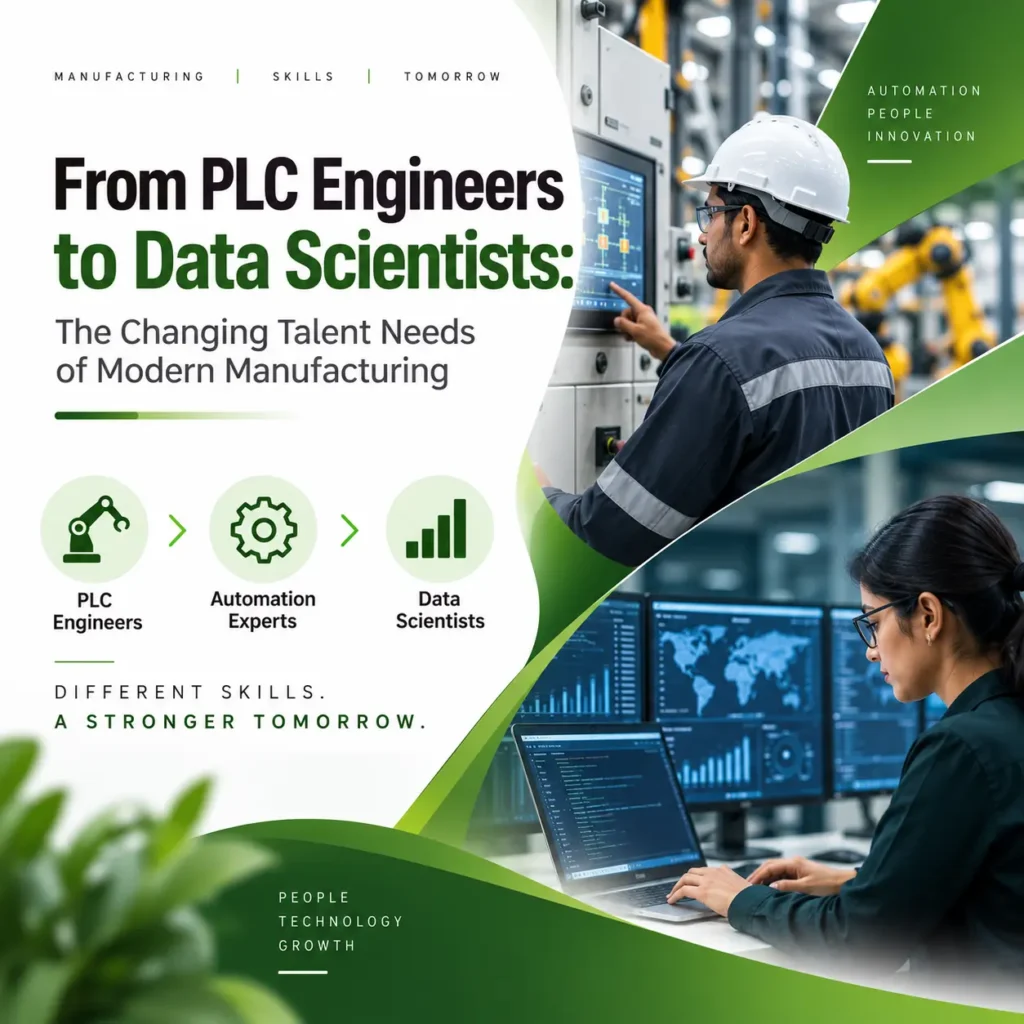
Home› Blogs Viriksha HR Solution From PLC Engineers to Data Scientists The Changing Talent Needs of Modern Manufacturing Get a Consultation Talk to an Expert Industry 4.0 Talent Acquisition: From PLC Engineers to Data Scientists: The Changing Talent Needs of Modern Manufacturing Ten years ago, a strong maintenance team and a competent PLC programmer covered most of a plant’s technical hiring needs. Today, the same plant might be running predictive maintenance models, pulling sensor data into a dashboard a data scientist built, and asking its quality team to interpret machine-learning output alongside a torque spec sheet. Nobody planned for this shift to happen this fast. It just did. Industry 4.0 talent acquisition is the hiring challenge sitting quietly underneath a lot of digital transformation initiatives in manufacturing right now — and it’s one that most internal HR teams and traditional recruitment vendors weren’t built to handle, because it doesn’t fit cleanly into either the “engineering hire” bucket or the “IT hire” bucket. The Skill Set Manufacturing Used to Need For most of manufacturing’s recent history, the technical hiring stack was fairly stable: Mechanical and electrical engineers for design and maintenance PLC and instrumentation engineers for automation and control systems Quality engineers trained on inspection standards and process control Production supervisors who understood shift-floor operations These roles haven’t disappeared — they’re still the backbone of any plant. But they’re no longer the whole picture, and that’s the part catching a lot of manufacturing leadership off guard. Know More Why This Is Harder to Hire For Than It Sounds The instinctive response is to treat this as two separate hiring problems: recruit engineers the traditional way, and recruit data/software talent through a tech-recruitment channel. In practice, this split creates a specific failure mode we see often. A data scientist hired through a generic tech recruitment process may have strong modeling skills but no context for how a production line actually behaves — which means their models solve problems that don’t matter and miss the ones that do. Conversely, a PLC engineer asked to “pick up some data skills” often ends up doing surface-level dashboard work without the statistical grounding to build anything predictive. Smart manufacturing hiring works best when it’s screened by people who understand both worlds — recruiters who can evaluate whether a data scientist candidate actually understands manufacturing context, and whether an automation engineer candidate has genuine software depth versus surface familiarity. What’s Changed: The New Layer of Manufacturing Talent Smart manufacturing has added a second, overlapping skill layer on top of the traditional one. It’s not replacing PLC engineers and mechanical specialists — it’s sitting alongside them, and increasingly, plants need both layers working together, not in separate silos. Data Scientists and Data Analysts Interpreting sensor and production data to predict equipment failure, optimize throughput, and identify quality issues before they become defects on the line. IoT and Automation Specialists Managing the sensor networks, connected equipment, and data pipelines that feed everything from real-time dashboards to predictive maintenance systems. Industrial Software Engineers Building and maintaining the software layer that connects shop-floor equipment to enterprise systems — MES, ERP integration, and custom plant software. Cybersecurity Specialists for OT Environments Manufacturing plants are increasingly connected, which means operational technology (OT) — not just corporate IT — needs its own security expertise, a role that barely existed on a plant org chart a decade ago. Robotics and Automation Engineers Beyond traditional PLC programming, roles now increasingly require experience with robotic process automation, collaborative robots (cobots), and vision-based inspection systems. This is the hiring reality behind manufacturing digital talent — plants need people who understand both the physical process and the digital layer sitting on top of it, and finding candidates who are genuinely fluent in both is harder than finding one or the other. What “Industry 4.0 Talent Acquisition” Means Industry 4.0 talent acquisition refers to the recruitment of hybrid technical talent for manufacturing environments undergoing digital transformation — combining traditional engineering and automation roles (PLC, mechanical, electrical, quality) with emerging digital roles (data science, IoT, industrial software, OT cybersecurity). It requires screening candidates for competency across both domains rather than treating manufacturing and technology hiring as separate recruitment tracks. How to Actually Plan for This Shift A few practical starting points we’d suggest to manufacturing leadership thinking through this: Map your current gap, not just your open roles. Most plants don’t have a clear picture of which digital capabilities they’re missing until a specific project — a predictive maintenance initiative, an MES rollout — forces the issue. Mapping this ahead of a project, not during it, gives hiring far more lead time. Don’t force digital roles into traditional engineering job descriptions. A “PLC Engineer with data analytics skills” job posting rarely attracts a strong data scientist — the framing signals the role is engineering-first, data-second, which is often not what the actual work requires. Hire for hybrid fluency, not perfect overlap. Very few candidates will be equally expert in mechanical systems and machine learning. The goal is finding people who are strong in one domain and genuinely conversant in the other — not unicorns who are top-tier in both. Build the team, not just the role. A single data scientist embedded in a traditionally structured plant team often struggles without a technical partner who understands both the data work and the shop floor. Pairing hires — an automation engineer with a data analyst, for example — frequently outperforms hiring either in isolation. Where Viriksha HR Solution Fits In for Industry 4.0 Talent Acquisition Digital transformation hiring in manufacturing requires recruiters who can technically screen across both traditional engineering and emerging digital roles — which is exactly where a lot of generic staffing falls short. At Viriksha HR Solution, we apply the same three-tier screening process and 5 C’s framework (Competency, Character, Chemistry, Culture, Consistency) across this full spectrum: Traditional roles: PLC engineers, mechanical/electrical engineers, quality and production supervisors Emerging roles: data analysts, IoT and automation specialists, industrial software engineers, OT
Hiring for a New Plant? How to Build Your Workforce From the Ground Up
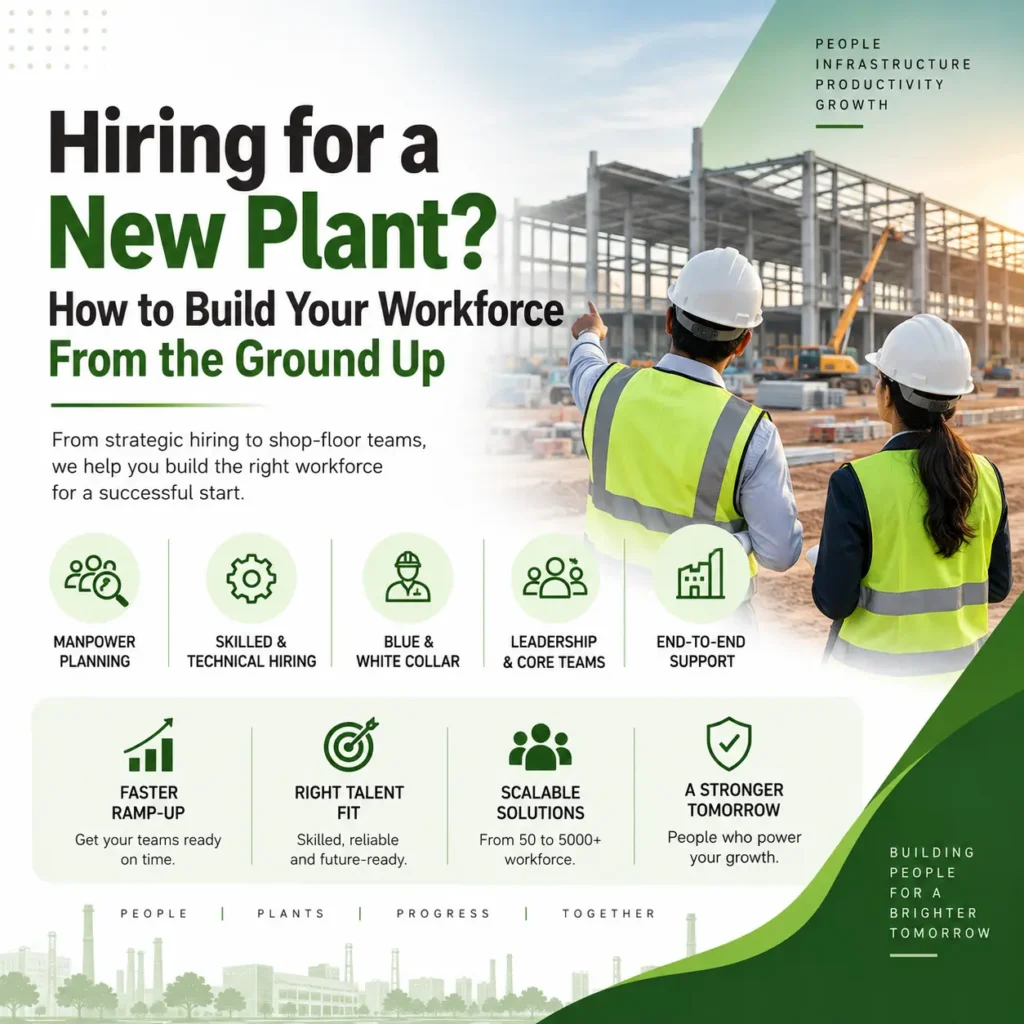
Home› Blogs Viriksha HR Solution Hiring for a New Plant? How to Build Your Workforce From the Ground Up Get a Consultation Talk to an Expert Your ComplianceOur Responsibility Your GrowthOur Mission Hiring for a New Plant? How to Build Your Workforce From the Ground Up There’s a specific kind of stress that comes with a plant launch date. The construction is on schedule. The machinery is ordered. The layout is finalized down to the last conveyor belt. And then someone in a leadership meeting asks the question that quietly derails everyone’s confidence: “Who’s actually going to run this place?” New plant workforce planning is where a lot of otherwise well-executed projects lose momentum — not because the building isn’t ready, but because the people aren’t. We’ve sat in enough of these conversations to know the pattern: hiring gets treated as a task for month five or six, right before commissioning, when it should have started around the same time the site broke ground. If you’re staring down a plant launch and wondering where to even begin on the people side, here’s how we’d think about it. Know More Why Workforce Planning Can’t Wait Until the Building Is Ready The instinct is understandable. Construction, machinery procurement, and layout planning feel urgent because they’re visible — you can watch a building go up. Hiring feels like something you can compress into a few weeks once the plant is nearly ready. It can’t, and here’s why. A plant head hired eight weeks before commissioning has no time to build a team, understand the equipment, or influence layout decisions that affect how the floor will actually run day to day. A maintenance team hired in the final month hasn’t had time to train on the specific machinery installed. Quality engineers brought in at the last minute inherit processes they had no hand in designing. Greenfield plant hiring works best when it runs in parallel with construction, not after it. Leadership and key technical roles should be filled 4–6 months before commissioning. Shop-floor and production roles typically follow 6–10 weeks out, once training schedules and shift patterns are locked in. Start With the Org Chart, Not the Job Postings Before a single job description goes out, map the plant’s org structure the way it will actually run at full capacity — not a placeholder structure you’ll “figure out later.” This matters more than it sounds like it should. A workforce plan for a new plant typically breaks into three layers: Leadership Layer Plant head, operations manager, and department heads for quality, maintenance, and production. These are the people who should be in the room during final layout and process decisions — hiring them late means excluding them from decisions they’ll have to live with for years. Technical & Supervisory Layer Production supervisors, maintenance engineers, quality control engineers, process engineers. This group needs enough lead time to complete equipment-specific training before the plant goes live. Operator & Shop-Floor Layer Machine operators, line workers, material handlers. This is usually the largest hiring volume and the one most people default to thinking about first — but it should come after the layers above it, not before, since supervisors need to be in place to help select and train the team reporting to them. Getting this sequence backwards — hiring operators before supervisors — is one of the most common mistakes we see in plant setup recruitment, and it usually shows up later as inconsistent training and unclear reporting lines in the first few months of operation. The Hiring Timeline That Actually Works Here’s a rough sequence we’ve seen work well for a mid-sized manufacturing plant, whether it’s automotive, industrial, or general manufacturing: 6 months out Plant head and senior leadership hiring begins. These roles have the longest notice periods and the most influence on downstream decisions. 4 – 5 months out Department heads — quality, maintenance, production — come on board. They begin working alongside leadership on SOPs, staffing structure, and equipment familiarization. 3 months out Supervisory and technical roles are filled — production supervisors, maintenance engineers, process engineers. Training on plant-specific equipment starts here. 6–10 weeks out Bulk hiring for operator and shop-floor roles begins, timed so training and onboarding wrap up just before commissioning, not immediately after. 2 – 4 weeks out Final onboarding, statutory registrations (ESI, PF, professional tax) for the full workforce, and dry-run staffing simulations before go-live. Here’s a rough sequence we’ve seen work well for a mid-sized manufacturing plant, whether it’s automotive, industrial, or general manufacturing: What “New Plant Workforce Planning” Actually Means New plant workforce planning is the structured process of hiring, training, and statutorily onboarding a manufacturing workforce ahead of a new facility’s commissioning date — typically sequenced from leadership and technical roles through to shop-floor operators, run in parallel with statutory compliance registration so the plant can operate legally and functionally from day one. Read Detailed Information Common Mistakes in New Plant Hiring A few patterns we’ve seen repeat across different plant launches: Starting too late Compressing months of hiring into weeks leads to rushed screening and higher early attrition. Hiring operators before supervisors Leaves the newest and least experienced layer of the workforce without proper onboarding structure. Treating compliance as a post-hiring task Creates a legally awkward gap between “workforce hired” and “workforce can be legally paid and reported.” Underestimating local hiring dynamics Salary benchmarks, notice periods, and talent availability vary significantly by industrial zone — a plant in SIPCOT Sriperumbudur faces different hiring conditions than one in Gummidipoondi, even within the same city. No dry-run staffing simulation Skipping a trial run of shift coverage and reporting lines before actual commissioning, which is when structural gaps in the plan usually surface — ideally before go-live, not during it. How Viriksha HR Solution Supports New Plant Launches We work with companies setting up plants across Chennai’s industrial corridors — SIPCOT, Guindy, Sholinganallur, Kelambakkam, Vandalur, Tambaram, Chengalpattu, and Pan India — on exactly this sequencing: leadership and technical
Success Stories: How Businesses Trust Viriksha HR Solution With Payroll and Compliance
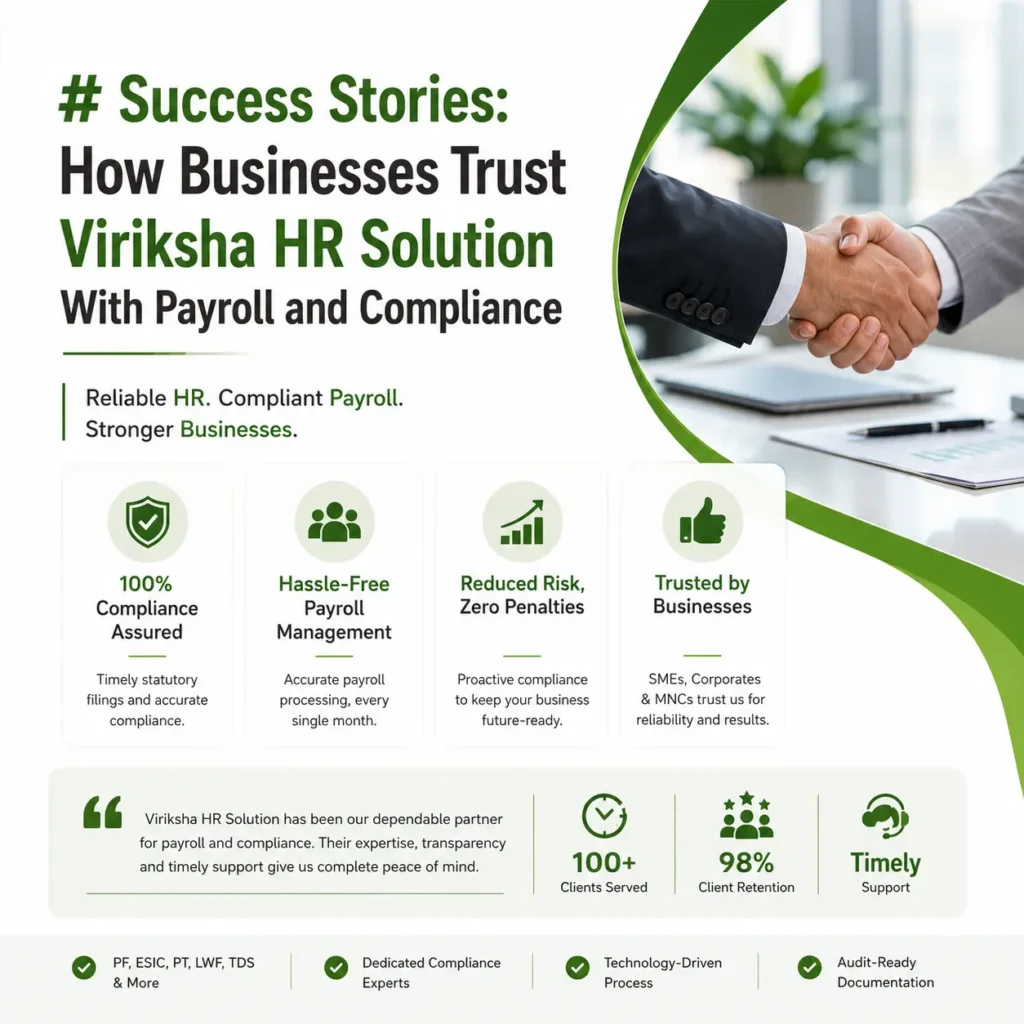
Viriksha HR Solution Success Stories: How Businesses Trust Viriksha HR Solution With Payroll and Compliance Payroll and Statutory Compliance Services for Businesses in Chennai Businesses across food services, manufacturing, commercial interiors, hospitality, technology, and staffing sectors face the same underlying challenge: employees must be paid accurately and on time, statutory filings must never slip, and the business must be ready for an HR audit at any point in the month — not just when one is scheduled. Viriksha HR Solution Private Limited provides end-to-end payroll outsourcing and HR statutory compliance services for businesses across Chennai and Pan India. Our support covers payroll processing, EPF and ESIC compliance, Professional Tax, Labour Welfare Fund returns, payroll TDS coordination, statutory record maintenance, and monthly HR audit assistance. The following client engagements demonstrate how our structured compliance model helps businesses of different sizes and sectors stay organised, accountable, and audit-ready. Explore more Client Engagements at a Glance Industry Services Managed Food and beverage services (facility vendor) Payroll, EPF, ESIC, PT, LWF, TDS, statutory registers, HR audit support Food and facility services (facility vendor) Payroll, EPF, ESIC, PT, LWF, TDS, statutory records, monthly audit attendance Laundry and institutional services End-to-end payroll, HR operations and statutory compliance Manufacturing (pipes) Payroll, EPF, ESIC, PT, LWF, TDS, statutory registers, HR audit support Commercial interiors Payroll, EPF, ESIC, statutory compliance Hospitality / food service ESI and PF company code registration, employee onboarding Technology End-to-end outsourced payroll and HR Staffing and recruitment ESI and PF filing support Food and Beverage Vendor: Payroll Compliance Support for a Corporate Facility Vendor This client operates as a food services vendor partner at a major corporate campus in Chennai. Its workforce functions within a large corporate environment where payroll accuracy, statutory documentation, and audit readiness are essential. Viriksha HR Solution manages the complete payroll and compliance cycle for this client’s own employees. The engagement includes: Monthly payroll processing and supporting documentation EPF and ESIC contribution processing and filing support Professional Tax and Labour Welfare Fund compliance Payroll-related TDS coordination Maintenance of applicable HR statutory registers and employment records Preparation of compliance documents for monthly reviews Attendance and support during monthly HR audit meetings This coordinated model gives the client a clearly documented compliance process. Records are maintained systematically, statutory activities are tracked according to the applicable schedule, and supporting documents remain available for audit verification. By functioning as an extended payroll and compliance team, Viriksha HR Solution enables this client to concentrate on food service delivery while maintaining control over its employment obligations. Partner With Viriksha HR Solution Contact Viriksha HR Solution Private Limited to discuss payroll outsourcing, EPF and ESIC compliance, Professional Tax, Labour Welfare Fund, payroll TDS, HR statutory registers, and monthly audit support in Chennai and across Tamil Nadu. Contact Us Food and Facility Vendor: Audit-Ready Payroll Management for an IT Campus Vendor This client operates as a facility services vendor at a large IT company’s campus in Chennai. Working within a major corporate facility requires the organisation to meet strict payroll timelines, maintain consistent employee documentation, and respond promptly to monthly compliance reviews. Viriksha HR Solution manages the company’s end-to-end payroll and statutory compliance process, including: Monthly salary and payroll processing EPF and ESIC processing and filing support Professional Tax and Labour Welfare Fund returns Payroll TDS administration and documentation Maintenance of applicable statutory registers Compilation of monthly HR audit records Representation and compliance support during HR audit meetings Our involvement extends beyond routine filing. We help organise the evidence required for audits, identify documentation gaps, and coordinate the closure of compliance observations within the agreed scope. This proactive approach allows the client to address compliance requirements continuously instead of preparing only when an audit is due. The result is a more disciplined payroll process and better visibility over statutory responsibilities. Laundry Services: Outsourced Payroll and HR for Institutional Operations This client provides laundry services to educational institutions in and around Chennai. As an institutional service provider, the company must manage employees working across service environments while maintaining consistent payroll and HR administration. Viriksha HR Solution functions as this client’s outsourced HR and payroll partner. We manage the operational cycle from payroll processing through statutory compliance and HR record administration. This arrangement provides the client with access to a structured HR function without requiring it to build and manage a complete internal payroll and compliance department. Its management team can remain focused on service quality and institutional client requirements while Viriksha coordinates the supporting HR processes. Manufacturing: Payroll and Statutory Compliance for a Pipe Manufacturer This client is a pipe manufacturing company where payroll accuracy and statutory discipline directly support uninterrupted production operations. A manufacturing workforce spread across shifts and departments requires payroll and compliance handling that keeps pace with operational schedules rather than lagging behind them. Viriksha HR Solution manages this client’s complete payroll and compliance cycle, including: Monthly payroll processing across shift-based and departmental staff EPF and ESIC contribution processing and filing support Professional Tax and Labour Welfare Fund compliance Payroll-related TDS coordination Maintenance of applicable HR statutory registers and records Support during HR audit reviews This structured approach gives the client a dependable compliance process that runs consistently alongside production activity, without diverting management attention from manufacturing operations. Commercial Interiors: Payroll Support for a Corporate Fit-Out Contractor This client is a commercial interiors company that executes fit-out and interior projects for large corporate clients. Delivering projects at this scale requires a compliant, well-documented workforce behind the scenes — even though the statutory compliance itself is unrelated to the client projects being delivered. Viriksha HR Solution manages this client’s own payroll and statutory compliance, including: Monthly payroll processing EPF and ESIC contribution processing and filing support Statutory compliance documentation and record maintenance By keeping the client’s internal payroll and compliance function organised, Viriksha HR Solution allows their management to focus on project execution and client delivery, with confidence that their own workforce obligations are being handled correctly. Hospitality: Statutory Registration and Employee Onboarding for a Restaurant This
Specialised Recruitment for Manufacturing, Technical and Leadership Roles
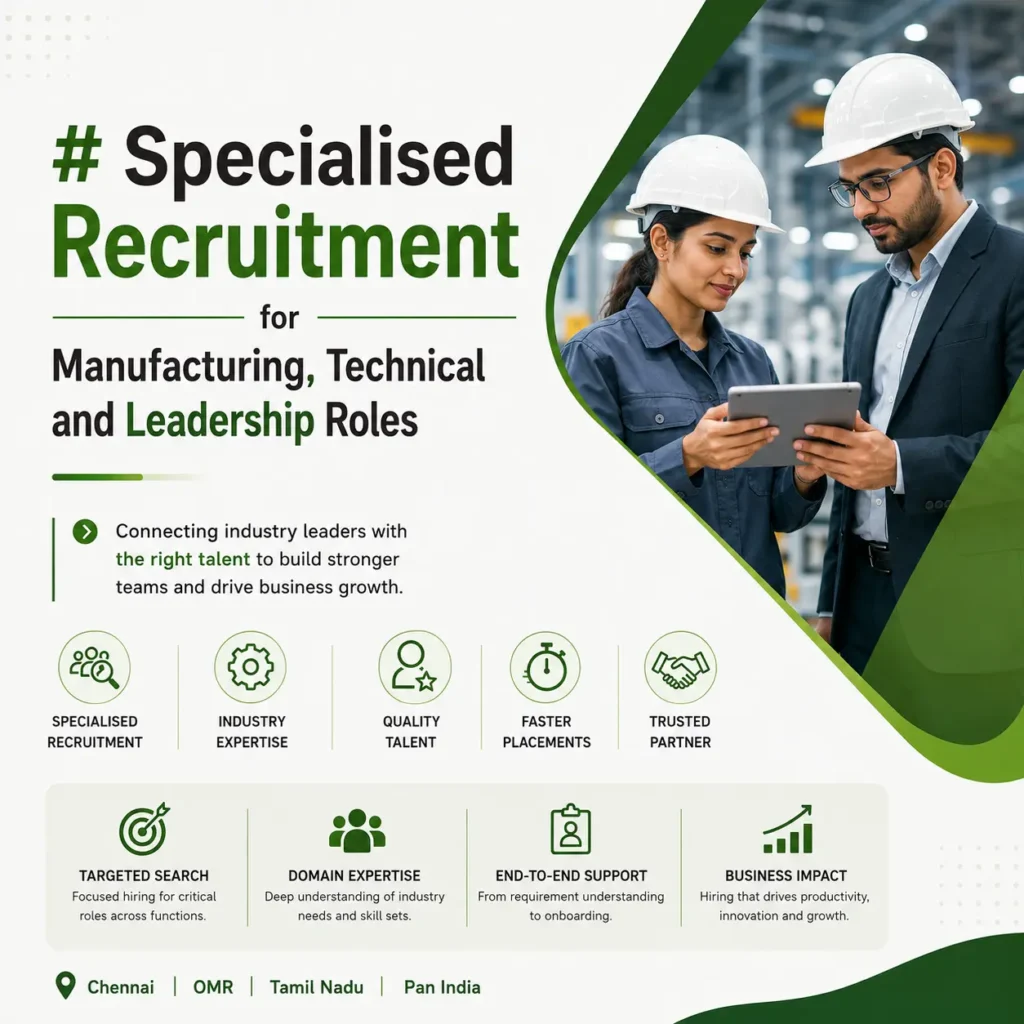
Viriksha HR Solution Specialised Recruitment for Manufacturing, Technical and Leadership Roles Specialised Recruitment for Manufacturing, Technical and Leadership Roles Manufacturing hiring carries a risk generic recruitment doesn’t account for: a mis-hire at the technical or leadership level doesn’t just cost a bad quarter — it can stall a production line, delay a plant commissioning, or leave a shift without supervision. Yet most staffing agencies run manufacturing requisitions through the same generic filter they use for any other role, filtering resumes on years of experience rather than the plant-floor competency that actually determines whether someone can do the job. Viriksha HR Solution provides specialised recruitment for manufacturing, technical, and leadership roles across Chennai’s industrial corridors and Pan India — built around manufacturing and leadership recruitment that’s screened for shop-floor reality, not just resume keywords. Explore more Why Manufacturing Hiring Needs Specialised Recruitment A production supervisor who can manage a shift, a maintenance engineer who can diagnose a breakdown under time pressure, a plant head who can hold a P&L and a compliance audit at the same time — none of this shows up cleanly on paper. Generic recruitment consultants screen for job titles. Leadership and technical recruitment in the manufacturing industry requires screening for judgment under operational pressure, which only comes from recruiters who understand what a manufacturing floor actually demands. This is the gap Viriksha HR Solution closes — specialised recruitment where every candidate is evaluated against the real, day-to-day requirements of a manufacturing environment, not a generic job description template. Our Recruitment Process for Manufacturing and Technical Roles We apply a structured three-tier screening process to every manufacturing requisition, combined with our 5 C’s of Recruitment framework — Competency, Character, Chemistry, Culture, and Consistency. 1. Basic Screening Technical qualification and shop-floor experience mapping — verifying not just what a candidate has done, but at what scale and under what operational conditions. 2. Candidate Assessment Report A structured evaluation covering technical depth, machinery or process familiarity, safety and compliance awareness, and problem-solving ability specific to the role and industry segment. 3. Manager-Level Screening A final round involving your plant or department head, validating both technical competency and team fit before a profile ever reaches you. For leadership roles specifically, this process extends to evaluating P&L ownership experience, cross-functional coordination ability, and track record managing compliance and workforce simultaneously — the combination manufacturing leadership actually requires. Roles We Recruit For Technical & Shop-Floor Roles We help you hire: Production Supervisors & Shift In-Charges Maintenance Engineers (Mechanical/Electrical) Quality Control & Quality Assurance Engineers Process Engineers Tool Room & Machine Shop Specialists Industrial & Production Engineers Leadership Roles We help you hire: Plant Heads & Plant Managers Operations Managers Production Managers Manufacturing Excellence / Lean Leaders General Managers – Manufacturing Department Heads (Quality, Maintenance, Supply Chain) We support hiring across this full band — from shift-level technical roles through senior plant leadership — as a single recruitment partner, so companies aren’t splitting technical hiring and leadership search across different vendors. Need to fill a technical role on your shop floor or a leadership seat in your plant? Viriksha HR Solution brings 15 years of specialised manufacturing recruitment expertise across Chennai’s industrial corridors and Pan India. Get in touch to discuss your hiring requirement. Contact us What “Manufacturing and Leadership Recruitment” Means Manufacturing and leadership recruitment refers to the specialised hiring of technical, supervisory, and senior leadership talent for manufacturing operations — requiring evaluation of shop-floor competency, safety and compliance judgment, and operational leadership ability, in addition to standard qualification screening. It differs from general recruitment in that candidates must be assessed against real production-environment demands rather than resume-based criteria alone. Chennai Industrial Corridors We Serve Viriksha HR Solution recruits manufacturing, technical, and leadership talent across Chennai’s key industrial zones, including: SIPCOT (Sriperumbudur & Oragadam) — automotive, electronics, and heavy manufacturing Guindy Industrial Estate — light engineering and precision manufacturing Sholinganallur — engineering-adjacent manufacturing and technical operations Kelambakkam — expanding industrial and manufacturing zone Vandalur — manufacturing and logistics-adjacent industrial units Tambaram — manufacturing and light industrial operations Chengalpattu — established manufacturing and industrial corridor OMR (Old Mahabalipuram Road) — engineering and technical operations roles ECR (East Coast Road) — manufacturing and industrial units along the coastal corridor Recruiting locally across these zones means understanding plant-specific hiring patterns, local salary benchmarks, and where technical and leadership talent is actually concentrated — not a generic city-wide search that treats every industrial zone the same. Why Companies Choose Viriksha HR Solution for Manufacturing Recruitment Technical and leadership screening, not resume-keyword matching 5 C’s framework evaluates competency alongside team and culture fit — critical for shift-based and plant environments 15-year expert recruitment team with cross-industry manufacturing hiring experience 1,250+ successful placements at executive and senior management level Chennai industrial-corridor expertise across SIPCOT, Guindy, Sholinganallur, and surrounding zones Pan India delivery capability for companies scaling manufacturing operations beyond Tamil Nadu Single recruitment partner for both technical shop-floor roles and senior leadership search Frequently asked questions What roles fall under manufacturing and leadership recruitment? This spans technical and shop-floor roles — production supervisors, maintenance engineers, quality engineers, process engineers — through senior leadership roles including plant heads, operations managers, and general managers overseeing manufacturing operations. How is manufacturing recruitment different from general recruitment? Manufacturing recruitment requires screening candidates against real production-environment demands — shop-floor competency, safety and compliance judgment, and operational leadership ability — rather than resume-based qualification matching alone. Which Chennai industrial areas does Viriksha HR Solution cover? We recruit across SIPCOT (Sriperumbudur and Oragadam), Guindy, Sholinganallur, Kelambakkam, Vandalur, Tambaram, Chengalpattu, OMR, and ECR. Does Viriksha HR Solution recruit for manufacturing leadership roles outside Chennai? Yes. While our strongest industrial-corridor expertise is in Chennai, our manufacturing and leadership recruitment services extend Pan India. How does Viriksha HR Solution verify technical competency for manufacturing roles? Through a three-tier screening process — basic technical and experience screening, a structured Candidate Assessment Report, and a manager-level screening round involving the client’s plant or department head.
One Dependable HR Partner for Recruitment, Talent Acquisition, Payroll, EPF, ESIC and Statutory Compliance
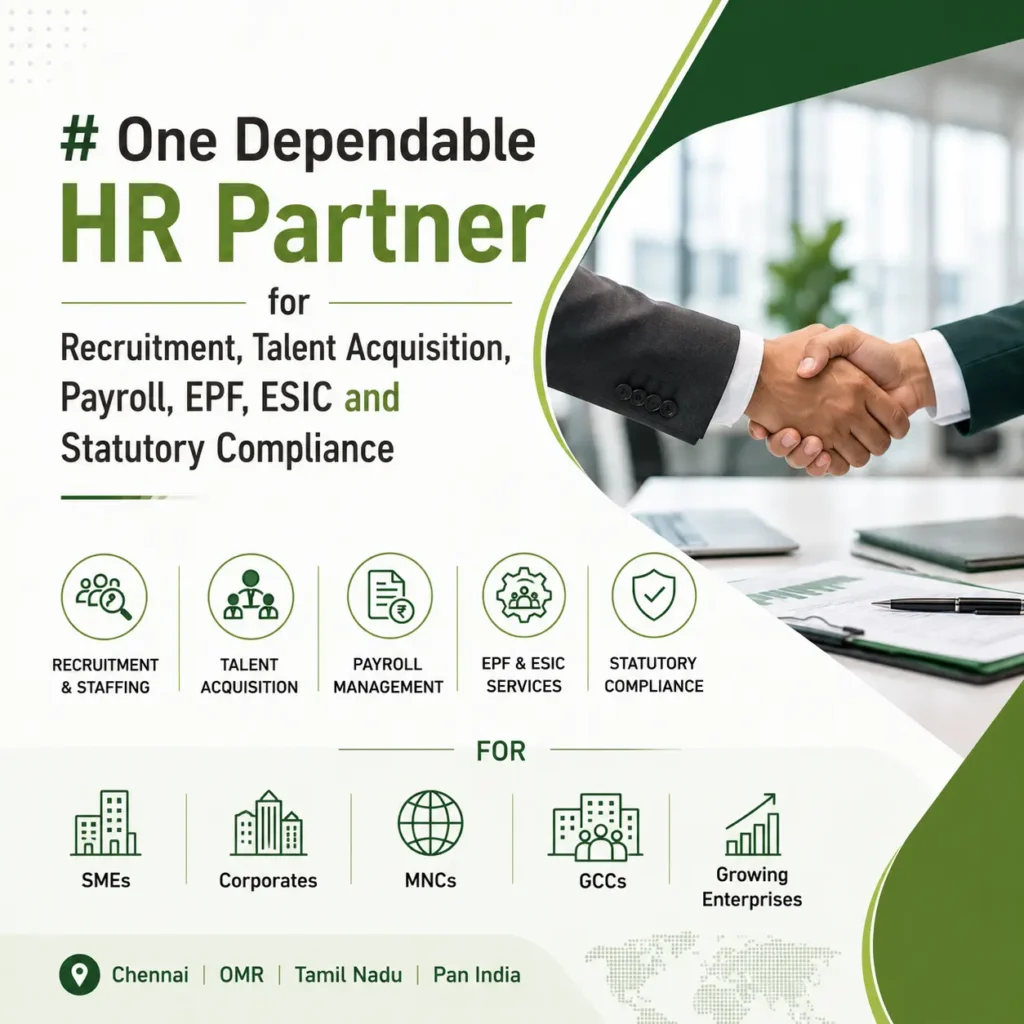
Viriksha HR Solution One Dependable HR Partner for Recruitment, Talent Acquisition, Payroll, EPF, ESIC and Statutory Compliance For SMEs, Corporates, MNCs, GCCs and Growing Enterprises Chennai | OMR | Tamil Nadu | Pan India Building a Stronger Workforce Through Integrated HR Consultancy Services For a growing organisation, human resources is no longer simply an administrative function. The quality of recruitment influences productivity. Payroll accuracy affects employee confidence. Statutory compliance protects the organisation from avoidable risk. Talent acquisition determines whether a company has the capabilities required for its next stage of growth. Yet many businesses continue to manage these responsibilities through disconnected vendors, fragmented internal processes and multiple points of accountability. A recruitment agency may handle hiring. A separate consultant manages payroll. Another professional handles EPF and ESIC. Internal teams coordinate employee data, attendance, documentation and statutory deadlines between them. As an organisation expands, this fragmented model can become inefficient. Viriksha HR Solution Pvt. Ltd. provides integrated HR Consultancy Services covering Recruitment Services, Talent Acquisition, Hiring Services, Payroll Services, Payroll Management, EPFO Services, ESIC Services and statutory compliance support for businesses in Chennai, Tamil Nadu and across India. Our objective is straightforward: enable businesses to access the talent they need while establishing reliable HR processes throughout the employee lifecycle. For SMEs, established corporate organisations, multinational companies and growing enterprises, this integrated approach can provide greater visibility, accountability and operational consistency. Explore more What Does an Integrated HR Partner Do? An integrated HR partner supports multiple stages of the employee lifecycle rather than addressing recruitment, payroll and compliance as unrelated activities. The engagement can begin when a business identifies a workforce requirement. The organisation may need a specialist, an HR Head, a Finance Manager, a Technical Manager, an experienced executive or an entire functional team. The HR partner supports talent identification and recruitment. Once employees join, the organisation must maintain accurate employee records, process salaries, administer statutory deductions, coordinate EPF and ESIC requirements and manage applicable compliance activities. When an employee leaves, payroll closure and Full & Final Settlement must also be handled systematically. Workforce Requirement → Talent Acquisition → Recruitment → Onboarding → Payroll Management → EPF & ESIC → Statutory Compliance → Full & Final Settlement A dependable HR consultancy should understand how these functions interact rather than treating each service as an isolated transaction. Recruitment Services Designed Around Business Requirements Recruitment is not successful merely because a vacancy has been filled. A successful hire should possess the required capability, understand the responsibilities of the position and have reasonable alignment with the organisation’s expectations. Poor recruitment decisions can be expensive. The direct cost of rehiring is only one consideration. Organisations may also experience lost productivity, delayed projects, management time spent resolving performance issues and disruption within existing teams. Our Recruitment Services are therefore structured around the actual business requirement rather than indiscriminate CV forwarding. We consider: The purpose of the position Required technical or functional capabilities Relevant industry exposure Experience expectations Reporting relationships Compensation parameters Location and working arrangements Expected joining timeline Factors that determine candidate suitability This allows recruitment to become a focused business process. Viriksha HR Solution supports recruitment across IT, engineering, manufacturing, automotive, finance, accounts, human resources, operations, logistics and other corporate functions, depending on client requirements. Talent Acquisition: Moving Beyond Vacancy-Based Hiring Recruitment typically begins with an immediate vacancy. Talent Acquisition takes a broader perspective. It considers not only whom an organisation needs today but also what capabilities the business may require as it grows. This distinction becomes particularly important for corporates, MNCs, GCCs and scaling SMEs. A structured Talent Acquisition strategy can help organisations anticipate these requirements instead of reacting only after vacancies become urgent. The process can include: Requirement analysis Talent-market identification Candidate sourcing Preliminary screening Candidate engagement Interview coordination Offer-stage follow-up Joining coordination For senior, specialist and business-critical positions, the search requires greater precision. These assignments may involve targeted candidate identification rather than relying exclusively on active job seekers. Hiring Services for Executive, Managerial and Specialist Positions Certain vacancies carry disproportionate business importance. A company may operate temporarily without a junior position, but prolonged vacancies in key functions can directly affect decision-making and execution. Human Resources We support hiring requirements such as: HR Heads HR Managers HR Generalists Talent Acquisition Professionals HR Compliance Officers Payroll Professionals HR Process Executives Other HR specialists Accounts and Finance Typical requirements can include: Finance Managers Accounts Managers Senior Accountants Finance Executives Commercial Professionals Accounts Payable professionals Accounts Receivable professionals Other finance specialists Technical, Engineering and Operations Depending on the sector, requirements may include: Technical Managers Engineering Managers Project Managers Operations Managers Functional Heads Engineering professionals Specialised technical talent Our Hiring Services can support entry-level through senior and executive requirements, although our emphasis for corporate engagements is increasingly on skilled white-collar, specialist, managerial and business-critical talent. For decision-makers, the better question is not simply: “How quickly can someone join?” but: “Can this person perform the role effectively and contribute to the organisation after joining?” HR Consultancy Services for Growing Businesses Not every organisation requires a large internal HR department. However, every organisation requires reliable HR processes. This is particularly relevant for SMEs experiencing rapid growth. During the early stages of a business, HR activities may be handled informally by founders, accounts teams or administrative personnel. That arrangement can work temporarily. As employee strength increases, however, informal processes become increasingly difficult to manage. Payroll becomes more complicated. Employee documentation expands. Statutory obligations require closer attention. Recruitment volume increases. Managers require greater HR support. Professional HR Consultancy Services can provide access to structured HR expertise without requiring every capability to be built internally from the beginning. Viriksha HR Solution can support businesses across recruitment, employee lifecycle processes, payroll and statutory compliance requirements. The objective is not to replace management responsibility. It is to provide a dependable operational framework that allows leadership teams to focus on running the business while HR processes are handled systematically. Payroll Services: Accuracy Is Non-Negotiable Employees expect their salaries to be accurate and paid on
Engineering Recruitment Agency for Software Teams
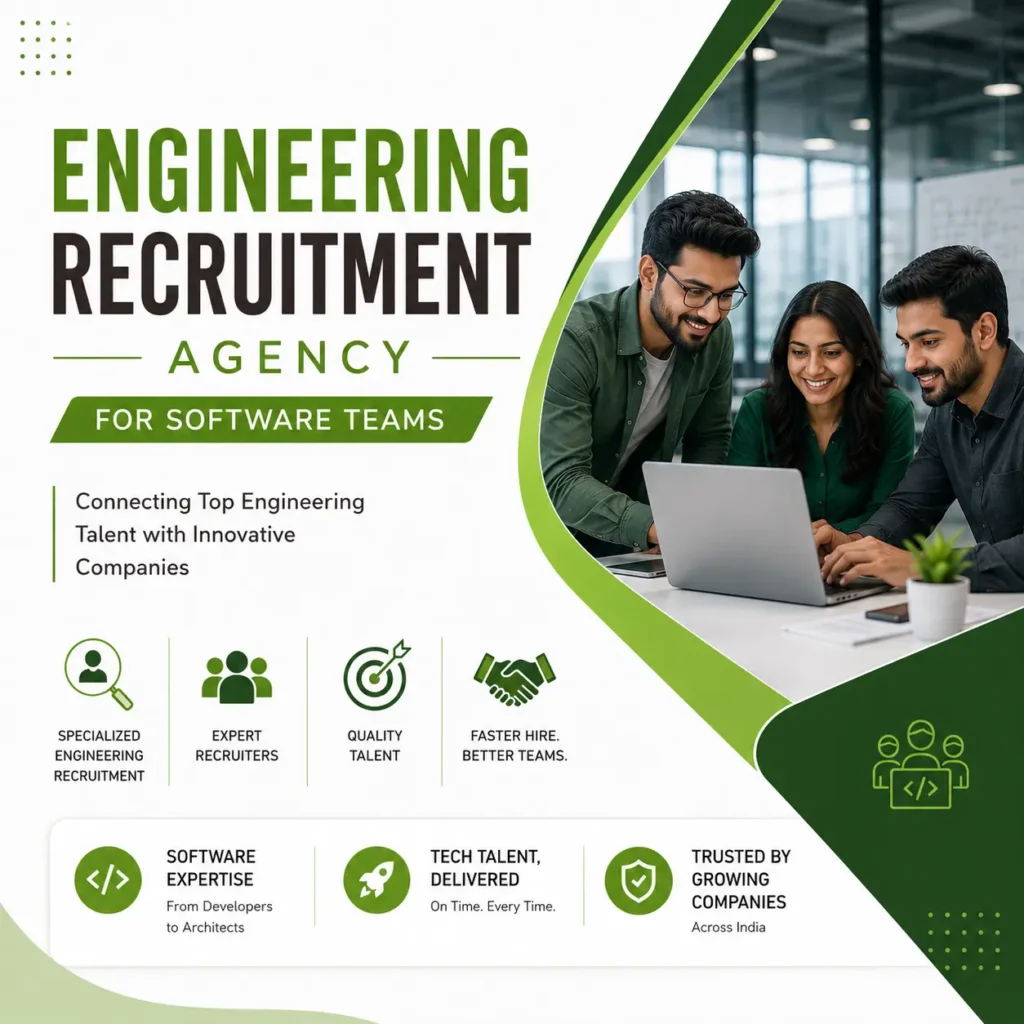
Viriksha HR Solution Engineering Recruitment Agency for Software Teams Build Great Software. Start With the Right Engineers. Software quality is a hiring outcome before it’s an engineering outcome. Every shipped bug, missed sprint, and architecture rewrite traces back, eventually, to who got hired. Most companies don’t have a technology problem — they have an engineering recruitment agency problem: relying on generic staffing that can’t tell a developer who ships production code from one who’s only ever cleared a coding round. Viriksha HR Solution works as an engineering staffing agency built specifically for software and technology teams — helping companies across Chennai and Pan India hire engineers who can actually build, not just interview well. Explore more Why Generic Hiring Fails Software Teams A standard job agency filters resumes on keywords: years of experience, tech stack listed, degree. That approach misses the things that actually predict whether an engineer will perform — depth on the specific stack you run, comfort with your scale of system, and whether they can work independently or need heavy hand-holding. This is why companies searching for an engineering job agency increasingly want more than a resume pipeline. They want a partner who understands the difference between a developer who’s maintained a legacy monolith and one who’s built distributed systems from scratch — and can screen for that difference before a candidate ever reaches an interview. Why Generic Hiring Fails Software Teams Viriksha HR Solution applies a structured three-tier screening process to every technical requisition, combined with our 5 C’s of Recruitment framework — Competency, Character, Chemistry, Culture, and Consistency. Basic Screening Technical stack verification, project history mapping, and role-fit filtering against your actual requirement — not just the job title on their last resume. Candidate Assessment Report A structured technical evaluation covering coding depth, system design exposure, and stack-specific competency, calibrated to the seniority level you’re hiring for. Manager-Level Screening A final technical round involving your hiring manager’s input, so candidates presented to you have already cleared a real technical bar. This is what separates engineering recruiting companies built for software hiring from general staffing vendors — the screening layer is discipline-specific, not generic. What “Engineering Recruitment Agency” Means An engineering recruitment agency is a specialized staffing partner that sources, technically screens, and places software and technology engineers for client companies — differing from general recruitment agencies in that it applies stack-specific and role-specific technical assessment rather than keyword-based resume matching alone. Roles We Recruit For As a full-scope engineering staffing firm, Viriksha HR Solution places talent across: Software Development — frontend, backend, and full-stack engineers across major stacks DevOps & Site Reliability Engineering — infrastructure, CI/CD, cloud platform roles Data Engineering & AI/ML — data pipeline, machine learning, and AI product roles Cloud & Product Engineering — SaaS product teams, cloud-native architecture roles QA & Test Engineering — automation and manual testing across the SDLC Engineering Leadership — tech leads, engineering managers, VP Engineering-level search We support hiring from junior developer through senior and leadership-level engineering roles, making us a fit both as an engineering staffing agency for startups building their first technical team and as a partner for scaled companies backfilling specialist roles. Contact Viriksha HR Solution For Your Next Hiring Building a software team that ships, not just one that interviews well? Viriksha HR Solution brings 15 years of engineering recruitment expertise and stack-specific technical screening — across Chennai and Pan India. Get in touch to discuss your engineering hiring requirement. Contact Us Beyond Sourcing: Contract and Permanent Engineering Staffing Companies searching for engineering staffing agencies are often solving two problems at once — finding the engineer, and structuring how they’re employed. Permanent Engineering Recruitment Full-cycle hiring for confirmed technical headcount, from individual contributors to engineering leadership. Engineering Contract Staffing For project-based or scale-flexible technical roles, with statutory compliance handled end-to-end — ESI, PF, professional tax, and applicable registrations. Both are delivered through one accountable partner, so you’re not managing a sourcing vendor and a separate compliance vendor for the same hire. Our Track Record 1,250+ successful placements at executive and senior management level over five years 15-year expert recruitment team with technical hiring experience across IT and product companies 3,600+ employees currently managed on payroll and compliance monthly Zero compliance issues across five years of operations 4.9-star Google rating across 79 reviews Chennai-Based, Pan India Capable Viriksha HR Solution is headquartered in Chennai, with placement experience concentrated across the city’s IT corridor — OMR, Sholinganallur, Siruseri, Taramani, Perungudi, Navalur, and Guindy. For clients outside Tamil Nadu, the same technical screening standard extends Pan India — including Bengaluru, Hyderabad, Pune, and NCR — so hiring quality doesn’t vary by location. Why Companies Choose Viriksha HR Solution as Their Engineering Recruiting Partner Stack-specific technical screening, not resume-keyword filtering 5 C’s framework balances technical competency with team and culture fit Combined recruitment + compliance capability for contract staffing needs 15 years of recruitment expertise across IT, product, and technology companies Track record of zero compliance issues, relevant for clients also needing payroll support Chennai IT-corridor expertise paired with Pan India delivery
Engineering R&D & GCC Recruitment Partner OMR
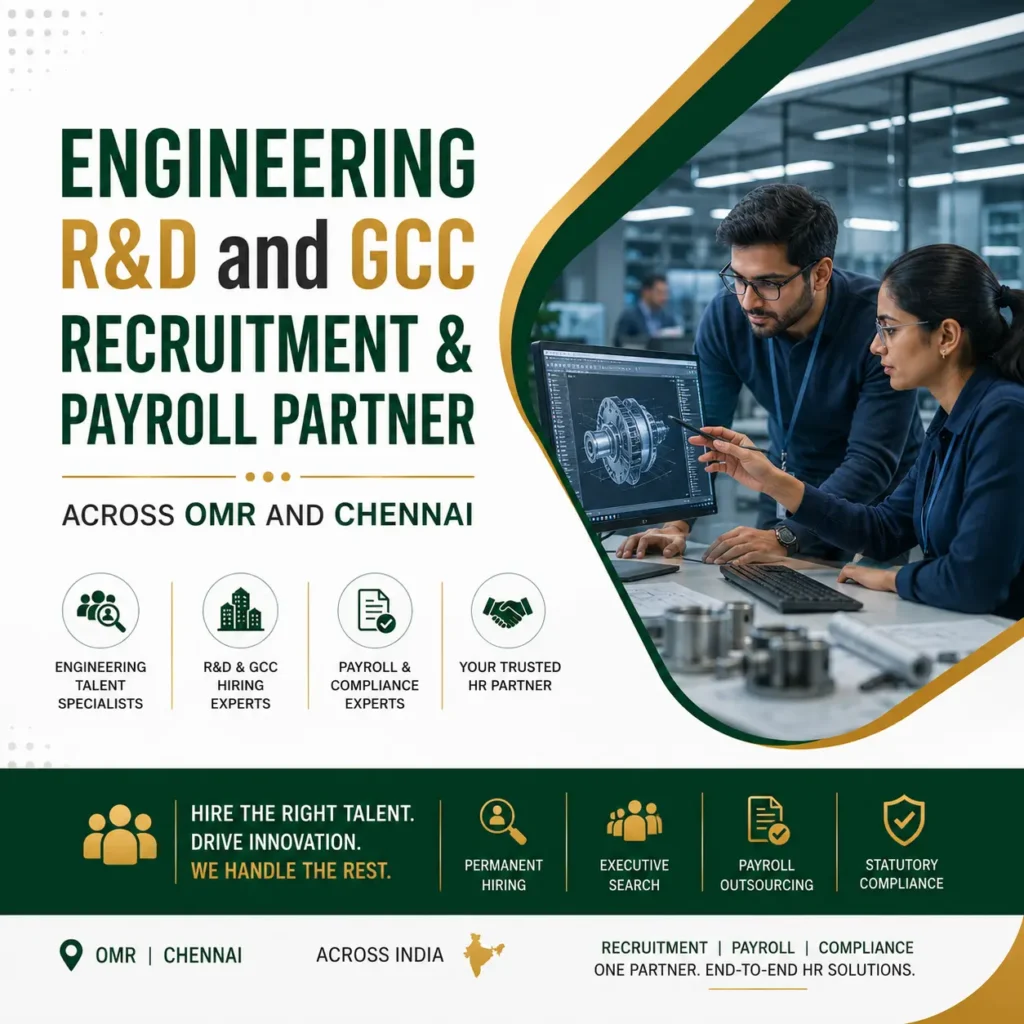
Viriksha HR Solution Engineering R&D and GCC Recruitment & Payroll Partner Across OMR and Chennai Engineering R&D and GCC Recruitment & Payroll Partner Across OMR and Chennai Setting up or scaling a Global Capability Centre in Chennai comes with a hiring problem most staffing agencies aren’t built to solve: you need engineering and R&D talent that meets global product standards, hired fast enough to hit a capacity-ramp deadline, and onboarded through statutory compliance that doesn’t create risk for the parent entity. Generic recruitment vendors handle one piece of this. Few handle all three. Viriksha HR Solution works as an engineering GCC recruitment and payroll partner for multinational capability centres and engineering R&D units along Chennai’s OMR corridor and Pan India — combining technical hiring with compliant payroll management under a single engagement. Explore more Why GCC and R&D Hiring Needs a Different Approach Global Capability Centres aren’t hiring for generic IT or back-office roles anymore. Chennai’s OMR belt — Taramani, Perungudi, Sholinganallur, Siruseri, Navalur — now hosts engineering R&D functions for automotive, semiconductor, industrial products, and embedded systems companies. These roles demand candidates who can work against global engineering standards, collaborate across time zones, and often hold domain depth in areas like embedded software, VLSI, product design, or systems engineering — on top of standard technical competency. A resume-matching approach fails here. So does treating GCC hiring like standard IT recruitment. Viriksha HR Solution’s engineering GCC recruitment process is built around the specific hiring bar MNC capability centres operate at — technical depth, global-standard documentation habits, and retention profile, not just qualification match. Our Engineering R&D and GCC Recruitment Process We apply our structured three-tier screening process — basic screening, a detailed Candidate Assessment Report, and manager-level technical screening — layered with the 5 C’s of Recruitment: Competency, Character, Chemistry, Culture, and Consistency. For GCC and R&D roles specifically, this includes: Domain-specific technical assessment — relevant to embedded systems, product engineering, VLSI/semiconductor design, mechanical/automotive R&D, or systems engineering, depending on the role Global-standard readiness evaluation — communication, documentation practices, and cross-time-zone collaboration fit, which matter more in a GCC context than in a standalone domestic engineering role Culture-fit screening for MNC environments — since retention risk in GCCs often comes from mismatched expectations around reporting structures and global stakeholder management, not technical gaps This is what separates engineering R&D recruitment for a capability centre from standard engineering hiring — the technical bar and the retention risk profile are both higher, and both need to be screened for upfront. What “Engineering GCC Recruitment” Means Engineering GCC recruitment refers to the specialized hiring of engineering and R&D talent for Global Capability Centres — captive offshore units of multinational companies — requiring candidates to meet global engineering standards while being sourced, screened, and onboarded through India-compliant employment processes. It combines technical domain screening with statutory and payroll compliance suited to MNC governance requirements. Payroll and Compliance Support for GCC Employers Recruitment is only half the requirement for most GCCs. The other half is running payroll and statutory compliance in a way that satisfies both Indian labour law and the parent company’s global audit standards. Viriksha HR Solution’s payroll outsourcing for GCC and R&D employers covers: EPF ManagementUAN generation, e-nomination filing, monthly EPF returns, claim processing, KYC approval, and transfer request approval — handled end-to-end for every employee on payroll. ESI and Professional TaxComplete ESI enrolment and contribution management, along with professional tax compliance across applicable states. Registrations and LicensingShops & Establishment Act registration, and other applicable licenses depending on the entity structure and location — with all filings tracked against statutory deadlines rather than handled reactively. GST and TDS ComplianceCoordination on GST and TDS compliance touchpoints relevant to payroll processing, with a direct collaboration point for your CA or audit firm — important for GCCs where the parent entity’s finance team expects clean, auditable local compliance records. Two-Level ValidationEvery payroll run at Viriksha HR Solution passes through two-level validation before disbursal — a control layer that has kept our compliance record at zero errors and zero compliance issues across five years, and across 3,600+ employees currently managed monthly. This combination means a GCC client isn’t stitching together a recruitment vendor and a separate payroll processor — hiring and compliant onboarding run through one accountable partner. HRMS Compatibility We work within whatever payroll and HR systems your GCC already runs on, including Zoho, Keka, and GreatHR, so onboarding data flows into your existing tech stack rather than creating a parallel record-keeping system for your India entity. OMR: Chennai’s GCC and Engineering R&D Corridor OMR has become Chennai’s primary Global Capability Centre and engineering R&D belt. Viriksha HR Solution recruits and supports payroll for GCC clients across: Taramani — R&D and technology park GCC units Perungudi — engineering and product R&D centres Sholinganallur — established GCC and IT-engineering hybrid campuses Siruseri (SIPCOT IT Park) — large-scale GCC and captive engineering units Navalur & Kelambakkam — newer GCC expansion zones Thoraipakkam & Karapakkam — mixed IT-engineering corporate campuses Recruiting locally along this corridor means understanding OMR-specific salary benchmarks, notice-period norms in the GCC talent pool, and where engineering R&D talent with MNC exposure is actually concentrated — rather than running a generic city-wide search. Partner With Viriksha HR Solution Planning to set up or scale a Global Capability Centre in Chennai? Viriksha HR Solution combines engineering R&D recruitment expertise with zero-error payroll compliance — across the OMR corridor and Pan India. Get in touch to discuss your GCC hiring and compliance requirement. Contact Us Pan-India GCC and Engineering R&D Hiring Support Beyond Chennai, Viriksha HR Solution extends the same GCC recruitment and payroll compliance model to capability centres and R&D units across other major Indian GCC hubs, including Bengaluru, Hyderabad, Pune, and the NCR region — supporting multi-location GCC clients who want consistent hiring quality and compliance standards across every India site, rather than a different vendor and a different process at each location. Why GCCs Choose Viriksha HR Solution Combined recruitment and payroll accountability
Engineering Recruitment Services and Talent Hiring Specialists
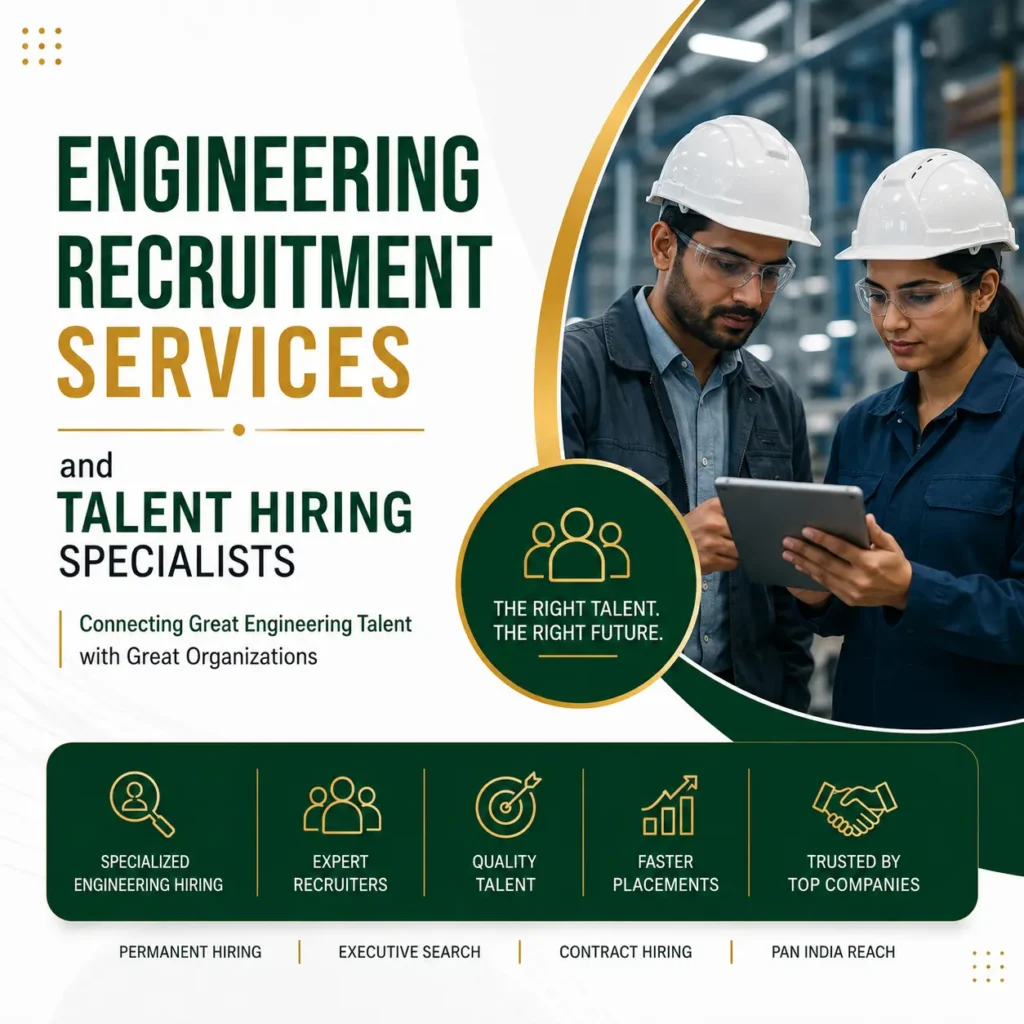
Viriksha HR Solution Engineering Recruitment Agency and Talent Hiring Specialists Engineering Recruitment Agency Engineering roles don’t fail at the offer stage. They fail earlier — at the sourcing stage, when generic hiring processes can’t tell a competent design engineer from someone who merely survived an engineering degree. For manufacturing plants, EPC firms, infrastructure companies, and product engineering teams across Chennai and Pan India, this gap shows up as stalled projects, missed commissioning deadlines, and engineers who don’t last past their probation period. Viriksha HR Solution is an engineering recruitment agency built specifically to close that gap. We provide engineering talent acquisition services for companies that need technically vetted, role-ready engineering professionals — not just resumes that match a keyword search. Why Generic Recruitment Doesn’t Work for Engineering Roles Most staffing agencies run every requisition through the same funnel: post the job, filter by degree and years of experience, forward the shortlist. That approach works reasonably well for generalist roles. It breaks down for engineering hiring, where the real differentiators — practical design competency, familiarity with specific codes and standards, hands-on exposure to particular machinery or software — never show up in a keyword scan of a resume. A mechanical design engineer who’s spent three years doing routine CAD modifications is not the same hire as one who’s led a product from concept to production. A site civil engineer who’s only worked on residential projects may struggle on an industrial EPC site. Generic recruitment consultants can’t tell the difference. Engineering recruiters who understand the discipline can. This is why companies increasingly search for a best engineering recruitment agency rather than a general-purpose staffing vendor — the technical vetting layer is the entire value proposition. Our Engineering Talent Acquisition Process Viriksha HR Solution applies a structured, three-tier screening process to every engineering requisition, layered on top of our proprietary 5 C’s of Recruitment framework — Competency, Character, Chemistry, Culture, and Consistency. Basic Screening Technical qualification verification, discipline-specific experience mapping, and role-fit filtering against the actual job requirement — not just the job title. Candidate Assessment Report A structured technical evaluation covering domain knowledge, tools and standards familiarity (AutoCAD, SolidWorks, SAP2000, PLC systems, IS/ISO codes, as relevant to the role), and problem-solving ability specific to the engineering discipline in question. Manager-Level Screening A final round conducted with hiring manager input to validate technical depth and team fit before a candidate profile ever reaches you. This end-to-end engineering recruitment service means you’re reviewing candidates who’ve already cleared a technical bar — not resumes that merely look right on paper. Engineering Disciplines We Recruit For As a full-scope engineering staffing agency, Viriksha HR Solution places talent across: Mechanical Engineering Design, production, quality, maintenance, tooling Civil Engineering Site execution, structural design, project planning, billing/QS roles Electrical Engineering Panel design, protection systems, site electrical, control systems Industrial & Production Engineering Process engineering, plant operations, lean/Six Sigma roles Instrumentation Engineering Automation, PLC/SCADA, calibration Project & Site Engineering EPC execution roles across manufacturing and infrastructure We support hiring from entry-level graduate engineer trainees through to senior engineering managers and technical department heads, making us equally suited as an engineering recruitment services partner for startups scaling their first technical team and established manufacturers backfilling specialist roles. What “Engineering Talent Acquisition” Means at Viriksha HR Engineering talent acquisition is the end-to-end process of identifying, technically evaluating, and onboarding engineering professionals for an organization — spanning sourcing, discipline-specific skills assessment, interview coordination, offer management, and (where applicable) statutory onboarding compliance. It differs from general recruitment in that it requires domain-specific technical screening rather than resume-keyword matching alone. Our Track Record Numbers matter more than promises in engineering hiring, where a bad fit is expensive to unwind: 1,250+ successful placements at executive and senior management level over five years 15-year expert recruitment team with cross-industry technical hiring experience 3,600+ employees currently managed on payroll and statutory compliance monthly, for clients who also route engineering hires through us for onboarding continuity Zero compliance issues across five years of operations These aren’t generic recruitment consultancy metrics — they reflect a firm built for repeat B2B engagements, not one-off placements. Partner With Viriksha HR Solution for Your Next Hiring Looking to hire qualified engineering professionals for your next project or plant expansion? Viriksha HR Solution brings 15 years of specialized engineering recruitment expertise, technical screening depth, and compliant staffing support — across Chennai and Pan India. Get in touch to discuss your engineering hiring requirement. Contact Us Engineering Recruitment and Staffing Solutions — Beyond Just Hiring Many companies searching for engineering workforce solutions actually need two things at once: qualified engineers, and a compliant way to employ them — whether that’s on direct payroll or through contract staffing for project-based site roles. Viriksha HR Solution supports both: Permanent Engineering Recruitment Full-cycle hiring for confirmed headcount — design engineers, project engineers, engineering managers, and technical leadership roles. Engineering Contract Staffing For project-based site roles (EPC execution, plant commissioning, turnaround projects) where headcount needs flex with project timelines. This includes statutory compliance handling — ESI, PF, professional tax, and applicable labour law registrations (Shops and Establishment Act, Contract Labour Act, BOCW Act where site-based construction/civil roles are involved). This combination is what makes us an engineering recruitment solutions provider rather than a pure sourcing vendor — you get the technical hire and the compliant employment structure in one engagement. Engineering Recruitment Services for Startups and Growing Companies Early-stage manufacturing units, product engineering startups, and growing EPC contractors often can’t justify an in-house technical recruiter for their first 10–20 engineering hires — but they can’t afford a mis-hire either. Our engineering recruitment services for businesses in this stage are structured around speed without dropping the technical vetting layer: faster turnaround on shortlists, flexible engagement (retained or contingency), and hiring manager involvement kept light so founders and technical leads aren’t buried in interview overhead. For established companies scaling a plant or opening a new site, we run the same process at volume — batch hiring for commissioning teams, shift-based