
Manufacturing Recruitment Agency & HR Services Across Chennai’s OMR Corridor | Staffing, Payroll & Compliance
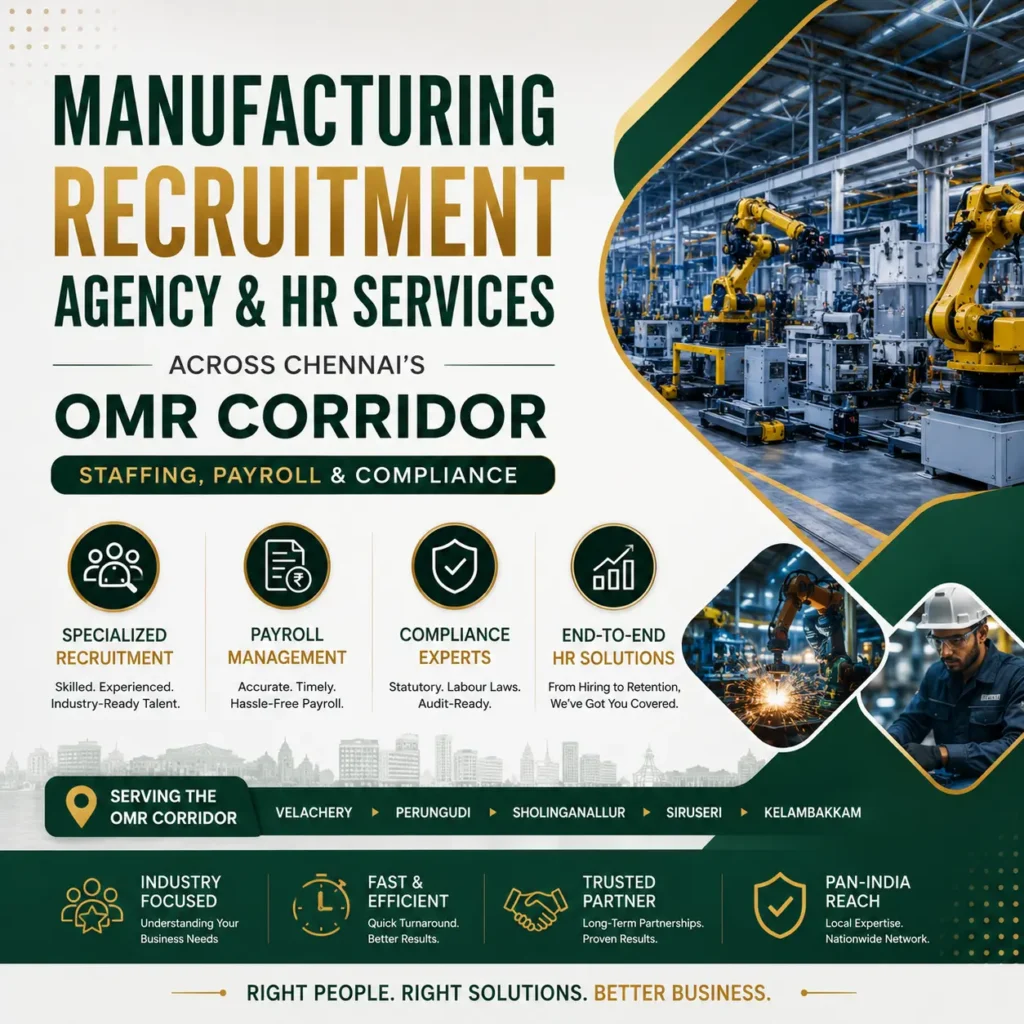
Viriksha HR Solution Manufacturing Recruitment Agency & HR Services Across Chennai’s OMR Corridor | Staffing, Payroll & Compliance Manufacturing HR Services & Recruitment Agency Across Chennai’s OMR Corridor Chennai’s OMR corridor is not just an IT destination — it is one of South India’s most active manufacturing belts, home to precision engineering units, electronics assembly lines, industrial automation companies, semiconductor R&D facilities, automotive component manufacturers, and a wide range of industrial machinery and equipment businesses. From the Perungudi Industrial Estate to the logistics and food processing clusters at Kelambakkam, manufacturing businesses across this corridor share a consistent operational challenge: finding the right industrial talent, managing payroll accurately for diverse workforce categories, and staying fully compliant with factory-specific statutory obligations. Viriksha HR Solutions is a full-service manufacturing recruitment agency and HR consultancy serving manufacturing and industrial businesses across Chennai’s entire OMR corridor — providing end-to-end manufacturing staffing solutions covering factory recruitment, payroll outsourcing services, ESI PF compliance, labour law adherence, and complete statutory filing support. Whether your plant operates out of Perungudi Industrial Estate, the electronics manufacturing clusters in Thoraipakkam, the product engineering firms in Siruseri, or the industrial units in Kelambakkam — Viriksha HR Solutions is your trusted manufacturing staffing company and HR partner across the corridor. Explore more Why Manufacturing Businesses Along OMR Need Specialist HR & Staffing Support Manufacturing and industrial businesses face HR challenges that are structurally distinct from those in IT or services sectors: Diverse workforce categories — permanent staff, contract workers, temporary workers, and daily wage employees all running on separate payroll structures simultaneously High-volume, skill-specific hiring — production engineers, quality inspectors, CNC operators, automation technicians, embedded systems engineers, and shop floor supervisors require sourcing from specialist talent pools Complex statutory compliance — Factories Act registration, Contract Labour Act compliance, PF, ESI, professional tax, and labour welfare fund obligations across permanent and contract workforces Seasonal and project-based staffing surges — requiring manufacturing temp agencies and manufacturing temporary employment agencies to respond quickly without compromising screening quality Executive and leadership hiring — plant managers, production heads, and R&D directors require manufacturing executive recruiters with genuine domain understanding A specialist manufacturing staffing agency with deep industrial sector knowledge eliminates these challenges systematically — delivering factory recruitment, payroll management, and compliance support as an integrated service rather than fragmented vendor relationships. Velachery — Manufacturing Recruitment & HR Services for Electronics & Engineering Units Velachery hosts small electronics units and small engineering companies — typically lean manufacturing operations requiring both operational staff and skilled technicians. These businesses often operate without dedicated HR departments, making manufacturing staffing solutions and payroll outsourcing services particularly valuable. Manufacturing Recruitment Services in Velachery: Viriksha HR Solutions supports Velachery’s electronics and engineering units as a specialist manufacturing employment agency — sourcing electronics assembly technicians, quality control inspectors, electrical engineers, and mechanical engineering staff. For small manufacturing units in Velachery, structured hiring support from a dedicated factory recruitment agency means consistent candidate quality without the overhead of an internal recruitment function. Payroll & Compliance Services in Velachery: Small manufacturing units in Velachery managing mixed workforces — permanent staff and contract workers — require payroll outsourcing services that handle both categories accurately. Viriksha HR Solutions provides salary processing services, CTC structuring services, ESI registration services, PF registration services, EPF consultant support, UAN registration services, professional tax registration, attendance management services, time office management, and complete ESI PF compliance services for Velachery manufacturing businesses. Taramani — Industrial Staffing & Payroll Services for Electronics R&D & Semiconductor Companies Taramani is Chennai’s electronics and semiconductor R&D hub — home to product engineering firms, embedded systems R&D companies, and semiconductor design businesses operating alongside IIT Madras Research Park. Hiring for these businesses demands manufacturing engineering recruitment agencies with genuine understanding of R&D roles — not generalist staffing vendors applying broad IT hiring approaches to specialized engineering positions. Manufacturing Recruitment Services in Taramani: As a specialist manufacturing engineering recruitment agency serving Taramani, Viriksha HR Solutions sources embedded systems engineers, semiconductor design engineers, electronics R&D professionals, product engineers, VLSI designers, and PCB layout specialists — from both active candidate pools and passive talent networks developed specifically for Chennai’s electronics and R&D sector. Payroll & Compliance Services in Taramani: R&D companies in Taramani often manage complex compensation structures — project-based pay, research stipends, contract engineer agreements, and variable components alongside standard CTC. Viriksha HR Solutions provides salary structuring services, salary optimization services, CTC structuring services, payslip generation services, PF compliance services, ESI monthly filing, PF monthly filing, PF ECR filing, and professional tax consultant support for Taramani’s electronics and semiconductor businesses. Partner with Viriksha HR Solutions — Chennai’s Trusted Manufacturing Recruitment Agency Contact Viriksha HR Solutions today to discuss your manufacturing recruitment, payroll outsourcing, or statutory compliance requirements — and build the workforce and compliance foundation your manufacturing business deserves. Contact Us Perungudi — Manufacturing Staffing Agency & HR Services at Perungudi Industrial Estate Perungudi Industrial Estate is the OMR corridor’s most diverse manufacturing cluster — home to industrial machinery manufacturers, pumps and valves businesses, precision engineering units, electrical panel manufacturers, electronics assembly operations, industrial automation equipment companies, automotive component manufacturers, industrial spares suppliers, and packaging product businesses. This concentration of varied manufacturing operations makes Perungudi one of the highest-demand locations for specialist industrial staffing agencies along the corridor. Manufacturing Recruitment Services in Perungudi: Viriksha HR Solutions operates as a dedicated factory staffing agency and industrial staffing agency for Perungudi Industrial Estate businesses — sourcing production supervisors, mechanical engineers, electrical engineers, CNC operators, quality control engineers, automation technicians, packaging line operators, maintenance engineers, and plant managers across all manufacturing categories present at Perungudi. For a precision engineering client at Perungudi Industrial Estate requiring rapid scale-up of CNC machining and quality inspection staff ahead of a large order cycle, Viriksha HR Solutions delivered a structured manufacturing staffing solution — screening and placing production staff within defined timelines while maintaining consistent technical assessment standards across every hire. Payroll & Compliance Services in Perungudi: Manufacturing businesses at Perungudi Industrial Estate — particularly those managing contract labour
HR Services, Recruitment & Payroll Compliance Across Chennai’s IT Corridor | Velachery to Kelambakkam
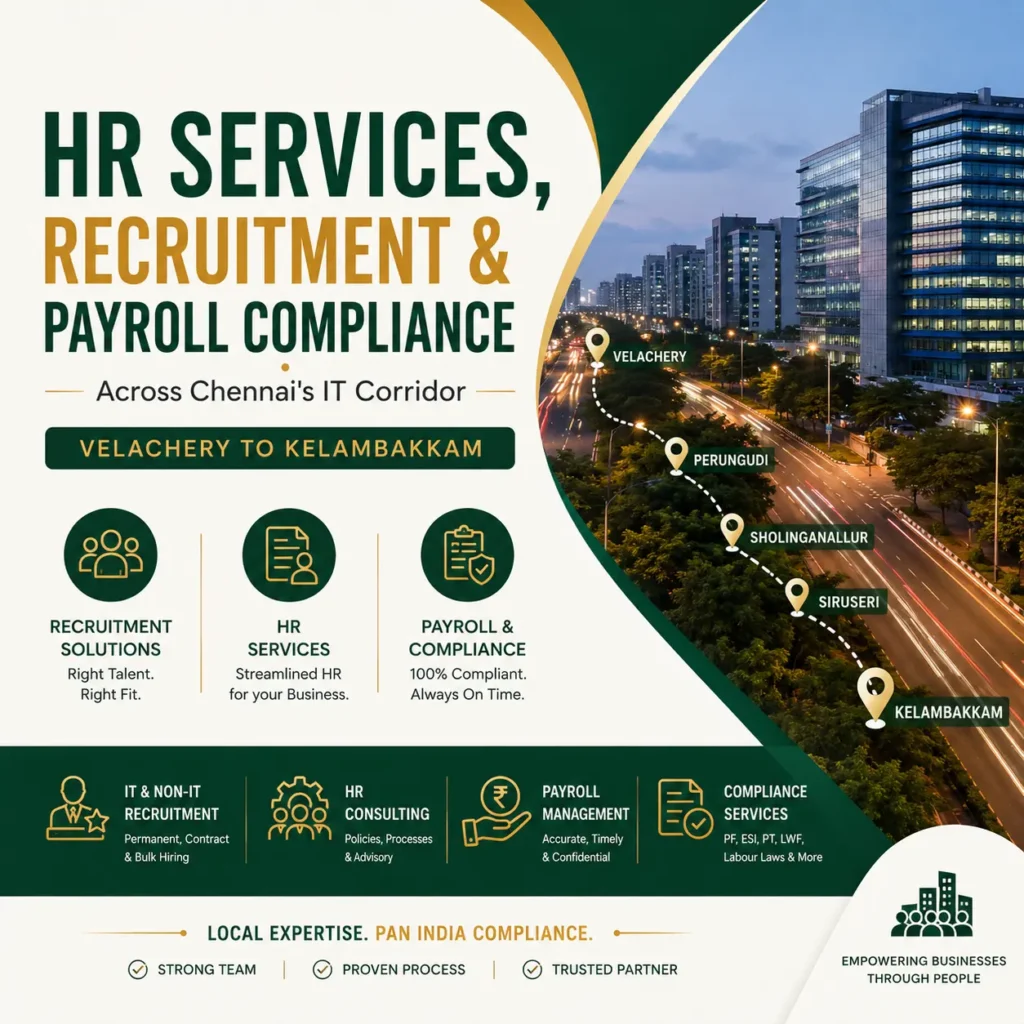
Viriksha HR Solution HR Services, Recruitment & Payroll Compliance Across Chennai’s IT Corridor | Velachery to Kelambakkam HR Services, Recruitment & Payroll Compliance Services Chennai’s IT corridor — stretching from Velachery and Taramani in the west through the OMR belt to Siruseri and Kelambakkam in the south — is home to one of India’s densest concentrations of technology companies, financial services firms, healthcare IT businesses, AI startups, and engineering consultancies. Thousands of businesses operating across this corridor share a common operational challenge: managing human resources, payroll, and statutory compliance with the precision and speed that fast-scaling technology environments demand. Viriksha HR Solution is a full-service HR consultancy serving businesses across Chennai’s entire IT corridor — providing end-to-end human resources services covering IT recruitment, payroll outsourcing services, ESI PF compliance services, HR outsourcing services, salary processing, labour law compliance, and statutory filing support. Whether your business operates out of TIDEL Park in Taramani, SIPCOT IT Park in Sholinganallur, RMZ Millenia in Perungudi, or Prince Infocity in Kandanchavadi — Viriksha HR Solutions is your trusted HR and payroll partner across the corridor. Explore more Why IT Corridor Businesses Need Specialist HR & Payroll Support Technology companies, BPOs, healthcare IT firms, and AI startups operating along Chennai’s IT belt face HR challenges that are structurally different from those in traditional industries: High attrition and continuous hiring cycles requiring always-on recruitment pipelines across software, DevOps, QA, and product roles Complex payroll structures involving variable pay, ESOPs, performance bonuses, contractor payments, and multi-state salary components Statutory compliance obligations across PF, ESI, TDS, professional tax, and labour law — with serious consequences for errors or late filings Rapid headcount scaling that outpaces internal HR bandwidth, particularly in funded startups and mid-sized IT firms Multi-location workforce management as businesses expand across Chennai zones and into other metros A specialist HR consultancy with deep IT sector knowledge — covering manpower recruitment, payroll management, HR payroll processing, and full statutory compliance — eliminates these pain points systematically rather than leaving businesses to manage them reactively. Velachery — HR & Payroll Services for IT, Banking BPOs & Healthcare IT Velachery hosts a dense mix of IT and software companies, banking and financial BPOs, healthcare IT firms, and technology-focused SMEs. Businesses in Velachery operate under significant hiring pressure — particularly for BPO operations professionals, banking IT specialists, healthcare data and software staff, and mid-level software engineers. Recruitment Services in Velachery: Viriksha HR Solution supports Velachery-based IT and BPO businesses with structured talent acquisition — sourcing software developers, QA engineers, business analysts, BFSI operations professionals, and healthcare IT specialists through active and passive candidate pipelines. As one of Chennai’s best IT recruitment agencies, Viriksha HR Solution reduces time-to-hire for Velachery businesses without compromising on technical screening standards. Payroll & Compliance Services in Velachery: Velachery businesses with mixed workforces — permanent employees, contract staff, and BPO shift workers — require payroll outsourcing services that handle variable pay components, shift allowances, and multi-category statutory deductions accurately. Viriksha HR Solution provides payroll processing services, salary structuring services, CTC structuring services, monthly payslip processing, and full ESI PF compliance services for Velachery-based companies. When a healthcare IT firm in Velachery engaged Viriksha HR Solution following ESI filing inconsistencies and TDS computation gaps that had accumulated over rapid hiring, the payroll process was restructured end-to-end — restoring compliance and payroll accuracy within a single processing cycle. Taramani — HR Solutions for AI Startups & IIT Madras Research Park Companies Taramani is Chennai’s emerging deep tech and AI hub — home to IIT Madras Research Park startups, AI and machine learning companies, and cutting-edge technology ventures. HR and payroll requirements here are highly specialized: hiring for AI researchers, data scientists, ML engineers, and research-oriented product teams requires a recruitment partner who understands these roles at a functional level, not just by job title. Recruitment Services in Taramani: Viriksha HR Solutions supports Taramani’s AI and deep tech companies with niche talent acquisition — sourcing AI/ML engineers, data scientists, research associates, and technical product managers from both active candidate pools and passive talent networks. For funded startups at IIT Madras Research Park scaling from 10 to 50+ employees, structured hiring pipelines from a best HR agency make the difference between hitting growth milestones and stalling on talent gaps. Payroll & Compliance Services in Taramani: Startups at Taramani often operate with complex compensation structures — ESOPs, research stipends, contract researcher agreements, and performance-linked components alongside standard CTC. Viriksha HR Solutions provides salary structuring services, CTC structuring services, salary optimization services, payslip generation services, and PF compliance services tailored to startup payroll complexity. PF registration services, UAN registration services, EPF consultant support, and professional tax registration are handled as integrated components of every payroll engagement. Perungudi — HR & Payroll Services for IT Companies at RMZ Millenia Perungudi — home to RMZ Millenia Business Park and a significant cluster of IT and software companies — sits at the heart of the OMR corridor. Businesses at RMZ Millenia range from mid-sized product companies to large IT services firms, all requiring consistent, scalable HR and payroll support. Recruitment Services in Perungudi: As a trusted manpower recruitment agency serving Perungudi’s IT cluster, Viriksha HR Solutions provides end-to-end IT recruitment — covering software engineers, DevOps engineers, cloud architects, QA leads, and project managers. Recruitment support is available for both permanent hiring and contract staffing requirements, with transparent pipelines and structured screening at every stage. Payroll & Compliance Services in Perungudi: Perungudi IT companies with 50–500 employees typically require full-stack payroll outsourcing services — covering salary processing services, attendance management services, time office management, payslip generation services, PF monthly filing, ESI monthly filing, ESI return filing, PF return filing, PF ECR filing, and professional tax consultant support. Viriksha HR Solutions manages this complete payroll and statutory compliance stack for Perungudi-based businesses, ensuring zero-delay filings and accurate statutory deductions every month. Partner with Viriksha HR Solutions Across Chennai’s IT Corridor Contact Viriksha HR Solutions today to discuss your recruitment, payroll outsourcing, or statutory compliance requirements — and build
Electrical Equipment Manufacturing Recruitment, Payroll and Compliance Services in India
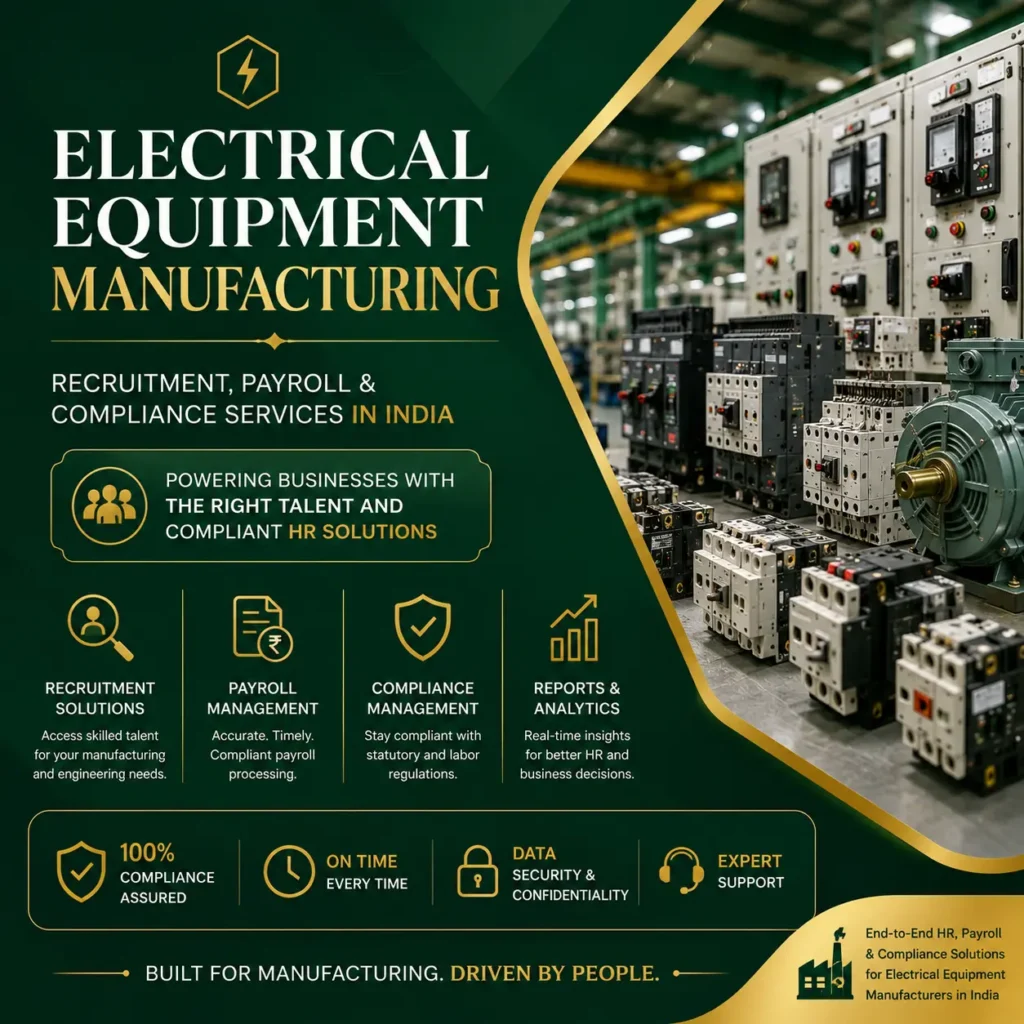
Viriksha HR Solution Electrical Equipment Manufacturing Recruitment, Payroll and Compliance Services in India Electrical Equipment Manufacturing Runs on Two Things — Precision Engineering and the Right People India’s electrical equipment manufacturing sector is one of the most strategically critical in the country. Switchgear, transformers, motors, cables, control panels, power distribution equipment, and industrial automation systems — these are not consumer products. They are the infrastructure that powers factories, hospitals, data centers, and entire cities. And yet, the companies building this infrastructure face some of the most persistent talent and compliance challenges of any manufacturing vertical. Skilled electrical engineers are scarce. Production technicians with domain-specific experience are hard to find and harder to retain. Payroll for large factory workforces carries statutory complexity that most internal HR teams are not equipped to manage alone. And compliance obligations — from PF and ESI to Factories Act licensing and contract labour regulations — stack up quickly as operations scale. Viriksha HR Solutions provides integrated recruitment, payroll outsourcing, and statutory compliance services specifically for electrical equipment manufacturing companies across India — covering the full workforce lifecycle from hiring the right engineers and production leaders to managing payroll accuracy and statutory compliance for every worker on the floor. Explore more Why Electrical Equipment Manufacturing Needs a Specialist HR Partner Electrical equipment manufacturing sits at a unique intersection of high-precision engineering, large-scale factory operations, and an increasingly technology-driven production environment. Generic HR support — whether for hiring or payroll — consistently falls short because it does not understand the operational and technical realities of this sector. Technical Role Complexity Hiring an electrical design engineer for a transformer manufacturer, a control panel wiring technician for a switchgear company, or an automation engineer for a motor manufacturing plant all require sector-specific knowledge to evaluate correctly. A candidate who is strong in one electrical sub-sector may be entirely mismatched for another. Large, Mixed Workforces With High Compliance Exposure Electrical equipment manufacturing facilities typically employ a mix of permanent engineers and supervisors, skilled and semi-skilled production workers, and contract labour for assembly, wiring, and material handling — each category carrying different wage structures, statutory obligations, and compliance risks. Regulatory and Safety Compliance Intensity Factories Act licensing, Factories Act safety compliance, contract labour regulations, and worker welfare obligations are not optional in this sector — they are actively enforced, and the penalties for gaps are significant. Skilled Talent Scarcity Experienced electrical engineers, high-voltage testing specialists, and production managers with deep domain knowledge in transformers, switchgear, or industrial automation are a genuinely scarce resource — and companies that cannot reach passive candidates consistently lose these hires to better-connected competitors. Recruitment Services for Electrical Equipment Manufacturers As a dedicated electrical equipment manufacturing recruitment agency and electronics manufacturing recruitment agency, Viriksha HR Solution covers every critical role across the electrical equipment manufacturing value chain. Leadership and Senior Roles We help you hire: Chief Operations Officer (COO) Plant Director Plant Head Factory Manager Operations Director Manufacturing Director Production Director Engineering Director Head of Manufacturing Head of Production Head of Electrical Engineering Engineering Manager Production Manager Maintenance Manager Technical Manager Design and Engineering Roles We help you hire: Electrical Design Engineer Electrical Engineer Senior Electrical Engineer Power Systems Engineer Control Panel Design Engineer Switchgear Design Engineer Transformer Design Engineer Motor Design Engineer Relay Protection Engineer Instrumentation Engineer Automation Engineer PLC Engineer SCADA Engineer Control Systems Engineer CAD Engineer – Electrical Product Design Engineer R&D Engineer – Electrical Application Engineer Production and Manufacturing Roles We help you hire: Production Engineer Production Supervisor Production Executive Assembly Engineer Assembly Supervisor Manufacturing Engineer Process Engineer Industrial Engineer Shift Engineer Shift Supervisor Line Leader Line Supervisor Shop Floor Engineer Production Planner Manufacturing Technician Quality Assurance and Testing Roles We help you hire: Quality Manager Quality Assurance Engineer Quality Control Engineer Quality Inspector Incoming Quality Engineer (IQC) In-Process Quality Engineer (IPQC) Outgoing Quality Engineer (OQC) Testing Engineer Electrical Testing Engineer High Voltage Testing Engineer Product Validation Engineer Reliability Engineer Calibration Engineer Compliance Engineer Maintenance and Utilities Roles We help you hire: Electrical Maintenance Engineer Maintenance Supervisor Maintenance Technician Utility Engineer Utilities Manager Breakdown Maintenance Engineer Preventive Maintenance Engineer Predictive Maintenance Engineer Service Engineer Electrical Technician Supply Chain, Stores and Procurement Roles We help you hire: Supply Chain Manager Procurement Manager Purchase Executive Buyer Vendor Development Engineer Materials Manager Materials Planner Inventory Controller Stores Manager Stores Executive Warehouse Manager Logistics Coordinator Project and Installation Roles We help you hire: Project Engineer Project Manager Electrical Project Engineer Site Engineer Site Supervisor Commissioning Engineer Installation Engineer Field Service Engineer Service Technician Technical Support Engineer Sales and Business Development Roles We help you hire: Technical Sales Engineer Sales Engineer Key Account Manager Business Development Manager Product Manager Product Specialist Application Sales Engineer Customer Support Engineer After Sales Service Engineer Channel Sales Manager Research and Development Roles We help you hire: Research Engineer Product Development Engineer Innovation Engineer Prototype Development Engineer New Product Introduction (NPI) Engineer Design Validation Engineer Product Testing Engineer EHS and Compliance Roles We help you hire: EHS Manager Safety Officer Environmental Engineer Compliance Manager ISO Coordinator Regulatory Compliance Engineer Specialized Manufacturing Roles We help you hire: Transformer Manufacturing Engineer Switchgear Engineer Control Panel Engineer LV Panel Engineer MV Panel Engineer HV Equipment Engineer Circuit Breaker Engineer Cable Manufacturing Engineer Wire Harness Engineer Busbar Design Engineer Power Distribution Engineer Energy Management Engineer Renewable Energy Systems Engineer Solar Electrical Engineer Battery Systems Engineer Junior and Entry-Level Roles We help you hire: Graduate Electrical Engineer Junior Electrical Engineer Electrical Design Trainee Graduate Engineer Trainee (GET) Production Trainee Quality Trainee Maintenance Trainee Electrical Engineering Intern Technician Trainee Apprentice – Electrical For Plant Manager, General Manager, and VP-level mandates, Viriksha HR runs a dedicated executive search process — confidential, relationship-driven, and built around sourcing senior electrical manufacturing leaders who are rarely visible through standard job postings. Sub-Sector Specialization — Where Viriksha HR Recruits Within Electrical Equipment Manufacturing Architecture and interior design projects increasingly depend on strong MEP and HVAC coordination to move from design intent to functional execution.
Payroll and Compliance Services for Electronics Companies in India
Viriksha HR Solution Payroll and Compliance Services for Electronics Companies in India Electronics Companies Run Two Very Different Workforces. Most Payroll Systems Handle Neither Well. Walk through any mid-sized electronics company in India and you will find two distinct worlds operating under the same roof. On one side, a manufacturing floor with production technicians, SMT operators, quality inspectors, and contract assembly staff — a workforce that looks and operates like any high-precision factory, with shift-based attendance, contractor-deployed manpower, and statutory compliance obligations that stack up quickly across PF, ESI, minimum wages, and labour licensing. On the other side, an engineering office or design center with hardware engineers, embedded developers, VLSI designers, and application engineers — a workforce that looks more like an IT company, with complex compensation structures, multi-component salary packages, and increasingly, global reporting lines that add cross-border payroll coordination to the compliance picture. Most payroll providers are built for one or the other. Very few handle both with the depth and accuracy that electronics companies actually need. Viriksha HR Solutions provides dedicated payroll outsourcing services and HR payroll and statutory compliance services built specifically for the electronics industry — covering the full workforce spectrum from production floor to engineering office to global capability center, across India. Explore more Why Electronics Company Payroll Is Uniquely Complex Two Workforce Structures Under One Entity Electronics companies with both manufacturing and design functions run two fundamentally different payroll structures simultaneously — shift-based factory payroll with piece-rate incentives and contractor compliance on one side, and multi-component engineering compensation with variable pay and ESOP components on the other. High Contract and Third-Party Labour in Manufacturing EMS and ODM facilities heavily depend on contract labour for assembly, testing, and material handling functions. Under the Contract Labour Act, the principal employer carries full liability if contractors default on wages, PF, or ESI — making contractor compliance monitoring a critical, non-negotiable function. Engineering Compensation Complexity Senior hardware engineers, VLSI designers, and R&D professionals typically carry multi-component packages — base salary, performance bonuses, project completion incentives, and increasingly, equity or ESOP components for design-focused companies and GCCs. Each component requires distinct tax treatment and careful CTC structuring. Multi-Location Operations Electronics companies frequently operate across multiple locations — a manufacturing facility in one state, a design center in another, and regional offices elsewhere — each triggering separate Professional Tax, Shops and Establishment, and labour welfare fund obligations. Global Workforce Coordination for GCCs Global Capability Centers set up by multinational electronics companies introduce cross-border payroll complexity — coordinating Indian payroll with global HR systems, managing expat compensation, handling shadow payroll for internationally mobile employees, and ensuring Indian statutory compliance aligns with global reporting requirements. Seasonal and Project-Based Headcount Fluctuation Electronics manufacturing volumes fluctuate with product cycles and client demand — requiring payroll systems that can absorb rapid headcount scaling during peak production periods and smooth contraction when project phases conclude. EPF Management for Electronics Companies — Complete End-to-End Handling Viriksha HR manages the complete EPF lifecycle for electronics company workforces, covering both manufacturing and engineering staff. UAN Generation Universal Account Number creation for every new production technician, assembly operator, engineer, and support staff member at the time of joining — critical given the volume and frequency of onboarding in electronics manufacturing environments. E-Nomination Process Supporting employees across both the manufacturing floor and engineering office in completing mandatory EPF e-nomination — a step frequently missed when onboarding happens at scale and speed. Monthly Returns Timely Electronic Challan cum Return filing every month, reconciled against actual attendance and shift data across manufacturing facilities and design offices simultaneously. Claim Process End-to-end support for PF withdrawal, advance, and pension claims for exiting employees — particularly relevant given the comparatively higher mobility of both production staff and engineering talent in the electronics sector. KYC Approval Employer-side verification and approval of employee KYC details on the EPFO portal, required before any claim or transfer can be processed — managed efficiently even for large production workforces. Transfer Request Approval Managing PF transfer approvals as engineers and technical staff move between group companies, project locations, or global assignments within the same electronics organization. Partner With Viriksha HR for Your Next Design Hire Whether you need a single senior hire, a complete project team, or ongoing talent acquisition support as your studio scales, Viriksha HR is ready to bring the right candidates to your table. Contact Us ESI Compliance Services for Electronics Companies ESI obligations cover a significant portion of electronics manufacturing workforces — production technicians, assembly operators, quality inspectors, and support staff earning up to ₹21,000 per month. As your dedicated ESI consultant, Viriksha HR manages: ESI Registration Services Timely registration for manufacturing facilities, design offices, and new locations as your electronics operation grows or expands into new states. ESI Monthly Filing and ESI Return Filing Accurate half-yearly return filing and monthly contribution deposits, reconciled against shift attendance and production floor wage data. Employee State Insurance Consultancy Ongoing advisory on ESI applicability across your workforce — particularly important when production staff receive wage revisions that move them above or below the coverage threshold. PF Compliance Services for Electronics Companies As your EPF consultant, Viriksha HR manages the complete Provident Fund cycle across your electronics workforce. PF Registration Services and EPF Registration Consultant Support Timely registration for new manufacturing facilities, design centers, and branch offices added as your electronics operation scales. UAN Registration Services UAN generation for every new hire across production, engineering, and support functions — managed efficiently even during high-volume hiring drives for new product ramp-ups. PF Monthly Filing, PF Return Filing and PF ECR Filing Accurate Electronic Challan cum Return filing every month, reconciled against payroll data across manufacturing and engineering workforces simultaneously. PF Compliance Services Complete handling of claims, transfers, KYC approvals, and e-nomination — including active monitoring of contractor-side PF deposits for outsourced assembly and production manpower. Professional Tax Registration and Compliance Professional Tax RegistrationState-specific registration for every location your electronics company operates — manufacturing plant, design center, regional office, or GCC facility.
Electronics Recruitment Agency in India — Hiring Engineering and Manufacturing Talent for the Electronics Industry
Viriksha HR Solution Electronics Recruitment Agency in India — Hiring Engineering and Manufacturing Talent for the Electronics Industry The Electronics Industry Is Moving Faster Than Most Companies Can Hire For Semiconductors are being redesigned. Supply chains are being restructured. Global electronics companies are setting up engineering centers in India. Original Design Manufacturers are scaling. Electronic Manufacturing Service providers are expanding capacity. And across every one of these movements, the same constraint keeps showing up — the right engineering and technical talent is not easy to find, and the cost of hiring slowly or hiring wrong is measured in product delays, lost contracts, and competitive ground given up to faster-moving rivals. Electronics is not a single industry. It is a convergence of hardware design, embedded systems, manufacturing precision, supply chain complexity, and increasingly, software-hardware integration that demands professionals who can operate at the intersection of multiple disciplines simultaneously. This is exactly why electronics companies — from component manufacturers and EMS providers to semiconductor design firms and aerospace electronics specialists — need a recruitment partner who understands this industry at the technical and commercial depth it demands. Viriksha HR Solutions is a dedicated electronics recruitment agency in India, placing engineering, design, manufacturing, and supply chain talent across the full electronics value chain — for companies operating locally in India and for global organizations expanding their engineering presence here. Explore more The Electronics Industry Landscape Viriksha HR Recruits For Electronic Manufacturing Services (EMS) EMS companies form the production backbone of the global electronics supply chain — assembling, testing, and delivering electronic products for OEMs across consumer, industrial, automotive, and medical markets. Hiring for EMS requires professionals who combine manufacturing discipline with electronics process knowledge — from SMT line management and quality assurance to supply chain coordination and production planning. Original Design Manufacturing (ODM) ODM companies go a step further — designing and manufacturing products that other companies brand and sell. This demands a unique blend of design engineering capability, manufacturing process knowledge, and commercial awareness. Talent for ODM roles needs to span concept-to-production thinking, not just execution within a defined process. Hardware Product Companies Companies building hardware products — whether consumer electronics, industrial devices, or connected hardware — need engineers who can take a product from concept through prototype, validation, and manufacturing ramp. This requires a rare combination of design depth, cross-functional collaboration, and production readiness thinking that most general recruiters cannot meaningfully assess. Electronic Components — Connectors, Sensors, and Components Manufacturing The components that make up electronic systems — connectors, sensors, passive components, power electronics, and more — are a specialized manufacturing world of their own. Hiring for components companies requires understanding of precision manufacturing, materials science, and the application engineering that bridges component design with end-product requirements. Aerospace Electronics and Avionics Aerospace electronics hiring operates at the highest standard of technical rigor and regulatory compliance in the industry. DO-178C, DO-254, AS9100 — these are not just certifications but frameworks that define how engineering talent is evaluated and deployed in this sector. Viriksha HR sources aerospace electronics engineers who meet these standards, not just those who list them on a resume. Medical Devices Medical electronics hiring carries its own compliance and precision requirements — ISO 13485, IEC 60601, FDA regulatory awareness, and the engineering discipline required to build devices where failure is not an option. Recruiting for medical device companies requires understanding both the technical requirements and the regulatory context that shapes every design decision. Automotive Electronics The automotive electronics sector is undergoing its most significant transformation in decades — driven by electrification, ADAS, connected vehicle systems, and autonomous driving technology. Hiring for automotive electronics requires engineers familiar with AUTOSAR, ISO 26262 functional safety standards, CAN/LIN/Ethernet automotive protocols, and the rigorous validation processes that automotive OEMs and Tier-1 suppliers demand. Electronics Engineering Roles We Recruit For Leadership and Senior Roles We help you hire: Chief Engineering Officer Vice President – Engineering Director of Electronics Engineering Head of Electronics Engineering Electronics Engineering Manager Engineering Manager Technical Director Principal Electronics Engineer Chief Design Engineer Engineering Project Manager R&D Manager – Electronics Product Development Manager Technical Lead – Electronics Design and Development Roles We help you hire: Electronics Design Engineer Electronic Hardware Engineer Hardware Design Engineer PCB Design Engineer PCB Layout Engineer Circuit Design Engineer Analog Design Engineer Digital Design Engineer Mixed Signal Design Engineer RF Design Engineer Embedded Hardware Engineer Product Design Engineer Electronics Product Development Engineer Power Electronics Engineer VLSI Design Engineer ASIC Design Engineer FPGA Design Engineer Embedded Systems Roles We help you hire: Embedded Systems Engineer Embedded Software Engineer Embedded Firmware Engineer Firmware Engineer Microcontroller Engineer Embedded Linux Engineer RTOS Engineer Device Driver Engineer IoT Engineer Edge Computing Engineer Testing and Validation Roles We help you hire: Electronics Test Engineer Hardware Test Engineer Validation Engineer Verification Engineer Product Testing Engineer EMC/EMI Test Engineer Reliability Engineer Quality Assurance Engineer Failure Analysis Engineer Calibration Engineer Manufacturing and Production Roles We help you hire: Electronics Manufacturing Engineer Production Engineer – Electronics Process Engineer – Electronics SMT Process Engineer SMT Production Engineer Assembly Engineer Industrial Engineer Manufacturing Quality Engineer NPI (New Product Introduction) Engineer Production Planning Engineer Semiconductor and VLSI Roles We help you hire: VLSI Engineer ASIC Verification Engineer Physical Design Engineer RTL Design Engineer DFT Engineer STA Engineer Layout Design Engineer Semiconductor Process Engineer Chip Design Engineer IC Design Engineer Telecommunications and Networking Roles We help you hire: RF Engineer Microwave Engineer Wireless Communications Engineer Telecom Engineer Network Hardware Engineer Antenna Design Engineer Signal Processing Engineer Optical Communications Engineer Automation and Control Roles We help you hire: Control Systems Engineer Instrumentation Engineer Automation Engineer Robotics Electronics Engineer PLC Engineer SCADA Engineer Mechatronics Engineer Industrial Automation Engineer Quality and Compliance Roles We help you hire: Electronics Quality Engineer Supplier Quality Engineer Product Compliance Engineer Regulatory Compliance Engineer ISO Quality Engineer EHS Compliance Engineer Six Sigma Engineer Field Service and Technical Support Roles We help you hire: Field Service Engineer Technical Support Engineer Installation Engineer Maintenance Engineer Electronics Service Engineer Customer Support Engineer Commissioning
Software Engineering Recruitment Agency in Chennai — Hiring Systems, Infrastructure and Engineering Talent
Viriksha HR Solution Software Engineering Recruitment Agency in Chennai — Hiring Systems, Infrastructure and Engineering Talent Building Great Software Is an Engineering Problem. So Is Hiring the People Who Solve It. There is a distinction that the best technology companies understand clearly, even if it rarely gets articulated in hiring conversations. Software developers build features. Software engineers build systems. The difference — in thinking, in scope, in the long-term impact on your product’s reliability and scalability — is enormous. A Senior Software Engineer who can design a fault-tolerant distributed system, architect a data pipeline that scales to ten million records, or build a platform that dozens of other developers can build on top of is not the same profile as a developer who can ship a React component or build a REST API. Both matter. But they require very different hiring approaches, very different evaluation criteria, and very different networks to reach. This is exactly where Viriksha HR Solutions operates as a dedicated software engineering recruitment agency in Chennai — focusing on the systems, infrastructure, platform, and computer engineering talent that powers the technical foundation of great technology companies. With a 15-year expert recruitment team embedded in Chennai’s technology ecosystem, Viriksha HR helps companies across the city’s major IT corridors hire software engineers who are not just technically qualified but genuinely capable of solving the hard engineering problems your business depends on. Explore more Why Software Engineering Hiring Is a Different Challenge Entirely Systems Thinking Cannot Be Faked in a Resume A software engineer’s ability to think about reliability, scalability, failure modes, and long-term maintainability is not visible from a list of technologies on a CV. It shows up in how they describe architectural decisions, trade-offs they have made under constraints, and the reasoning behind technical choices — none of which a generalist recruiter is equipped to probe. Computer Engineering Roles Span an Enormous Technical Range From embedded systems engineers to cloud platform architects, from distributed systems specialists to computer vision engineers — the scope of what “software engineering” covers is vastly wider than most software engineer recruiting firms are equipped to navigate. Mismatching a candidate’s depth to a role’s actual requirements is one of the most common and costly errors in this space. Evaluation Without Technical Context Is Dangerous Hiring a Software Engineer without proper technical screening is one of the highest-risk decisions a technology company can make. A wrong hire at this level does not just underperform — they introduce technical debt, architectural problems, and engineering culture issues that can take years to untangle. The Best Engineers Are the Hardest to Reach Senior software engineers solving hard technical problems are almost never job searching actively. They are designing systems, mentoring engineering teams, or quietly evaluating whether the right opportunity might be worth a conversation. Reaching them requires a staffing agency for software engineers with genuine relationships — not just algorithmic job board matching. Viriksha HR’s 15-year expert recruitment team brings the technical context, engineering network, and evaluation discipline that software engineering recruitment at this level demands. Software Engineering Roles We Recruit For As a complete software engineering recruitment agency, Viriksha HR covers the full spectrum of engineering functions — from systems and infrastructure to platform and computer engineering. Leadership and Senior Roles We help you hire: Chief Technology Officer (CTO) Vice President – Engineering Director of Software Engineering Director of Engineering Head of Engineering Engineering Manager Software Engineering Manager Technical Director Principal Engineer Principal Software Engineer Staff Software Engineer Distinguished Engineer Technical Lead Engineering Lead Software Architect Enterprise Architect Solutions Architect Software Engineering Roles We help you hire: Software Engineer Senior Software Engineer Associate Software Engineer Application Engineer Software Consultant Systems Engineer Software Integration Engineer Product Engineer Platform Engineer Infrastructure Engineer Release Engineer Build Engineer Software Configuration Engineer Build and Release Engineer Full Stack Engineering Roles We help you hire: Full Stack Engineer Senior Full Stack Engineer Full Stack Developer MERN Stack Engineer MEAN Stack Engineer Java Full Stack Engineer .NET Full Stack Engineer Python Full Stack Engineer Front-End Engineering Roles We help you hire: Front-End Engineer Front-End Developer UI Engineer React Engineer Angular Engineer Vue.js Engineer JavaScript Engineer Web UI Engineer Back-End Engineering Roles We help you hire: Back-End Engineer Back-End Developer Java Engineer Python Engineer .NET Engineer C# Engineer Node.js Engineer Golang Engineer PHP Engineer Ruby on Rails Engineer Spring Boot Engineer Mobile Software Engineering Roles We help you hire: Mobile Software Engineer Android Engineer iOS Engineer Flutter Engineer React Native Engineer Mobile Application Engineer Cross-Platform App Engineer Cloud and DevOps Engineering Roles We help you hire: DevOps Engineer Site Reliability Engineer (SRE) Cloud Engineer AWS Engineer Azure Engineer Google Cloud Engineer Kubernetes Engineer Docker Engineer DevSecOps Engineer Infrastructure Automation Engineer Data Engineering and AI Roles We help you hire: Data Engineer Machine Learning Engineer Artificial Intelligence Engineer Deep Learning Engineer Generative AI Engineer NLP Engineer Computer Vision Engineer AI Software Engineer MLOps Engineer Prompt Engineer Embedded and Systems Engineering Roles We help you hire: Embedded Software Engineer Embedded Systems Engineer Firmware Engineer Systems Software Engineer C/C++ Software Engineer Device Driver Engineer Real-Time Systems Engineer API and Integration Engineering Roles We help you hire: API Engineer Integration Engineer Middleware Engineer Microservices Engineer API Integration Engineer Database Engineering Roles We help you hire: Database Engineer Database Administrator (DBA) SQL Engineer Oracle Database Engineer PostgreSQL Engineer MongoDB Engineer Data Platform Engineer Quality Engineering Roles We help you hire: Software Quality Engineer QA Engineer Automation Test Engineer Software Development Engineer in Test (SDET) Performance Test Engineer Manual Test Engineer Test Automation Engineer Test Lead ERP and Enterprise Software Roles We help you hire: SAP ABAP Engineer Salesforce Engineer Oracle Applications Engineer Microsoft Dynamics Engineer ERP Software Engineer Enterprise Applications Engineer Junior and Entry-Level Roles We help you hire: Graduate Software Engineer Associate Software Engineer Junior Software Engineer Junior Application Engineer Software Engineer Trainee Graduate Engineer Trainee (GET) Software Engineering Intern Programming Intern Specialized Software Engineering Roles We help you hire: Security Software Engineer Blockchain Engineer IoT Software Engineer
Software Developer Recruitment Agency in Chennai — Hire the Right Developers Faster
Viriksha HR Solution Software Developer Recruitment Agency in Chennai — Hire the Right Developers Faster The Best Software Developers Are Not Waiting for Your Job Post Every technology company, product startup, and IT services firm in Chennai knows this reality. The moment a software developer role opens up, the clock starts ticking — on project timelines, sprint commitments, and the patience of an engineering team already stretched thin covering the gap. Post the role on a job portal and you get volume without quality. Run it through a general staffing agency and you get profiles that look right on paper but fall apart at the first technical screening. And by the time the right candidate finally comes through, two or three competing companies have already made offers. Hiring software developers in Chennai has never been more competitive — and never more consequential for companies trying to ship products, serve clients, and scale engineering teams without losing momentum. Viriksha HR Solutions is a dedicated software developer recruitment agency in Chennai, backed by a 15-year expert recruitment team that understands technology hiring at a depth that general agencies simply cannot match. We help companies across Chennai’s IT corridors hire software developers who are technically strong, culturally aligned, and ready to contribute from day one. Explore more Why Software Developer Hiring Needs More Than a Job Portal Technical Screening Cannot Be Skipped or Rushed The difference between a developer who has genuinely built production-grade systems and one who has listed the right frameworks on their resume is not visible without proper technical evaluation. A recruitment partner without domain understanding cannot make this distinction — and you end up spending valuable engineering manager time interviewing candidates who should never have made it through. Stack-Specific Expertise Varies Enormously A React developer building a complex enterprise dashboard and one who has only worked on static marketing pages carry the same job title but very different capability levels. Software developer staffing done right requires granular understanding of frameworks, architectures, and the real-world application of tools — not just keyword matching. The Best Developers Are Passive Senior and mid-level software engineers with strong track records are rarely browsing job boards. They are shipping features, mentoring junior developers, and quietly open to the right opportunity only when it reaches them through the right channel. Reaching this talent pool requires a software development recruitment agency with genuine relationships — not just job postings. Speed Is Everything in a Competitive Market In Chennai’s IT corridors — from OMR to Guindy to Nungambakkam — strong developers receive multiple offers within days of becoming available. Companies that move in one week win. Companies that take three weeks to schedule a second interview lose consistently. Viriksha HR’s 15-year expert recruitment team is built to address all four of these challenges simultaneously — evaluating technical depth, accessing passive talent, and moving with the urgency that software developer hiring demands. Software Developer Roles We Recruit For Leadership and Senior Roles We help you hire: Chief Technology Officer (CTO) Vice President – Engineering Director of Software Engineering Director of Technology Head of Engineering Head of Software Development Engineering Manager Software Development Manager Technical Director Technical Lead Software Architect Enterprise Architect Solutions Architect Principal Software Engineer Staff Software Engineer Full Stack Development Roles We help you hire: Full Stack Developer Senior Full Stack Developer Full Stack Engineer MERN Stack Developer MEAN Stack Developer Java Full Stack Developer .NET Full Stack Developer Python Full Stack Developer PHP Full Stack Developer Front-End Development Roles We help you hire: Front-End Developer Front-End Engineer UI Developer React Developer Angular Developer Vue.js Developer JavaScript Developer HTML/CSS Developer Web UI Developer Back-End Development Roles We help you hire: Back-End Developer Back-End Engineer Java Developer Python Developer .NET Developer C# Developer Node.js Developer PHP Developer Golang Developer Ruby on Rails Developer Kotlin Developer Spring Boot Developer Mobile Application Development Roles We help you hire: Mobile App Developer Android Developer iOS Developer Flutter Developer React Native Developer Xamarin Developer Ionic Developer Mobile Software Engineer Web Development Roles We help you hire: Web Developer Senior Web Developer WordPress Developer Drupal Developer Magento Developer Shopify Developer E-commerce Developer CMS Developer Cloud and DevOps Roles We help you hire: DevOps Engineer Site Reliability Engineer (SRE) Cloud Engineer Cloud Solutions Engineer AWS Developer Azure Developer Google Cloud Platform (GCP) Engineer Kubernetes Engineer Docker Engineer Platform Engineer Infrastructure Automation Engineer API and Integration Roles We help you hire: API Developer Integration Developer Middleware Developer Microservices Developer REST API Developer API Integration Specialist Database Development Roles We help you hire: Database Developer SQL Developer Database Administrator (DBA) PostgreSQL Developer MySQL Developer Oracle Database Developer MongoDB Developer NoSQL Database Engineer Embedded and Systems Development Roles We help you hire: Embedded Software Engineer Firmware Engineer Embedded Systems Developer Systems Programmer C/C++ Developer Device Driver Developer AI, ML and Emerging Technology Roles We help you hire: Artificial Intelligence Engineer Machine Learning Engineer Deep Learning Engineer Generative AI Engineer Prompt Engineer NLP Engineer Computer Vision Engineer Data Science Developer Blockchain Developer IoT Developer Robotics Software Engineer AR/VR Developer Game Developer Quality Assurance and Automation Roles We help you hire: Software Test Engineer QA Engineer Automation Test Engineer Software Development Engineer in Test (SDET) Performance Test Engineer Manual Tester Automation Tester Test Lead ERP and Enterprise Application Development Roles We help you hire: SAP ABAP Developer Salesforce Developer Microsoft Dynamics Developer Oracle Applications Developer ERP Application Developer CRM Developer Junior and Entry-Level Roles We help you hire: Graduate Software Engineer Junior Software Developer Junior Web Developer Junior Full Stack Developer Junior Front-End Developer Junior Back-End Developer Junior Mobile App Developer Software Engineer Trainee Software Developer Intern Application Developer Intern Programming Intern Specialized Software Development Roles We help you hire: Application Developer Software Engineer Senior Software Engineer Application Support Developer Software Integration Engineer Release Engineer Build Engineer Build and Release Engineer Software Configuration Manager DevSecOps Engineer Low-Code/No-Code Developer RPA Developer FinTech Software Developer HealthTech Software Developer EdTech Software Developer SaaS Application Developer For Technical Lead, Engineering Manager,
Best HR Firms in Chennai | Recruitment, Payroll & Compliance Services
Viriksha HR Solution Best HR Firms in Chennai | Recruitment, Payroll & Compliance Services Best HR Firms in Chennai | Recruitment, Payroll & Compliance Services Chennai is one of India’s most commercially active cities — a hub for manufacturing, information technology, healthcare, architecture, finance, and professional services. As businesses across these sectors grow and compete for skilled talent, the demand for reliable, experienced HR Firms in Chennai has never been higher. For business owners, plant heads, and senior HR leaders, choosing the right HR firm isn’t a minor procurement decision. The firm you partner with directly influences how fast you hire, how accurately your payroll runs, how well your business stays compliant with statutory obligations, and ultimately how productive and stable your workforce becomes. This guide covers what the best HR Firms in Chennai actually deliver — and why Viriksha HR Solutions stands out as a trusted partner for businesses of all sizes across industries. Explore more What Do HR Firms in Chennai Do? The best HR Firms in Chennai operate as full-service workforce partners — not narrow staffing vendors or standalone payroll processors. A capable HR firm covers the complete human resources lifecycle: Recruitment and talent acquisition across technical, operational, clinical, and leadership roles Payroll processing with accuracy, timeliness, and full statutory alignment Statutory compliance — PF, ESI, TDS, gratuity, professional tax, and labour law HR documentation — employment contracts, policy manuals, onboarding frameworks HR audits — compliance health checks and process gap identification Workforce planning aligned with business growth and expansion objectives This breadth separates genuine HR Firms in Chennai from single-function vendors. When a business engages a full-service HR firm, it gets one accountable partner managing everything from the first hire to ongoing compliance — rather than coordinating across multiple vendors with fragmented accountability. Why Businesses in Chennai Need a Specialist HR Firm Chennai’s business landscape creates specific HR pressures that generic or in-house-only approaches struggle to address: Talent Competition Is Intense Across manufacturing, IT, and healthcare — Chennai’s three dominant employment sectors — competition for skilled talent is fierce. Production engineers, software developers, clinical professionals, and finance leaders are in consistent demand, and businesses without structured hiring pipelines consistently lose top candidates to faster-moving competitors. Statutory Compliance Is Complex and Consequential Businesses operating in Chennai navigate a layered compliance environment — Factories Act requirements for manufacturing units, IT establishment regulations, healthcare-specific statutory obligations, and professional tax requirements under Tamil Nadu state law. Errors in any of these areas carry financial penalties and legal exposure that HR Firms in Chennai are specifically equipped to prevent. Internal HR Teams Are Often Stretched Most mid-sized businesses in Chennai run HR with lean internal teams. A single HR manager handling recruitment, payroll, compliance, documentation, and employee relations simultaneously is neither sustainable nor risk-free. HR Firms in Chennai provide the specialist depth that internal generalists cannot replicate across all functions at once. Multi-Location Growth Requires Consistent HR Infrastructure Chennai-headquartered businesses expanding into Bengaluru, Hyderabad, Pune, Mumbai, or Delhi NCR need HR infrastructure that scales consistently — not city-by-city reinvention of payroll and compliance processes. The right HR firm brings pan-India capability from day one. Core Services Offered by the Best HR Firms in Chennai 1. Recruitment and Talent Acquisition Recruitment is typically the first reason businesses engage HR Firms in Chennai — and the quality of this service varies significantly across providers. The best HR firms combine active sourcing from job portals and networks with passive candidate engagement, structured screening, and sector-specific role knowledge. Industries served include: Manufacturing — plant managers, production supervisors, quality engineers, maintenance technicians, and shop floor staff across large and mid-sized industrial units IT and technology — software engineers, DevOps specialists, QA professionals, product managers, technical architects, and senior engineering leadership Healthcare — doctors, nurses, allied health professionals, hospital administrators, and clinical operations staff Architecture and interior design — architects, interior designers, MEP and HVAC engineers, project managers, costing specialists, and procurement professionals Accounting — accounts payable and receivable, tax professionals, statutory auditors, cost accountants, and senior finance leaders Finance — FP&A analysts, treasury managers, risk and compliance officers, corporate finance professionals, and CFO-level hires When a Chennai-based manufacturing client needed to scale production staffing ahead of a new order cycle, Viriksha HR Solutions delivered a structured hiring pipeline — sourcing and screening production and quality candidates within defined timelines, allowing the client to meet operational targets without last-minute hiring pressure. 2. Payroll Processing and Statutory Compliance Payroll accuracy and compliance aren’t optional — they’re foundational. Among HR Firms in Chennai, Viriksha HR Solutions manages the full statutory payroll stack: Provident Fund (PF/EPF) — registration, monthly contributions, employee and employer deductions, and annual filings Employee State Insurance (ESI) — eligibility management, contribution processing, and returns Tax Deducted at Source (TDS) — accurate salary TDS computation, deduction, and timely deposit and filing Gratuity and Leave Encashment — correct provisioning and payout aligned with Payment of Gratuity Act requirements Professional Tax — Tamil Nadu state compliance and multi-state professional tax management for pan-India payrolls Labour law compliance — Factories Act, Shops and Establishments Act, Contract Labour (Regulation and Abolition) Act, and Maternity Benefit Act adherence A healthcare client in Chennai approached Viriksha HR Solutions after identifying significant inconsistencies in their ESI filing and TDS computation — gaps that had accumulated over two years of rapid headcount growth. Viriksha HR Solutions restructured the payroll process end-to-end, bringing both accuracy and compliance into alignment within a single quarter. 3. HR Documentation and Policy Development Among HR Firms in Chennai, documentation support is often undervalued — but for businesses that have scaled quickly without formal HR infrastructure, it’s frequently the area with the highest latent risk. Viriksha HR Solutions helps businesses develop and formalize: Employment contracts and offer letter templates aligned with labour law requirements HR policy manuals covering leave, attendance, performance, and conduct Employee handbooks for onboarding and reference Separation and exit documentation Contractor and vendor agreements with compliance-aligned clauses 4. HR Audits A structured HR audit from Viriksha HR
Best HR Consultancy in Chennai for Small Businesses & Large Companies | Recruitment, Payroll & Compliance

Viriksha HR Solution Best HR Consultancy in Chennai for Small Businesses & Large Companies Best HR Consultancy in Chennai for Small Businesses & Large Companies | Recruitment, Payroll & Compliance Chennai has emerged as one of India’s most dynamic business cities — home to a thriving manufacturing corridor, a rapidly growing IT sector, expanding healthcare institutions, and a flourishing professional services industry. As businesses across these sectors scale, one challenge consistently surfaces: managing human resources with the precision, compliance, and speed that growth demands. For companies operating in and around Chennai — and for businesses headquartered elsewhere that are expanding into South India — finding the right HR Consultancy in Chennai is one of the most consequential decisions leadership teams make. The right partner doesn’t just fill vacancies or process payroll. It becomes an extension of your business, managing recruitment, statutory compliance, HR documentation, and workforce planning with the expertise and accountability that internal teams often cannot sustain alone. Viriksha HR Solutions is one of Chennai’s most trusted HR Consultancy partners — serving small businesses building their first formal HR infrastructure and large companies managing complex, multi-location workforce needs across India. Explore more Why Chennai Businesses Need a Specialist HR Consultancy Chennai’s business environment is unique. The city hosts some of India’s largest manufacturing plants, mid-sized IT product and services firms, private hospitals, architectural and infrastructure firms, and accounting and finance enterprises — all competing for the same finite pool of skilled talent. This creates a set of HR challenges specific to Chennai-based businesses: Intense competition for skilled talent across engineering, technology, clinical, and finance roles Complex statutory compliance requirements across factories, IT establishments, healthcare facilities, and professional services High attrition in certain sectors — particularly IT and healthcare — requiring continuous, structured hiring pipelines Multi-location expansion as Chennai-headquartered businesses scale into Bengaluru, Hyderabad, Mumbai, Delhi, and other metros Growing workforce sizes that outpace in-house HR bandwidth quickly A specialist HR Consultancy in Chennai with deep local market knowledge and pan-India reach addresses all of these challenges systematically — not through one-off interventions, but through structured, ongoing partnerships built around each business’s specific workforce needs. What Viriksha HR Solutions Offers as an HR Consultancy in Chennai As a full-service HR Consultancy in Chennai, Viriksha HR Solutions provides end-to-end human resources support across three core pillars: recruitment and talent acquisition, payroll and statutory compliance, and HR documentation and audit. 1. Recruitment and Talent Acquisition Finding the right talent in Chennai’s competitive market requires more than posting on job portals and waiting. Viriksha HR Solutions combines active sourcing, passive candidate engagement, and sector-specific screening to deliver qualified candidates across roles and seniority levels. Industries served include: Manufacturing — production supervisors, quality engineers, plant managers, maintenance technicians, and shop floor staff IT and technology — software developers, DevOps engineers, QA specialists, product managers, and technical leads Healthcare — doctors, nurses, allied health professionals, hospital administrators, and clinical support staff Architecture and interior design — architects, interior designers, MEP engineers, project managers, costing and procurement specialists Accounting — accounts payable/receivable, tax professionals, auditors, cost accountants, and senior finance leaders Finance — FP&A analysts, treasury managers, risk officers, corporate finance professionals, and CFO-level leadership For a manufacturing client in Chennai scaling production capacity, Viriksha HR Solutions structured a hiring pipeline that delivered plant operations and quality control staff within tight timelines — allowing the client to meet production targets without compromising on technical screening standards. For an IT firm expanding its engineering team, Viriksha HR Solutions sourced backend and DevOps talent from both active and passive candidate pools, reducing time-to-hire significantly compared to the client’s earlier in-house recruitment approach. 2. Payroll Processing and Statutory Compliance Payroll accuracy and statutory compliance are non-negotiable for any business operating in Chennai — and the consequences of getting them wrong range from employee dissatisfaction to regulatory penalties and litigation. As an experienced HR Consultancy in Chennai, Viriksha HR Solutions manages: Provident Fund (PF/EPF) — registration, monthly contributions, employee and employer deductions, and filing Employee State Insurance (ESI) — eligibility tracking, contribution management, and returns Tax Deducted at Source (TDS) — accurate computation, deduction, and timely filing across employee categories Gratuity and Leave Encashment — proper provisioning and payout management in line with statutory requirements Professional Tax — state-specific compliance for Tamil Nadu and other states for businesses with pan-India operations Labour law compliance — Factories Act, Shops and Establishments Act, Contract Labour Act, and other applicable regulations A healthcare client in Chennai engaged Viriksha HR Solutions to restructure their payroll process after identifying gaps in ESI compliance and inconsistencies in TDS computation. Within a quarter, payroll accuracy improved measurably and the client’s compliance exposure was significantly reduced. 3. HR Documentation and Policy Development Many fast-growing businesses — particularly those that scaled quickly without structured HR systems — operate with inconsistent or incomplete documentation. This creates ambiguity in employee relationships, increases dispute risk, and often surfaces as a significant liability during HR audits. Viriksha HR Solutions helps businesses formalize: Employment contracts and offer letter templates HR policy manuals and employee handbooks Leave, attendance, and performance management policies Separation and exit documentation Contractor agreements and compliance-aligned onboarding documentation 4. HR Audits A structured HR audit from Viriksha HR Solutions assesses the current state of a business’s HR function — identifying compliance gaps, documentation shortfalls, and process inefficiencies before they escalate into legal or financial problems. For a professional services client in Chennai, an HR audit conducted by Viriksha HR Solutions uncovered multiple documentation gaps — including missing statutory registrations and incomplete employee files — that had accumulated over years of rapid growth. Correcting these proactively protected the client from audit-related penalties that would otherwise have been significant. Get in touch with Viriksha HR Solutions today Get in touch with Viriksha HR Solutions today to discuss your recruitment, payroll, or compliance requirements — and take the first step toward a stronger, more productive workforce. Contact Us HR Consultancy in Chennai for Small Businesses Small businesses in Chennai often operate with minimal
Logistics Payroll and Compliance Services
Viriksha HR Solution Supply Chain and Logistics Payroll and Compliance Services A Delayed Driver Salary Can Stall Your Entire Supply Chain Few industries depend as heavily on a large, distributed, and operationally critical workforce as logistics. Drivers, warehouse staff, loaders, fleet supervisors, dispatch coordinators, and last-mile delivery personnel keep goods moving every single day — often across multiple cities, multiple shifts, and multiple employment arrangements within the same company. This workforce structure makes logistics payroll uniquely demanding. A single 3PL provider or transport company might run payroll for permanent warehouse staff, drivers engaged through fleet contractors, daily wage loaders, and office-based supply chain planners — all in the same monthly cycle, each with different wage rules, statutory obligations, and compliance exposure. Get this wrong, and the consequences are not abstract. Delayed driver payments lead to absenteeism exactly when delivery volumes peak. Missed PF deposits for warehouse staff trigger penalties and erode trust in an industry already facing high attrition. And undocumented contract labour arrangements expose your company to liability that can surface during a labour inspection or a large client’s vendor compliance audit. Viriksha HR Solution provides dedicated payroll outsourcing services and HR payroll and statutory compliance services built specifically for logistics, warehousing, transportation, and supply chain companies across India. Explore more Why Logistics Payroll Is Structurally Different A Workforce Spread Across Multiple Employment Categories Logistics companies typically run payroll simultaneously for permanent warehouse and office staff, drivers engaged directly or through fleet contractors, daily wage loaders and helpers, and third-party manpower deployed at distribution hubs — each category carrying different statutory rules. Multi-City and Multi-Hub Operations Logistics companies operate distribution centers, warehouses, and transport hubs across multiple states, each triggering separate Professional Tax, Shops and Establishment, and labour welfare obligations that need to be tracked location by location. Shift-Based and Round-the-Clock Operations Warehouses and dispatch hubs frequently run multiple shifts to match delivery cycles, requiring accurate night shift allowance, overtime, and weekly-off calculation for every payroll cycle. High Contract and Third-Party Labour Dependency A significant portion of logistics workforces — loaders, helpers, and even drivers — are often engaged through manpower contractors. Under the Contract Labour Act, the principal employer carries liability if these contractors default on wages, PF, or ESI. High Attrition and Constant Onboarding Warehouse and last-mile delivery roles see comparatively higher turnover than other industries, meaning a continuous cycle of onboarding, UAN generation, and exit settlement processing. EPF Management for Logistics Companies — Complete End-to-End Handling Viriksha HR manages the full EPF lifecycle for logistics workforces, including: UAN Generation Universal Account Number creation for every new warehouse worker, driver, and office staff member at the time of joining — important given how frequently logistics companies onboard staff during peak season ramp-ups. E-Nomination Process Supporting employees in completing the mandatory EPF e-nomination, a step frequently skipped when onboarding happens at volume and speed. Monthly Returns Timely Electronic Challan cum Return filing every month, reconciled against actual attendance and shift data across multiple hubs and locations. Claim Process End-to-end support for PF withdrawal, advance, and pension claims — especially relevant given the higher attrition typical of warehouse and delivery roles. KYC Approval Employer-side verification and approval of employee KYC details on the EPFO portal, required before any claim or transfer can be processed. Transfer Request Approval Managing PF transfer approvals as staff move between hubs, contractors, or group companies within the logistics network. Partner With Viriksha HR for Your Next Logistics Hire Viriksha HR Solutions is a dedicated logistics recruitment agency serving companies across Chennai and India — from growing 3PL providers to large manufacturers and e-commerce operations building out complete logistics and supply chain teams. Explore more ESI Compliance Services for Logistics Workforces ESI obligations apply to employees earning up to ₹21,000 per month — covering a large proportion of warehouse staff, loaders, and drivers in most logistics operations. As your ESI consultant, Viriksha HR manages: ESI Registration Services Timely registration for new warehouses, hubs, and offices, and ongoing coverage management as headcount grows. ESI Monthly Filing and ESI Return Filing Accurate half-yearly return filing and monthly contribution deposits, reconciled against shift and attendance data. Employee State Insurance Consultancy Ongoing advisory on ESI applicability and coverage, including verifying that contractor-deployed warehouse and loading staff are properly covered. PF Compliance Services for Logistics Companies As your EPF consultant, Viriksha HR manages PF compliance across the logistics workforce, including: PF Registration Services and EPF Registration Consultant Support Ensuring correct registration as new hubs and warehouses are added to your operations. PF Monthly Filing, PF Return Filing and PF ECR Filing Accurate filing every month, even as headcount fluctuates with seasonal delivery volume spikes. PF Compliance Services Complete handling of claims, transfers, KYC, and e-nomination, plus active monitoring of contractor-side PF deposits for outsourced warehouse and driver manpower — protecting your company from principal employer liability. Licenses and Registrations We Manage for Logistics Companies Logistics operations — particularly those involving warehousing, fleet management, and contract manpower — carry a wide set of licensing obligations that Viriksha HR manages end-to-end. Shops and Establishment Act LicenseMandatory registration for every warehouse, distribution hub, or office location your company operates, including newly opened regional hubs. Contract Labour (Regulation and Abolition) Act LicenseEssential for logistics companies engaging loaders, helpers, and drivers through manpower contractors — both at the contractor level and as principal employer registration for your company. ISMW (Inter-State Migrant Workmen) Act LicenseHighly relevant in logistics, where warehouse and loading staff are frequently recruited from other states to work at hub locations — requiring proper registration and worker documentation. Professional Tax RegistrationState-specific registration and filing for every city where your company operates a hub, warehouse, or office. Labour Welfare Fund RegistrationApplicable in several states and managed alongside PF and ESI as part of your company’s complete statutory obligation. Factories Act License (DISH) — Where ApplicableFor logistics companies operating associated packaging, assembly, or light manufacturing units connected to warehousing operations, DISH licensing is managed as required. We also manage compliance under the Payment of Wages Act, Minimum