
Home› Blogs
Viriksha HR Solution
From PLC Engineers
to Data Scientists
The Changing Talent Needs of Modern Manufacturing
Your Compliance
Our Responsibility
Our Responsibility
Your Growth
Our Mission
Table of Contents
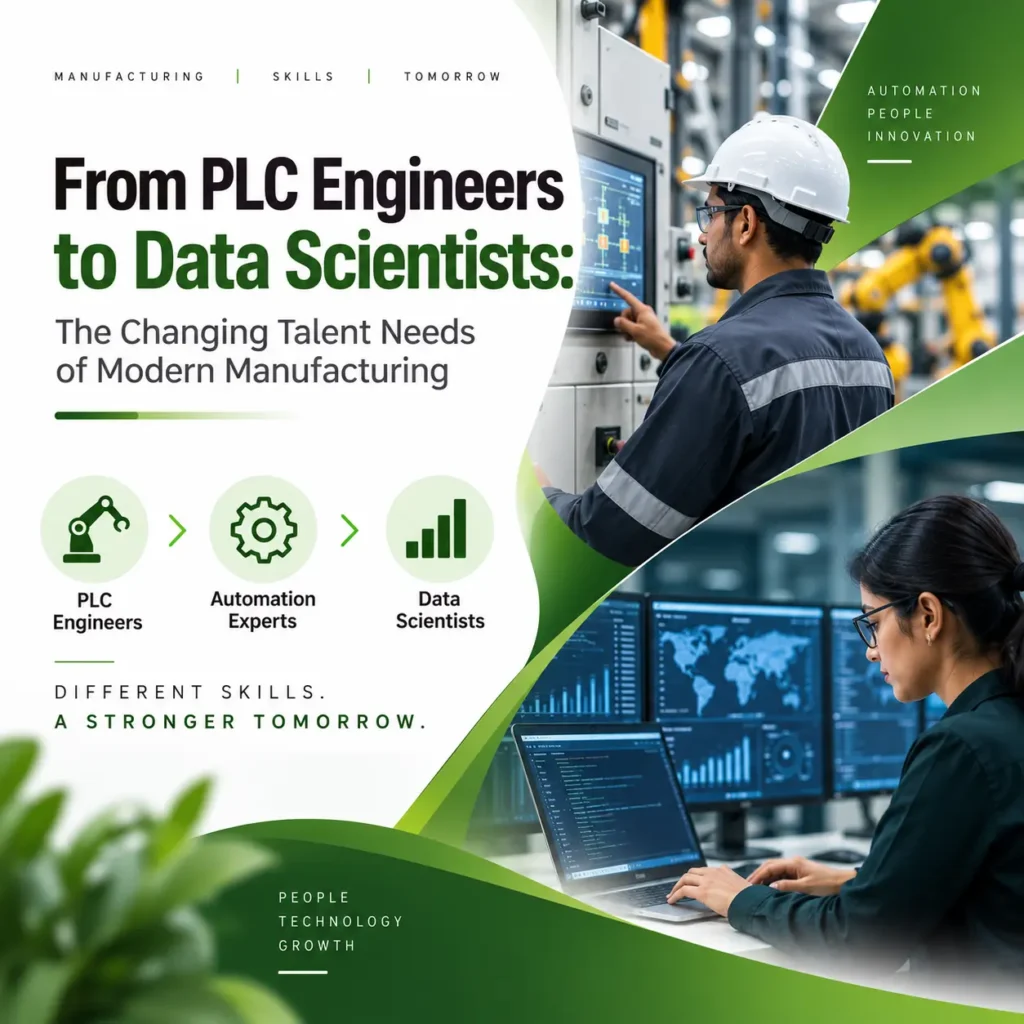
ToggleFrom PLC Engineers to Data Scientists: The Changing Talent Needs of Modern Manufacturing
Ten years ago, a strong maintenance team and a competent PLC programmer covered most of a plant’s technical hiring needs. Today, the same plant might be running predictive maintenance models, pulling sensor data into a dashboard a data scientist built, and asking its quality team to interpret machine-learning output alongside a torque spec sheet. Nobody planned for this shift to happen this fast. It just did.
Industry 4.0 talent acquisition is the hiring challenge sitting quietly underneath a lot of digital transformation initiatives in manufacturing right now — and it’s one that most internal HR teams and traditional recruitment vendors weren’t built to handle, because it doesn’t fit cleanly into either the “engineering hire” bucket or the “IT hire” bucket.
The Skill Set Manufacturing Used to Need
For most of manufacturing’s recent history, the technical hiring stack was fairly stable:
- Mechanical and electrical engineers for design and maintenance
- PLC and instrumentation engineers for automation and control systems
- Quality engineers trained on inspection standards and process control
- Production supervisors who understood shift-floor operations
These roles haven’t disappeared — they’re still the backbone of any plant. But they’re no longer the whole picture, and that’s the part catching a lot of manufacturing leadership off guard.
Why This Is Harder to Hire For Than It Sounds
The instinctive response is to treat this as two separate hiring problems: recruit engineers the traditional way, and recruit data/software talent through a tech-recruitment channel. In practice, this split creates a specific failure mode we see often.
A data scientist hired through a generic tech recruitment process may have strong modeling skills but no context for how a production line actually behaves — which means their models solve problems that don’t matter and miss the ones that do. Conversely, a PLC engineer asked to “pick up some data skills” often ends up doing surface-level dashboard work without the statistical grounding to build anything predictive.
Smart manufacturing hiring works best when it’s screened by people who understand both worlds — recruiters who can evaluate whether a data scientist candidate actually understands manufacturing context, and whether an automation engineer candidate has genuine software depth versus surface familiarity.
What's Changed: The New Layer of Manufacturing Talent
Smart manufacturing has added a second, overlapping skill layer on top of the traditional one. It’s not replacing PLC engineers and mechanical specialists — it’s sitting alongside them, and increasingly, plants need both layers working together, not in separate silos.
Data Scientists and Data Analysts
Interpreting sensor and production data to predict equipment failure, optimize throughput, and identify quality issues before they become defects on the line.
IoT and Automation Specialists
Managing the sensor networks, connected equipment, and data pipelines that feed everything from real-time dashboards to predictive maintenance systems.
Industrial Software Engineers
Building and maintaining the software layer that connects shop-floor equipment to enterprise systems — MES, ERP integration, and custom plant software.
Cybersecurity Specialists for OT Environments
Manufacturing plants are increasingly connected, which means operational technology (OT) — not just corporate IT — needs its own security expertise, a role that barely existed on a plant org chart a decade ago.
Robotics and Automation Engineers
Beyond traditional PLC programming, roles now increasingly require experience with robotic process automation, collaborative robots (cobots), and vision-based inspection systems.
This is the hiring reality behind manufacturing digital talent — plants need people who understand both the physical process and the digital layer sitting on top of it, and finding candidates who are genuinely fluent in both is harder than finding one or the other.
What "Industry 4.0 Talent Acquisition" Means
Industry 4.0 talent acquisition refers to the recruitment of hybrid technical talent for manufacturing environments undergoing digital transformation — combining traditional engineering and automation roles (PLC, mechanical, electrical, quality) with emerging digital roles (data science, IoT, industrial software, OT cybersecurity). It requires screening candidates for competency across both domains rather than treating manufacturing and technology hiring as separate recruitment tracks.
How to Actually Plan for This Shift
A few practical starting points we’d suggest to manufacturing leadership thinking through this:
Map your current gap, not just your open roles. Most plants don’t have a clear picture of which digital capabilities they’re missing until a specific project — a predictive maintenance initiative, an MES rollout — forces the issue. Mapping this ahead of a project, not during it, gives hiring far more lead time.
Don’t force digital roles into traditional engineering job descriptions. A “PLC Engineer with data analytics skills” job posting rarely attracts a strong data scientist — the framing signals the role is engineering-first, data-second, which is often not what the actual work requires.
Hire for hybrid fluency, not perfect overlap. Very few candidates will be equally expert in mechanical systems and machine learning. The goal is finding people who are strong in one domain and genuinely conversant in the other — not unicorns who are top-tier in both.
Build the team, not just the role. A single data scientist embedded in a traditionally structured plant team often struggles without a technical partner who understands both the data work and the shop floor. Pairing hires — an automation engineer with a data analyst, for example — frequently outperforms hiring either in isolation.
Where Viriksha HR Solution Fits In
Digital transformation hiring in manufacturing requires recruiters who can technically screen across both traditional engineering and emerging digital roles — which is exactly where a lot of generic staffing falls short. At Viriksha HR Solution, we apply the same three-tier screening process and 5 C’s framework (Competency, Character, Chemistry, Culture, Consistency) across this full spectrum:
- Traditional roles: PLC engineers, mechanical/electrical engineers, quality and production supervisors
- Emerging roles: data analysts, IoT and automation specialists, industrial software engineers, OT cybersecurity roles
Because we recruit across both layers, we’re positioned to help manufacturing clients across Chennai’s industrial corridors — SIPCOT, Guindy, Sholinganallur, and beyond — and Pan India build teams where the traditional and digital skill sets are evaluated together, not screened by two disconnected processes.
Frequently Asked Questions
It’s the recruitment of hybrid technical talent for manufacturing environments undergoing digital transformation — combining traditional engineering roles with emerging digital roles like data science, IoT, and industrial software engineering.
No. Traditional roles remain essential — the shift is additive, not a replacement. Plants increasingly need traditional engineering talent working alongside new digital roles, not one instead of the other.
Common emerging roles include data scientists and analysts, IoT and automation specialists, industrial software engineers, OT cybersecurity specialists, and robotics/automation engineers.
Because it requires evaluating hybrid competency — genuine understanding of both manufacturing context and digital/data skills — which most generic recruitment processes aren’t built to screen for.
By mapping current digital capability gaps ahead of specific transformation projects, writing job descriptions that don’t force digital roles into traditional engineering templates, and considering paired hiring — a digital specialist alongside a traditional engineer — rather than hiring either in isolation.