
Viriksha HR Solution
Hiring Healthcare IT Professionals
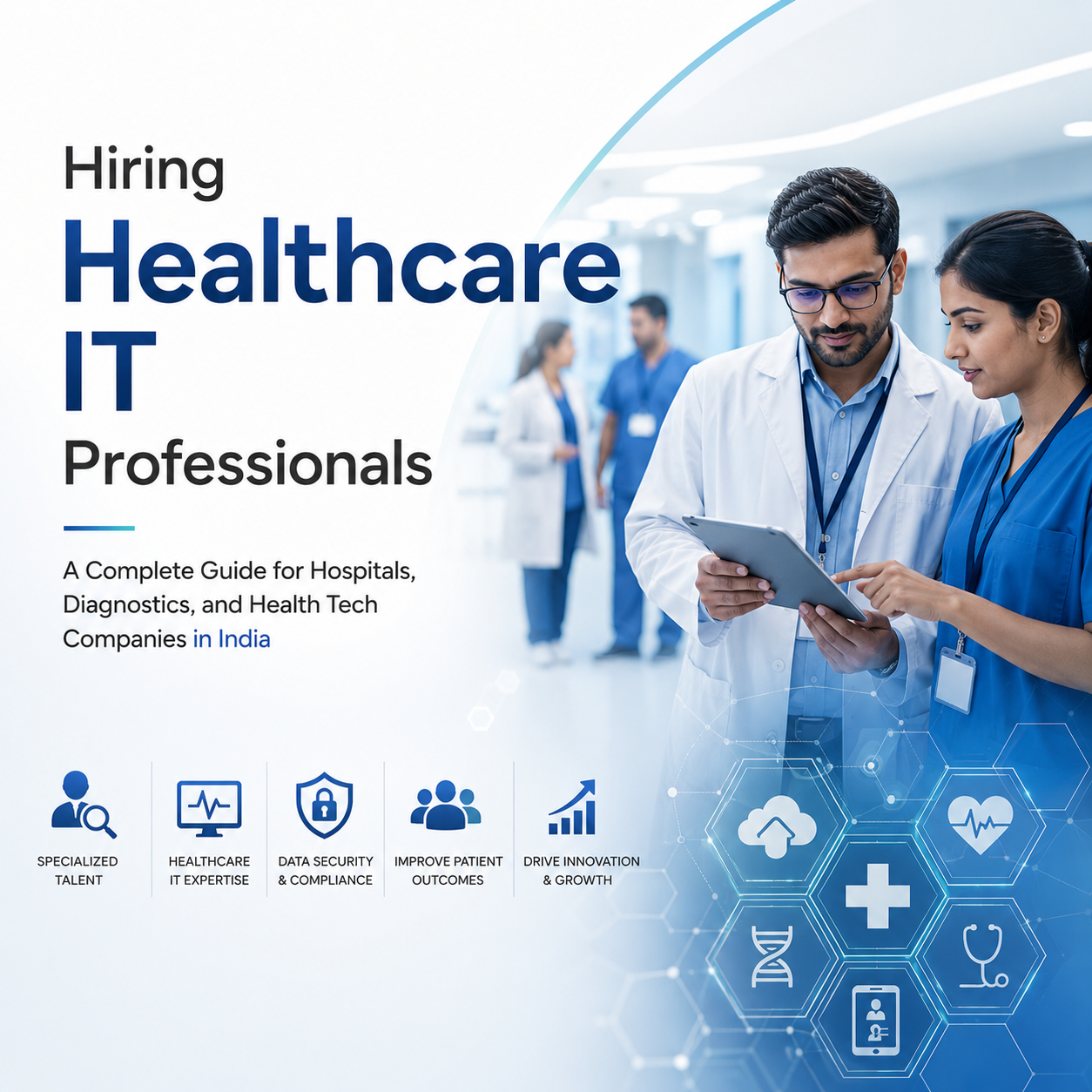
Hiring Healthcare IT Professionals: A Complete Guide for Hospitals, Diagnostics, and Health Tech Companies in India
09-06-2026 Tuesday
Table of Contents
ToggleHiring Healthcare IT Professionals
Healthcare is the industry where technology failure has consequences that no other sector experiences. A banking system outage is a financial inconvenience. A healthcare IT failure can delay a diagnosis, disrupt a surgical schedule, or compromise patient safety. The stakes attached to healthcare IT — and by extension to the quality of the people who build and manage it — are uniquely high.
In 2026, India’s healthcare sector is in the middle of the most significant technology transformation in its history. Hospital Information Systems are being replaced and integrated. Electronic Medical Records are being standardised. Telemedicine platforms are scaling from pandemic-era exceptions to permanent service delivery channels. Health data is being federated through the Ayushman Bharat Digital Mission. Diagnostics companies are deploying AI-assisted image analysis. Pharmaceutical companies are building digital clinical trial infrastructure. And health insurance companies are rebuilding their technology stacks around real-time claims processing and fraud detection.
Every one of these transformations requires people — healthcare IT professionals who understand both the clinical environment and the technology that serves it. Finding those people is the challenge this guide addresses — for hospital groups, diagnostic chains, health tech companies, pharmaceutical IT teams, health insurance technology organisations, and medical device companies across Chennai and India.
“Compliance is not a cost center. It is a trust signal — to your employees, your investors, your bank, and
your clients. In Chennai’s competitive business landscape, the companies that comply consistently are the ones that scale consistently.”
— VIRIKSHA HR SOLUTION, CHENNAI
Why Healthcare IT Recruitment Is Uniquely Difficult
Recruiting for healthcare IT is harder than recruiting for general IT — and harder than recruiting for clinical roles — because it requires a professional who sits at the intersection of both worlds.
A Hospital Information System implementation specialist who does not understand clinical workflows cannot configure the system around how doctors and nurses actually work. The result is a technically functional system that clinical staff resist — and eventually abandon. An EMR data analyst who does not understand medical coding — ICD-10, CPT, SNOMED — cannot produce analysis that the clinical team can act on. A telemedicine platform engineer who does not understand the regulatory requirements governing remote clinical consultation cannot build a compliant product.
Healthcare IT professionals are rare because the combination of clinical domain knowledge and technology capability develops slowly — through years of working within healthcare environments, not through a course or a certification. The most experienced healthcare IT professionals in India have built that knowledge through exposure to large hospital implementations, diagnostic chain deployments, or health tech product development — and they are employed, performing well, and not actively looking.
The second challenge is the regulatory complexity specific to healthcare technology in India. The Digital Information Security in Healthcare Act framework, the Ayushman Bharat Digital Mission standards for Health IDs and linked health records, CDSCO requirements for software as a medical device, and state-level clinical establishment regulations all affect how healthcare technology is designed, deployed, and governed. Professionals who understand these requirements are scarce and valuable.
Healthcare IT Roles in Demand in 2026
Hospital Information System Professionals
HIS specialists — who implement, customise, support, and upgrade the integrated software systems that manage hospital operations — are in sustained demand across India's large hospital groups. HIS covers patient registration, bed management, OPD and IPD workflows, pharmacy management, billing, and integration with clinical systems — all of which must function without interruption in a 24-hour clinical environment. HIS roles in active demand include HIS implementation consultants, HIS support engineers, HIS integration architects, hospital IT managers, and HIS project managers for large-scale hospital group roll-outs and upgrades.
EMR and Clinical Data Professionals
Electronic Medical Record systems are the clinical documentation backbone of modern hospitals — and implementing, managing, and extracting value from them requires professionals who understand both the clinical workflows the system must support and the technology that implements them. EMR professionals in demand include EMR implementation specialists, clinical informatics managers, medical coding specialists — ICD-10, CPT, DRG — health data analysts, and clinical data managers for research and regulatory submission programmes.
Telemedicine and Digital Health Platform Professionals
India's telemedicine market has grown from a pandemic emergency measure to a permanent healthcare delivery channel — with platforms serving rural health access, specialist consultation, chronic disease management, and mental health services. Building and operating these platforms requires a specific combination of healthcare domain knowledge and digital product capability. Telemedicine platform roles in demand include product managers with healthcare domain experience, backend engineers familiar with healthcare data standards — HL7, FHIR — telemedicine operations managers, patient experience designers, and regulatory affairs specialists for digital health products requiring CDSCO classification.
Health Data and Analytics Professionals
Healthcare data is the most complex and most valuable data in any industry — and the organisations that extract clinical and operational intelligence from it gain advantages in patient outcomes, operational efficiency, and population health management that are directly measurable. Health data roles in demand include healthcare data engineers, clinical data scientists, population health analysts, health economics specialists, and AI model developers for clinical decision support and medical imaging analysis applications.
Health Insurance Technology Professionals
India's health insurance sector is rebuilding its technology infrastructure around real-time claims processing, AI-assisted underwriting, fraud detection, and customer digital experience. Health insurance technology roles in active demand include claims technology developers, underwriting technology specialists, health insurance product managers, fraud analytics professionals, and TPA integration engineers.
Medical Device and Diagnostic IT Professionals
Medical device companies and diagnostic chains are investing in connected device infrastructure, remote monitoring platforms, AI-assisted diagnostic tools, and laboratory information management systems. Roles in demand include LIS implementation specialists, medical device software engineers, regulatory affairs professionals for SaMD classification, and clinical validation specialists for AI diagnostic applications.
Healthcare Cybersecurity Professionals
Patient data is among the most sensitive personal data categories under the Digital Personal Data Protection Act 2023 — and healthcare organisations are primary targets for ransomware and data breach attacks. Healthcare cybersecurity professionals who understand both information security frameworks and the clinical systems they protect are among the most sought-after profiles in health tech recruitment.
The Five Biggest Hiring Challenges in Healthcare IT Recruitment
The clinical domain knowledge gap — technology professionals with genuine clinical workflow experience are rare. Most technology professionals who claim healthcare experience have worked at the periphery of clinical systems — in billing, administration, or infrastructure — rather than in the clinical core. Assessing genuine clinical domain knowledge requires healthcare-specific screening, not a general technical interview.
The ABDM and regulatory knowledge requirement — the Ayushman Bharat Digital Mission has created a new layer of healthcare IT compliance — Health ID integration, federated health records, FHIR API standards, and data sharing protocols — that professionals must understand to work effectively in any health data role. This knowledge is recent, specific, and not widely held even among experienced healthcare IT professionals.
The 24-hour availability expectation — healthcare IT systems cannot go offline during business hours and be restored the next morning. Support and operations roles in hospital IT require professionals who understand and accept the 24-hour availability requirements of clinical infrastructure — a requirement that reduces the candidate pool for every operational role.
The compensation structure mismatch — healthcare organisations — particularly public sector hospitals and non-profit hospital trusts — frequently offer compensation structures that are below the IT market rate. The result is a talent gap where the organisation’s hiring budget does not reach the talent pool its technology complexity demands. Understanding this mismatch and structuring realistic compensation frameworks is a precondition for effective healthcare IT recruitment.
The multi-vendor environment complexity — most large hospitals operate a patchwork of systems from multiple vendors — an HIS from one supplier, an EMR from another, a PACS from a third, a billing system from a fourth — that must be integrated into a coherent data and workflow environment. Professionals who can operate effectively in this multi-vendor, multi-system complexity are more experienced and more valuable than those with single-system exposure.
Building a Healthcare IT Recruitment Strategy That Works
Define roles with clinical context — every healthcare IT job description must specify the clinical environment the professional will work in — hospital, diagnostics, pharma, health insurance, or health tech — the specific systems they will work with, the clinical workflows they must understand, and the regulatory requirements relevant to the role. Generic IT job descriptions do not attract healthcare IT professionals — they attract general IT professionals who are not equipped for the role.
Source through healthcare IT networks — the best healthcare IT professionals in India are connected to each other through professional networks — hospital IT associations, health informatics groups, HIMSS India community, and informal networks built through shared project experience at major hospital implementations. Effective healthcare IT recruitment requires a recruiter with genuine relationships in these networks — not a LinkedIn search filtered by “healthcare.”
Assess clinical domain knowledge explicitly — technical interviews for healthcare IT roles must include clinical domain assessment — not just technology assessment. An HIS implementation specialist who cannot describe a clinical admission-to-discharge workflow has domain knowledge gaps that will surface in implementation. An EMR data analyst who cannot explain the difference between ICD-10 and SNOMED-CT cannot produce clinically meaningful analysis. Domain assessment must be built into every healthcare IT interview process.
Move faster than the healthcare hiring cycle typically allows — healthcare organisations are historically slow hiring environments — multiple approval layers, lengthy committee reviews, and extended reference checking. In a talent market where good healthcare IT candidates have multiple offers, the organisation that moves through a structured process in four weeks outcompetes the organisation whose process takes twelve. Streamlining the hiring process — without removing necessary clinical and technical assessment — is a strategic priority.
Build relationships with health informatics talent pipelines — healthcare IT talent in India is produced through a specific set of academic and professional pathways — health informatics programmes, clinical informatics training, and on-the-job development within large hospital IT teams. Building relationships with these pipelines — HIMSS India events, health informatics academic programmes, and large hospital IT departments that produce talent — creates a proactive sourcing advantage that reactive job posting cannot replicate.
How Viriksha HR Solutions Recruits Healthcare IT Professionals Across India
Viriksha HR Solutions is a specialist healthcare IT recruitment partner — placing hospital IT professionals, health data specialists, telemedicine platform professionals, health insurance technology managers, diagnostic IT specialists, and healthcare cybersecurity professionals for hospital groups, diagnostic chains, health tech companies, pharmaceutical IT teams, and health insurance technology organisations across Chennai and Pan India.
Domain-specific recruitment consultants — our healthcare IT recruitment team understands the clinical environment as well as the technology. Our consultants can have a credible conversation with an HIS implementation specialist about clinical workflows, with a health data scientist about FHIR standards, and with a healthcare cybersecurity professional about the DPDP Act’s implications for patient data. That domain credibility is what allows us to represent opportunities accurately to passive candidates and assess genuine clinical domain knowledge in the professionals we shortlist.
Active healthcare IT talent network — Viriksha maintains relationships with healthcare IT professionals across Chennai’s large hospital groups — Apollo Hospitals, Fortis, MIOT International, SRM, and others — and across Pan India’s health tech ecosystem — diagnostics chains, pharmaceutical IT teams, health insurance technology organisations, and digital health startups. When a healthcare IT brief comes in, our first step is activating that network.
Healthcare IT roles Viriksha recruits for:
Hospital Information Systems — HIS implementation consultants, HIS support engineers, HIS project managers, and hospital IT managers across HMIS platforms including Infor Cloverleaf, Oracle Health, and custom HIS environments.
EMR and clinical data — EMR implementation specialists, clinical data managers, medical coding professionals, health data analysts, and clinical informatics managers.
Telemedicine and digital health — telemedicine product managers, backend engineers with HL7 and FHIR experience, digital health operations managers, and regulatory affairs specialists for SaMD applications.
Health data and analytics — healthcare data engineers, clinical data scientists, population health analysts, and AI model developers for clinical decision support and medical imaging.
Health insurance technology — claims technology developers, underwriting technology specialists, fraud analytics professionals, and TPA integration engineers.
Medical device and diagnostics IT — LIS implementation specialists, medical device software engineers, and regulatory affairs professionals.
Healthcare cybersecurity — information security managers with healthcare experience, DPDP Act compliance technology specialists, and healthcare infrastructure security engineers.
HR and compliance support for healthcare organisations — for hospital groups, diagnostic chains, and health tech companies that also need payroll management, statutory compliance, PF and ESI consultancy, and contract staffing for IT professionals, Viriksha provides the complete HR function alongside recruitment. Healthcare IT contract professionals deployed through Viriksha are employed compliantly — payroll processed before the 5th, statutory filings completed mid-month, and all statutory registers maintained.