

Viriksha HR Solution
How Businesses Should Plan Hiring Strategy for the Financial Year
04-05-2026 Monday
Table of Contents
ToggleHow Businesses Should Plan Hiring Strategy for the Financial Year
Most businesses in India approach hiring the same way they approach a fire — they respond when it starts, not before. A role opens. Urgency builds. The search begins under pressure. Compromises get made on quality, speed, or both. The hire is made. The cycle repeats.
A hiring strategy is the opposite of that. It is the decision — made at the start of the financial year, before any specific vacancy exists — about how the business will acquire the people it needs to grow. Which roles will be filled, through which sourcing model, at what cost, on what timeline, and with what quality standard.
Businesses that plan their hiring strategy at the start of the financial year consistently hire better, hire faster, and spend less per hire than businesses that don’t. This guide shows exactly how to build that strategy — for businesses in Chennai and across India.
“Compliance is not a cost center. It is a trust signal — to your employees, your investors, your bank, and
your clients. In Chennai’s competitive business landscape, the companies that comply consistently are the ones that scale consistently.”
— VIRIKSHA HR SOLUTION, CHENNAI
Why the Financial Year Start Is the Right Moment to Plan Hiring
The new financial year brings three things that are essential for hiring strategy: confirmed business targets, approved headcount, and a twelve-month horizon that is clear enough to plan against but recent enough to be accurate.
Business targets tell you where growth is coming from — which functions need to expand, which new markets or products need teams, which leadership gaps need to be filled. Approved headcount translates those targets into specific roles. The twelve-month horizon gives you the time to plan sourcing models, budget allocation, and hiring timelines by quarter — before the first urgent vacancy compresses all of those decisions into a single panicked brief.
Wait until June to start planning and you have already lost Q1. Wait until a business unit escalates a critical vacancy and you are planning under pressure — which means you are not planning at all.
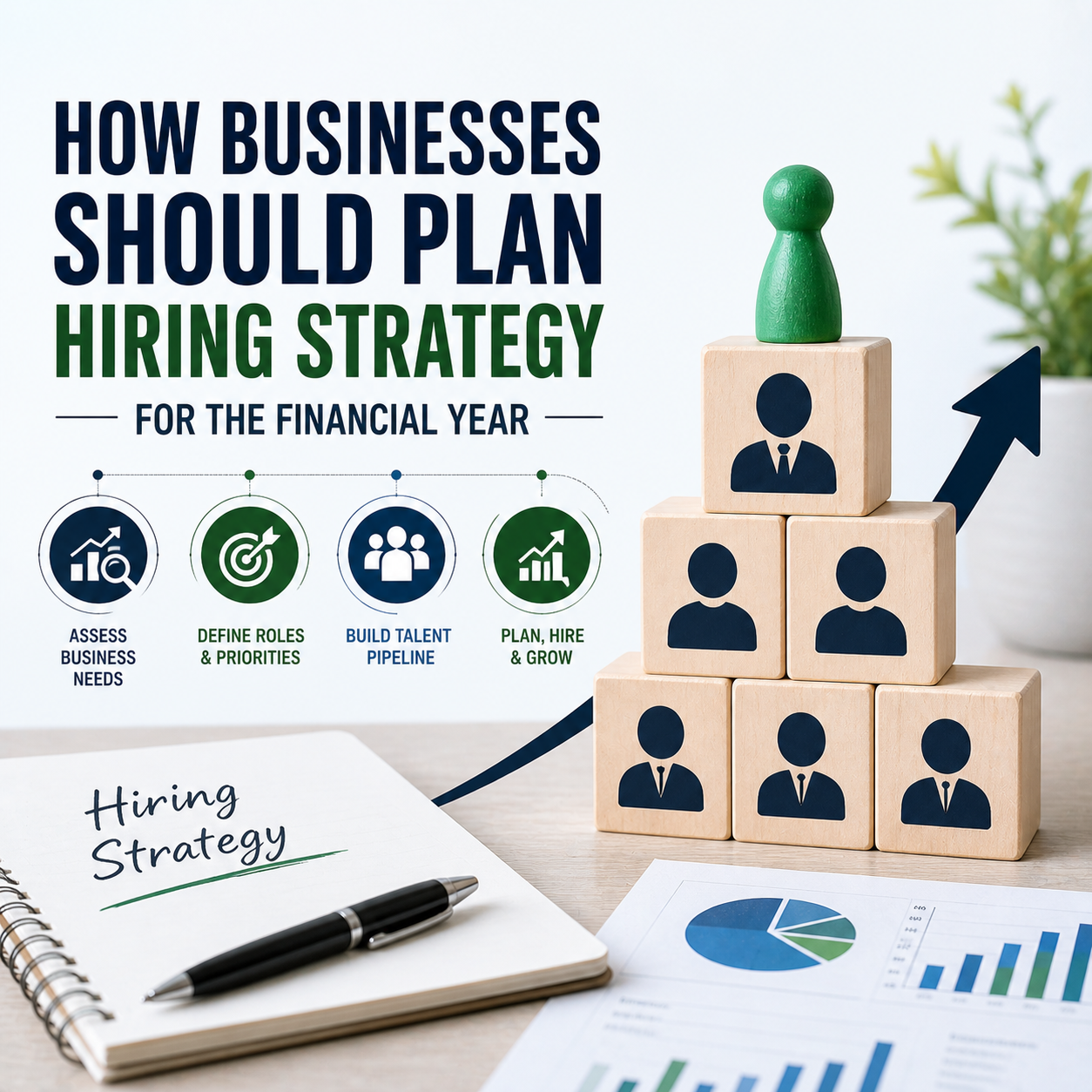
Step 1 — Build the Headcount Plan Before You Build Anything Else
Every hiring strategy starts with a confirmed headcount plan. Not a wish list. Not a provisional approval. A role-by-role, function-by-function, quarter-by-quarter plan that has been signed off by business unit heads and finance.
The headcount plan has two components that most businesses undercount.
Growth hiring — net new roles the business needs to create to deliver its targets. These are the roles that appear in business unit plans and headcount approval requests.
Backfill hiring — roles that need to be refilled due to attrition. In India, average corporate attrition across industries runs between 15% and 25% annually. For IT companies in OMR and Sholinganallur, BFSI firms in Chennai, and manufacturing businesses in Ambattur and Sriperumbudur, attrition-driven backfill can equal or exceed growth hiring in volume. A hiring strategy that plans only for growth and ignores attrition runs out of sourcing capacity by Q2.
Once the headcount plan is confirmed, classify every role by tier — junior and volume, mid-level specialist, senior management, and leadership or CXO. The tier determines the sourcing model, the cost per hire, the time-to-fill estimate, and the budget allocation. Without this classification, every role gets managed the same way — which means expensive channels are used for volume roles and inadequate channels are used for leadership mandates.
Step 2 — Match the Sourcing Model to the Role Tier
The single biggest efficiency lever in hiring strategy is sourcing model alignment — making sure the right channel is used for the right role type, rather than defaulting to the same approach for every vacancy.
Junior and volume roles — direct sourcing through job portals, campus hiring, employee referral programmes, and walk-in drives. For businesses in Chennai with regular volume requirements — manufacturing, retail, logistics, BPO — campus partnerships established at the start of the year deliver a consistent supply of candidates at significantly lower cost per hire than reactive portal usage.
Mid-level specialist roles — recruitment agency or RPO model. For businesses with more than 40 to 50 mid-level hires planned for the year, Recruitment Process Outsourcing consistently outperforms ad-hoc agency usage on cost, speed, and quality. RPO embeds the recruitment function within the HR team — managing sourcing, screening, interview coordination, and offer management — at a per-hire or monthly management fee that is substantially lower than combined internal recruiter cost and ad-hoc agency fees.
Senior management roles — retained recruitment agency search. Senior roles in Chennai’s competitive talent market — IT directors, BFSI heads, operations leaders, manufacturing plant managers — are not filled by job postings. They are filled by direct outreach to employed professionals who are not actively looking. A retained search brief with a specialist recruitment agency delivers a shortlist of evaluated, genuinely interested candidates within two to four weeks — faster and at lower total cost than a three-month internal search that ends with the same candidates.
Leadership and CXO mandates — executive search. Leadership vacancies are the most expensive to leave open — in lost momentum, team uncertainty, and deferred decisions. Executive search firms with genuine networks in the relevant sector and function should be briefed at the start of the year on anticipated leadership needs — including succession planning gaps — so searches begin before urgency drives every decision.
Step 3 — Build the Recruitment Budget From the Bottom Up
A recruitment budget built from the top down — “we spent ₹X last year, let’s add 10%” — is a budget that has no relationship to what the business actually needs to hire. A recruitment budget built from the bottom up — role by role, tier by tier, sourcing model by model — is a budget that finance will approve because it is defensible, and that HR will actually be able to deliver within.
The bottom-up approach works like this: take the confirmed headcount plan. Classify every role by tier. Apply the appropriate cost per hire for each tier and sourcing model. Add attrition-driven backfill at the expected rate. Add background verification costs — per candidate, across all check types. Add relocation and joining costs for outstation hires. Add employer branding investment if brand is a strategic priority. Add a 10% to 15% contingency for urgent or unplanned hires.
The total is your recruitment budget. The line items are your justification.
Benchmark cost per hire by tier for Chennai and Pan India: Junior and volume roles — ₹15,000 to ₹40,000 per hire through direct sourcing. Mid-level specialist roles — 8% to 12% of annual CTC through recruitment agency. Senior management — 15% to 20% of annual CTC through retained agency search. Leadership and CXO — 20% to 25% of annual CTC through executive search.
Step 4 — Set Time-to-Fill Targets and Work Backwards
A hiring strategy without time-to-fill targets is a plan with no timeline. Time-to-fill targets define when each hire must be in place — and working backwards from that date tells you when the search must begin.
Benchmark time-to-fill for India: Junior and volume roles — 2 to 4 weeks from brief to joining. Mid-level specialist roles — 6 to 10 weeks from brief to joining, including notice period. Senior management — 12 to 18 weeks from brief to joining, including 60 to 90 day notice period. Leadership and CXO — 16 to 24 weeks from brief to joining.
The notice period reality is the most commonly missed input in hiring planning for India. A mid-level role needed in August requires an offer in May. A senior leadership role needed in October requires a search brief in June. Businesses that ignore notice periods consistently find themselves managing critical vacancies that were theoretically “in progress” for months — because the search started too late to account for the joining timeline.
Apply these timelines to your quarter-by-quarter headcount plan and you get the answer to the question most businesses never ask at the start of the year: if we need this person by Q3, when do we need to start looking?
Step 5 — Plan for Employer Brand, Not Just Job Postings
In Chennai and across India’s competitive talent markets, employer brand increasingly determines whether the right candidates engage with your opportunity — or scroll past it.
Employer brand is not a marketing function. It is a hiring function. Businesses with strong employer brand in their sector and location receive more applications per posting, attract higher-quality candidates at each sourcing touchpoint, and convert offers at higher rates. Businesses without brand compete on salary alone — and in a market where every employer is competing for the same talent pool, competing on salary alone is a race to a budget ceiling.
New financial year hiring strategy is the right moment to make one concrete investment in employer brand — a refreshed career page, a structured employee story content plan, a consistent presence on LinkedIn, or a campus engagement programme in the institutions that produce the talent the business needs. None of these require large budgets. All of them compound in value over the year.
Step 6 — Build a Talent Pipeline Before the Vacancy Opens
The gap between a planned hire and a reactive hire is usually a talent pipeline — or the absence of one. A talent pipeline is a live, maintained set of relationships with qualified candidates who are not yet actively looking but would consider a move for the right opportunity.
For businesses with predictable hiring patterns — the same function, the same level, the same skills, recurring every quarter — a talent pipeline eliminates the cold start on every search. The brief goes out. The pipeline is activated. The shortlist is ready in days rather than weeks.
Building a talent pipeline is not a passive exercise. It requires consistent outreach, a genuine value proposition to offer candidates who are not looking, and a recruiter or recruitment partner who maintains the relationships actively. Most internal HR teams do not have the bandwidth to do this alongside reactive hiring — which is why businesses that use a recruitment agency or talent acquisition partner for pipeline building consistently outperform those that attempt it alone.
Speak to Viriksha HR Solutions today
Speak to Viriksha HR Solutions today and build your hiring strategy for the financial year before the first vacancy opens.
How Viriksha HR Solutions Helps Businesses Build and Execute Their Hiring Strategy
Viriksha HR Solutions works with businesses across Chennai and Pan India at every stage of the hiring strategy cycle — from financial year planning through to offer management and onboarding.
At the start of the financial year, our talent acquisition consultants work with HR leadership to translate business targets into a role-level hiring plan, classify roles by tier, design the sourcing model for each tier, and build a month-by-month delivery timeline that accounts for notice periods and joining windows.
Viriksha's recruitment agency team manages end-to-end hiring for mid-level specialist roles across IT, BFSI, manufacturing, healthcare, logistics, and professional services — delivering evaluated shortlists within 5 to 7 working days, with one dedicated recruitment consultant owning every brief.
For businesses with 40 or more mid-level hires planned for the year, our RPO model embeds our team within your HR function — managing sourcing, screening, interview coordination, offer management, and onboarding as a fully integrated service at a per-hire cost that consistently beats the combination of internal recruiter cost and ad-hoc agency fees.
Our executive search practice manages CXO, VP, Director, and Business Head mandates with a dedicated consultant, direct candidate outreach, structured assessment, and a shortlist of genuinely qualified leaders — typically within 6 to 10 weeks of a confirmed brief.
Background verification
Every hire placed through Viriksha includes BGV coordination — education, employment, address, police verification, and reference checks — integrated into the offer timeline so joining is not delayed by verification that starts after the offer is accepted.
Recruitment budget benchmarking
For HR leaders who need to present a data-backed recruitment budget to finance, our team provides compensation benchmarking and cost-per-hire data for key role types across Tamil Nadu and Pan India.
A hiring strategy built at the start of the financial year and executed with the right partner does not just fill roles faster. It builds the team the business actually needs — at the cost the business actually planned for — on the timeline the business actually requires.