

Viriksha HR Solution
Payroll Outsourcing: Benefits, Process, and Business Impact
Payroll Outsourcing: Benefits, Process, and Business Impact for Businesses in India
15-06-2026 Monday
Table of Contents
TogglePayroll Outsourcing: Benefits, Process, and Business Impact for Businesses
Payroll is the one HR function that every employee experiences directly — and the one function that cannot afford to be wrong. A salary paid late damages trust in ways that take months to rebuild. A statutory deduction calculated incorrectly creates a compliance liability that compounds with interest. A PF ECR that does not match the Wage Register triggers an EPFO inquiry. A missed ESI deadline attracts 12% per annum interest from day one.
For most businesses in Chennai and across India, payroll is simultaneously the most important monthly process and the most resource-intensive one to manage correctly. It requires payroll accounting expertise, statutory compliance knowledge, deadline discipline, and the ability to manage exceptions — mid-month joiners, salary revisions, variable pay, full and final settlements — without errors that affect the routine payroll for everyone else.
Payroll outsourcing is the decision to stop managing this complexity internally and engage a specialist provider who manages it completely — so the business gets accurate salaries, clean filings, maintained registers, and a compliance record that holds up to any scrutiny, every month, without consuming internal bandwidth.
This guide covers everything businesses in India need to know about payroll outsourcing — the benefits, the process, the cost impact, the risks of getting it wrong, and how Viriksha HR Solutions delivers it across Chennai and Pan India.
What Is Payroll Outsourcing?
Payroll outsourcing is the engagement of a specialist external provider to manage the complete monthly payroll cycle — including salary calculation, statutory deduction computation, payslip generation, bank transfer file preparation, PF and ESI filing and remittance, Professional Tax payment, TDS management, statutory register maintenance, and monthly compliance reporting — on behalf of the client business.
The distinction between payroll processing and payroll outsourcing matters. Payroll processing is the calculation of salaries. Payroll outsourcing is the management of the complete function — processing plus everything that surrounds it. A payroll processing vendor calculates salaries when you send them inputs. A payroll outsourcing partner reconciles attendance data before calculating, flags anomalies before processing, manages all statutory filings independently, maintains every required register, and provides a monthly compliance report confirming that every obligation has been met.
For businesses in India, where payroll is directly connected to statutory obligations under the EPF Act, the ESI Act, the Income Tax Act, the Professional Tax legislation of every applicable state, and the Labour Welfare Fund Act — payroll outsourcing is not just an operational convenience. It is a compliance management decision.
The Benefits of Payroll Outsourcing — Why Businesses Choose It
Benefit 1 — Complete Statutory Compliance Without Internal Expertise
India’s payroll compliance framework spans multiple central acts and state-specific legislation — each with its own calculation requirements, its own filing deadlines, and its own penalty regime. Managing all of it correctly requires expertise that most businesses do not have in-house — and cannot justify hiring in-house for the volume of work it involves.
Payroll outsourcing provides access to that expertise as a service. The payroll outsourcing provider knows that PF must be calculated on basic wages and dearness allowance — not gross wages. They know that ESI must be calculated on total gross wages — including all allowances and overtime. They know that the TDS calculation must be revised when a bonus is paid. They know that the Professional Tax slab in Tamil Nadu is different from Karnataka is different from Maharashtra. And they implement all of this correctly every month — without the client having to know any of it or monitor any of it.
Benefit 2 — Deadline Discipline That Never Slips
The statutory deadlines attached to payroll are fixed and unforgiving. PF ECR by the 15th. ESI challan by the 15th. TDS deposit by the 7th. Form 24Q within 31 days of quarter end. Late payment of PF contributions attracts interest at 12% per annum under Section 7Q — plus damages under Section 14B that can reach 25% of the arrear amount per annum. Late ESI remittance attracts 12% per annum interest. Late TDS deposit attracts 1.5% per month.
A business that manages payroll internally will miss a deadline eventually — when the payroll executive is on leave, when the bank has a technical issue, when inputs arrive late, or simply when the process has too many manual steps to complete before the deadline every single month.
A payroll outsourcing provider manages deadlines as a core function — with internal target dates set five working days before every statutory deadline, backup processes for every step, and a compliance calendar that tracks every obligation for every client across every applicable state.
Benefit 3 — Statutory Registers Maintained as Standard
The most significant gap between a payroll software vendor and a genuine payroll outsourcing provider is statutory register maintenance. Most payroll software calculates salaries and generates payslips. It does not maintain the Wage Register, Muster Roll, Leave Register, Overtime Register, Employee Register, and Holiday Register in the prescribed format required by the Tamil Nadu Shops & Establishments Act and applicable central labour laws.
These registers are what a labour inspector asks for first. A business whose registers are not maintained — or not maintained correctly — faces a notice during an inspection regardless of how current its PF and ESI filings are. Register maintenance must be part of the payroll outsourcing scope — not an optional add-on.
Benefit 4 — Management Bandwidth Recovered
The internal cost of payroll management is almost always understated — because it includes management time that does not appear on a payroll budget. The HR executive who spends three days processing payroll every month, the finance manager who reviews and approves it, the director who fields the compliance query from EPFO, the founder who handles the salary dispute because the HR executive is already at capacity — all of this management bandwidth is consumed by payroll and unavailable for the business activities it should be driving.
Payroll outsourcing recovers this bandwidth completely. The outsourcing provider owns the process. The client’s involvement is limited to approving the final payroll summary before salary transfer — a 30-minute review rather than a three-day process.
Benefit 5 — Scalability Without Headcount
As the business grows — from 30 employees to 100, from one location to four — the payroll function grows in complexity proportionally. More employees means more calculations, more statutory filings, more register entries, more joiner and leaver processing, and more exceptions to handle. Managing this growth with internal headcount means hiring more payroll staff — with the associated recruitment cost, training investment, and management overhead.
A payroll outsourcing provider scales with the business. Adding 50 employees does not require hiring an additional payroll executive. Opening an office in a new state does not require building compliance expertise in that state’s legislation from scratch. The outsourcing provider’s infrastructure — expertise, systems, and processes — absorbs the growth without the client having to build any of it.
Benefit 6 — Error Reduction and Accuracy
Payroll errors are expensive — not just in the cost of correction but in the trust they erode. An employee who receives an incorrect salary in three out of twelve months has a legitimate grievance that affects their relationship with the employer and, over time, their decision to stay.
Payroll outsourcing providers manage accuracy through structured processes — multiple verification checkpoints between input and output, cross-referencing of calculations against previous months to identify anomalies, and a review layer before every payroll is finalised. The error rate in a professionally managed payroll outsourcing engagement is significantly lower than the error rate in an internally managed process where the same person calculates and reviews their own work.
Benefit 7 — Cost Savings Relative to In-House
The cost comparison between payroll outsourcing and in-house payroll management consistently favours outsourcing for businesses under 300 employees. An in-house payroll function for a 100-employee business in Chennai requires at minimum a payroll executive at ₹25,000 to ₹45,000 per month and a compliance manager at ₹40,000 to ₹65,000 per month — plus employer contributions on their salaries, HRMS and payroll software subscriptions, and the accumulated cost of the errors and compliance gaps that in-house teams produce when managing a function that requires specialisation across multiple domains.
A payroll outsourcing engagement for the same business typically costs significantly less — while delivering deeper expertise, broader coverage, and zero accumulated compliance liability.
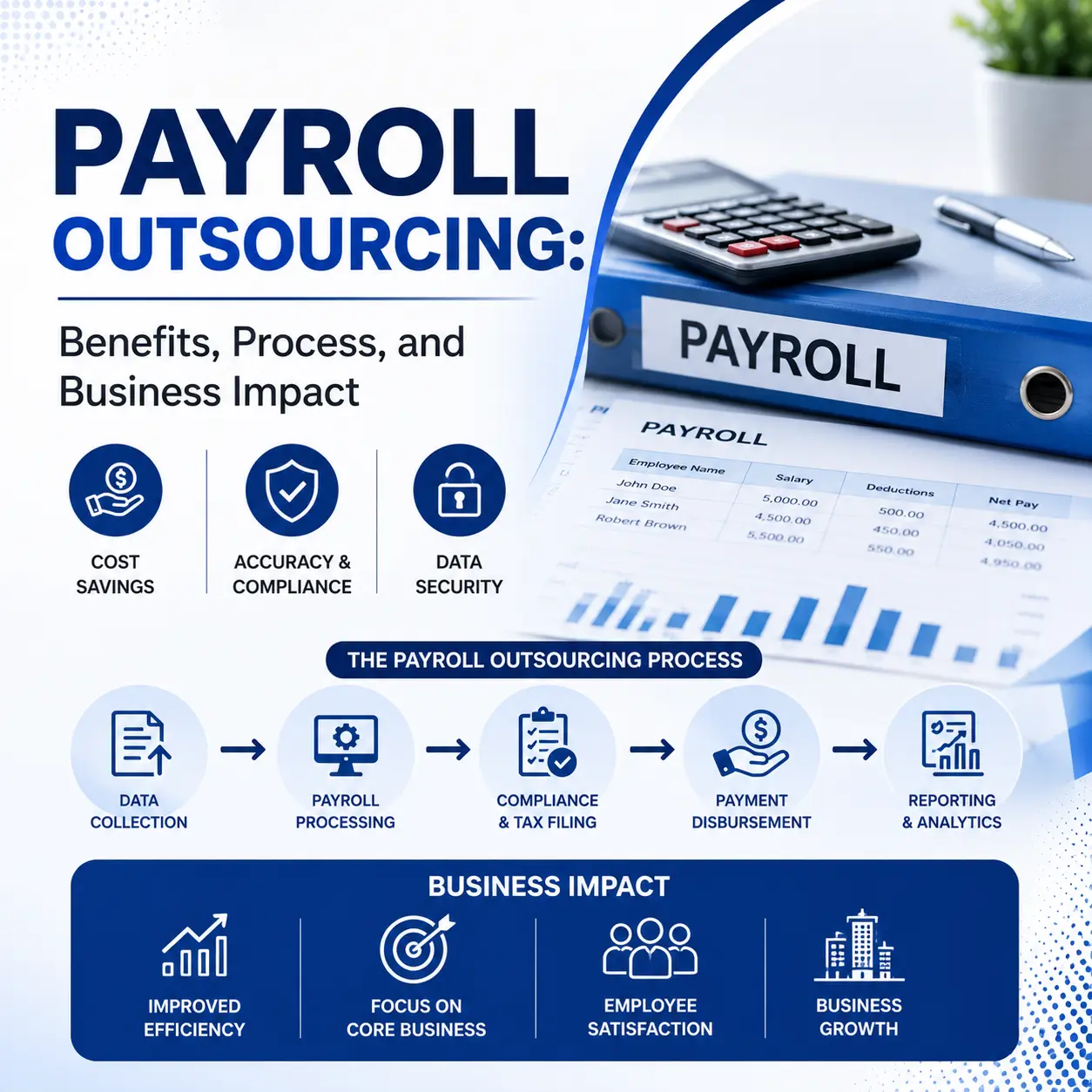
The Payroll Outsourcing Process — What Actually Happens Every Month
Understanding the payroll outsourcing process — exactly what happens, in what sequence, with what inputs and outputs — is the foundation of evaluating any provider. Here is the complete monthly cycle that a genuine payroll outsourcing engagement should deliver.
Week 1 — Attendance Data Collection and Reconciliation
The payroll outsourcing cycle begins with data collection. The provider collects attendance inputs from the client’s attendance system — biometric device export, HRMS data, or manual records — and reconciles them before processing begins.
Reconciliation means identifying and resolving discrepancies — employees marked present in the biometric system who are on approved leave, attendance data that does not match the shift schedule, overtime hours that need to be confirmed against supervisor approval. Every discrepancy is flagged to the client’s HR team for confirmation before the payroll is processed.
This step is what separates a genuine payroll outsourcing provider from a basic payroll processor. A payroll processor receives inputs and calculates. A payroll outsourcing provider verifies inputs before calculating — because errors that enter at the attendance stage compound through every downstream calculation.
Week 1 to 2 — Salary Calculation and Statutory Deduction
Once attendance data is confirmed, the salary calculation begins. Gross salary is calculated for every employee based on current salary structures — including pro-rated amounts for mid-month joiners and leavers, variable pay components, overtime pay at the applicable rate, and any other compensation components applicable for the month.
Statutory deductions are applied to every employee — PF at 12% of basic wages and dearness allowance from the employee, ESI at 0.75% of gross wages, Professional Tax at the applicable state slab rate, Labour Welfare Fund as per state schedule, and TDS computed under the employee’s declared tax regime and revised where any change in salary or declaration has occurred.
Full and final settlement calculations for employees who have left during the month — outstanding wages, leave encashment, notice pay where applicable, and proportionate gratuity for eligible employees — are calculated and verified separately before being included in the month’s payroll.
Week 2 — Payroll Review and Client Approval
Before any salary is processed, the complete payroll is presented to the client for review and approval. The payroll review pack includes a payroll summary — total gross wages, total statutory deductions, total net wages, headcount movement — and the individual calculation for every employee.
The client reviews and approves the payroll. Any corrections — a salary revision that was missed, a bonus that was not included in the inputs, an employee whose leave data was incorrect — are made before processing, not after. This approval checkpoint is the quality control gate between processing and payment.
Week 2 to 3 — Salary Disbursement and Statutory Filing
Once payroll is approved, the bank transfer file is generated and provided to the client’s finance team for salary disbursement. Salaries are credited to employee accounts on the agreed date — typically before the 5th of the month for payroll outsourcing clients.
Simultaneously, statutory filings are initiated. The PF ECR is generated from payroll data, verified against employee records, and uploaded to the EPFO portal — with challan generated and remittance completed before the 15th. The ESI challan is remitted before the 15th. Professional Tax is remitted to the applicable state authority before the state-specific deadline. Labour Welfare Fund contributions are made as per the applicable state schedule.
Week 3 to 4 — Statutory Register Updates and Monthly Report
As a standard deliverable in the same payroll cycle, all statutory registers are updated — the Employee Register for any joiner and leaver movements, the Wage Register with the complete salary calculation for every employee, the Muster Roll with attendance entries for the month, the Leave Register with leave accruals and availed leave, and the Overtime Register for any overtime worked.
A monthly compliance report is prepared and delivered to the client before the 5th of the following month — covering total payroll cost by department, headcount movement, all statutory fiabilities for the month, and proof of every filing made. This report is the client’s evidence of compliance — the document they can produce to any auditor, inspector, or investor to demonstrate that every statutory obligation for the month was met.
Payroll Outsourcing for Special Situations
Multi-Location and Pan India Payroll
Managing payroll across multiple states is not simply a question of processing more salaries — it is a question of applying different state-specific compliance rules in every state simultaneously. Professional Tax rates and slabs differ by state. Minimum wage rates differ by state, by industry, and by employee category. Labour Welfare Fund contribution schedules differ. Shops & Establishments Act registration requirements differ.
Payroll outsourcing for multi-location businesses provides state-specific compliance management in every state — correct PT slabs, correct minimum wage verification, correct LWF schedules, and correct register formats — from a single engagement with one point of contact and one unified monthly compliance report covering every location.
International and Cross-Border Payroll
For businesses with employees based outside India — in GCC countries, Southeast Asia, or other international locations — payroll outsourcing provides cross-border salary management, international payment coordination, applicable statutory compliance in the country of employment, and documentation management for every internationally deployed employee.
Contract Staffing Payroll
For businesses engaging contract workers through a staffing agency as employer of record, payroll outsourcing manages the complete employment and compliance relationship for every deployed worker — salary processing, PF and ESI contributions, PT deductions, LWF, and statutory registers — with salary credited to workers before the 5th of every month and all statutory filings completed mid-month.
Payroll for Small Businesses
Small businesses — under 50 employees — are frequently excluded from payroll outsourcing conversations because they assume the service is priced for larger organisations. The reality is that small businesses carry identical statutory compliance obligations to large ones — the same PF Act, the same ESI Act, the same minimum wage requirements, the same register maintenance obligations — and face the same penalties for non-compliance. Payroll outsourcing for small businesses is priced on a per-employee model with no minimum headcount requirement — and at a monthly cost that is almost always lower than what a part-time payroll executive would cost.
The Business Impact of Payroll Outsourcing — What Changes When You Switch
The business impact of payroll outsourcing is visible almost immediately — typically within the first two to three payroll cycles after the engagement begins.
Payroll errors fall to near zero
Payroll errors fall to near zero — because the structured process eliminates the manual steps where errors originate. Employees stop raising salary queries. HR stops spending time investigating and correcting payroll discrepancies.
Compliance notices stop arriving
Compliance notices stop arriving — because every filing is completed before its deadline, every contribution is calculated on the correct wage base, and every register is maintained in the correct format. The EPFO and ESIC portal histories show clean, on-time remittances for every month. There is nothing for an inspector to find.
Management bandwidth is recovered
Management bandwidth is recovered — the founder stops thinking about payroll. The HR executive stops spending three days a month on it. The finance manager stops chasing the payroll team for the bank transfer file. These hours go back into the business.
Employee trust improves
Employee trust improves — salaries arrive on the same date every month, payslips are correct, and PF accounts reflect accurate contributions. Employees stop raising payroll concerns — which means HR stops managing payroll grievances and starts managing the things that actually improve the organisation.
Compliance records become an asset
Compliance records become an asset — when an investor conducts due diligence, when an acquirer reviews the business, when a large client asks for evidence of statutory compliance, the payroll outsourcing client can produce twelve months of clean compliance reports, complete statutory filing records, and well-maintained registers. The compliance record becomes evidence of organisational quality — not a source of anxiety.
Common Payroll Outsourcing Mistakes to Avoid
Outsourcing payroll but not compliance — the most expensive mistake. If the payroll outsourcing engagement does not include statutory register maintenance, minimum wage monitoring, and POSH compliance, it is payroll processing — not payroll outsourcing. The compliance risk remains entirely with the client.
Choosing a provider based on price alone — a payroll outsourcing engagement that is priced below market is priced below market for a reason. The provider is cutting scope, cutting quality, or both. The consequences — compliance gaps, missed deadlines, incorrect calculations — cost significantly more than the saving on the monthly fee.
Not reviewing the monthly compliance report — the monthly report is the evidence that the outsourcing is working. Business owners who do not review it have no visibility into whether their compliance obligations are actually being met.
Failing to inform the provider of business changes — new joiners, salary revisions, new office locations, changes in contract worker arrangements — every business change that affects payroll must be communicated to the provider before the affected payroll cycle. Changes that are not communicated create errors that the provider cannot catch because they were never told.Not integrating payroll with HR — payroll outsourcing that operates in isolation from recruitment and HR documentation creates onboarding gaps — new joiners who are hired through one process but enrolled in PF and ESI through a separate process, with delays that create compliance exposure during the gap period.
How Viriksha HR Solutions Delivers Payroll Outsourcing Across Chennai and Pan India
Viriksha HR Solutions is a trusted payroll outsourcing provider for businesses across Chennai, Tamil Nadu, and Pan India — managing the complete monthly payroll cycle for businesses from 15 to 500 employees, across every industry, and across every state the business operates in.
Every Viriksha payroll outsourcing engagement follows the structured monthly process described in this guide — attendance data collection and reconciliation, salary calculation with all statutory deductions, client review and approval, salary disbursement, statutory filing and remittance, statutory register updates, and monthly compliance report — delivered as a coordinated monthly output with a dedicated payroll manager who owns every deliverable.
What every Viriksha payroll outsourcing client receives:
Complete salary processing — gross calculation, all statutory deductions on the correct wage base, payslips, and bank transfer file. PF ECR generated, verified, and uploaded before the 15th — every month. ESI challan remitted before the 15th — every month. Professional Tax remitted before the applicable state deadline. Labour Welfare Fund contributed as per state schedule. TDS calculated under the correct regime for every employee, revised after every mid-year change, and deposited before the 7th. Statutory registers — Wage Register, Muster Roll, Leave Register, Overtime Register, Employee Register, Holiday Register — maintained as a standard monthly deliverable. Monthly compliance report covering all statutory liabilities and filing proofs, delivered before the 5th of the following month.
Additional services integrated with payroll outsourcing:
PF and ESI consultancy — UAN creation, KYC seeding, nomination filing, transfer and withdrawal support, EPFO and ESIC inspection support, and notice response management.
Multi-state compliance — state-specific PT slabs, minimum wage verification, and LWF schedules for every state in which the client operates.
Contract staffing payroll — salary credited to contract workers before the 5th, all statutory filings completed mid-month, statutory registers maintained for every deployed worker.
Annual compliance — Form 24Q Q4 filing, Form 16 generation and issuance before June 15, ESI half-yearly return filing, annual bonus calculation and payment support, gratuity liability computation.
HR integration — for clients who also take recruitment, contract staffing, and statutory compliance services from Viriksha, payroll is fully integrated with the complete HR function — so every hire is onboarded correctly, every contract worker is enrolled immediately, and every compliance obligation is met from the first day of employment.
The Viriksha payroll calendar — what happens and when:
Before 10th — attendance data collected, reconciled, and payroll calculation completed. Before 15th of month — payroll approved, salaries credited. Before 15th — PF ECR uploaded and challan remitted. Before 15th — ESI challan remitted. Before state deadline — PT remitted. Before 7th of following month — TDS deposited. Before 5th of following month — monthly compliance report delivered. Ongoing — statutory registers updated, joiner and leaver compliance managed.Payroll outsourcing with Viriksha means one thing above everything else — payroll is no longer something the business manages. It runs. Accurately, compliantly, on time. Every month. Without the business having to think about it.