
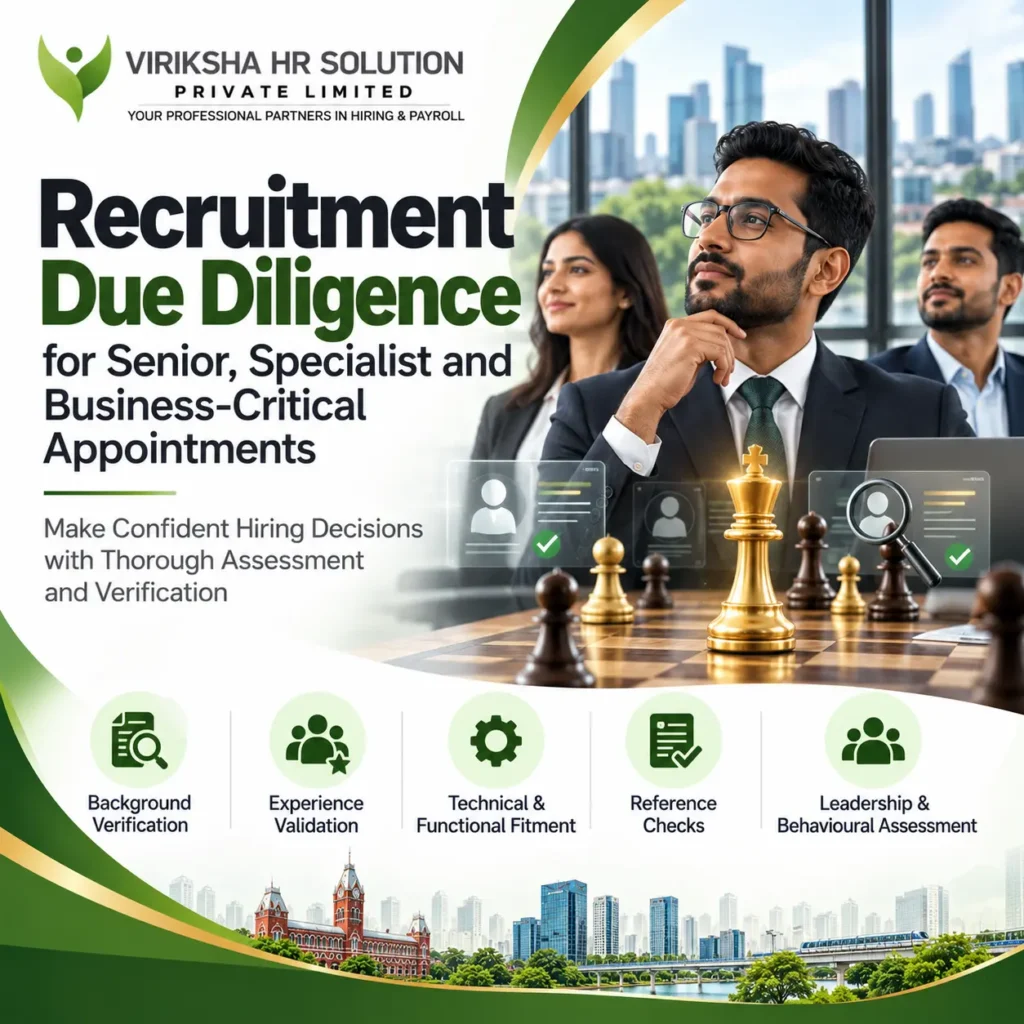
Recruitment Due Diligence for Senior,
Specialist and Business-Critical Appointments

Table of Contents
ToggleRecruitment Due Diligence for Senior, Specialist and Business-Critical Appointments
Some hires are quietly forgiving. If an executive assistant or a junior analyst isn’t the right fit, the damage is limited and usually reversible. Other appointments aren’t forgiving at all. A plant head who can’t hold a production line together, a CFO whose track record was polished in the interview, a lead architect hired for depth that turns out to be breadth. These decisions shape budgets, teams and customer relationships for years, and they’re often made on a handful of conversations and a well-written resume.
Recruitment due diligence is the discipline of treating those appointments the way a business treats an acquisition: verifying the claims, testing the evidence and understanding the risks before committing. This guide explains what it covers, when it’s worth doing, what a rigorous process looks like and how to run one without turning hiring into an interrogation.
What Is Recruitment Due Diligence?
Recruitment due diligence is a structured process of verifying a candidate’s claimed skills, achievements, work history, references and role fit before an offer is made, with the depth of checking matched to the seniority and business impact of the appointment. It goes beyond standard screening by testing evidence rather than accepting claims, and by assessing risk areas such as leadership track record, integrity, cultural fit and likelihood of retention. It is most valuable for senior, specialist and business-critical roles where a wrong hire is expensive to reverse.
Why Senior and Business-Critical Hires Need More Than a Standard Process
Standard hiring is built for volume and speed. Senior hiring has different risks:
- Claims are harder to check. Senior achievements are often team outcomes, so “I led a turnaround” can describe leading it, joining it or watching it.
- Interviews reward presentation. Experienced candidates interview well. That is a skill, and it isn’t always the skill the job needs.
- The best candidates are passive. Senior talent rarely applies, so the pool is smaller and information is thinner.
- The cost of failure compounds. A senior mis-hire affects the team they build, the decisions they make and the people who leave because of them.
- Reversal is slow and visible. Exiting a senior leader takes months and carries reputational cost.
Standard Screening vs Recruitment Due Diligence
| Factor | Standard Screening | Recruitment Due Diligence |
|---|---|---|
| Typical roles | High-volume, early to mid-level | Senior, specialist, business-critical |
| Basis of assessment | Resume, interview, basic references | Evidence-tested claims, structured technical and leadership assessment, deeper references |
| Focus | Can they do the job? | Can they do the job, will they succeed here, and what are the risks? |
| Reference approach | Courtesy confirmation | Structured conversations with specific, probing questions |
| Output | Shortlist | Shortlist plus assessment report with strengths, gaps and risks |
| Time investment | Short | Longer, concentrated on a few finalists |
The Five Layers of Recruitment Due Diligence
| Layer | What Is Verified | Typical Methods |
|---|---|---|
| 1. Credentials and history | Employment dates, designations, education, certifications | Document review and verification with the issuing institution or employer, with consent |
| 2. Achievement verification | Whether claimed results are real, and what role the candidate played | Detailed project walkthroughs, metrics, cross-checks with references |
| 3. Capability depth | Technical, functional or leadership skill at the level required | Structured technical assessment, case discussions, scenario questions |
| 4. Reference and reputation | How others experienced working with the candidate | Multiple structured references, including at least one that wasn’t supplied by the candidate where appropriate and permitted |
| 5. Fit and risk | Cultural fit, motivation, retention risk, notice and compensation alignment | Manager-level conversations, expectation alignment, counter-offer readiness |
No single layer is decisive. The value comes from how they cross-check each other. A claim that survives all five is far more reliable than one that survives an interview.
A Worked Example: What One Wrong Senior Hire Can Cost
This is an illustration, not a client case. Assume a senior leader hired at ₹60 lakh annual CTC, which is ₹5 lakh a month.
| Cost Element | Approximate Impact |
|---|---|
| Salary paid for eight months before the exit | ₹40 lakh |
| Replacement search and the vacancy that follows (three to four more months) | Months of unfilled leadership |
| Team disruption: attrition, delayed decisions, lost momentum | Hard to quantify, often larger than the salary |
| Second search and a second notice period | Another full cycle |
Even before counting disruption, the visible cost is ₹40 lakh in salary for a misfit. Against that, a few extra weeks of structured verification on the final two or three candidates is a small, proportionate investment.
When Is Recruitment Due Diligence Worth It?
It’s not for every hire. It makes sense when the answer to any of these is yes:
| Question | Why It Matters |
|---|---|
| Does the role carry P&L, budget or major decision authority? | Errors scale with authority |
| Does it lead a team, function or plant? | Impact multiplies across people |
| Is the skill rare or hard to replace quickly? | Vacancy and reversal costs rise |
| Is the role customer-facing at a senior level? | Reputation risk |
| Does it involve access to sensitive data, finances or IP? | Integrity matters more |
| Is the hire confidential, or replacing someone sensitively? | Discretion and judgement matter |
For Chennai businesses, this typically means plant heads and GMs in SIPCOT and Oragadam, GCC and R&D leaders along OMR, senior finance and operations leaders, and niche technology architects.
Common Mistakes in Senior and Critical Hiring
Treating the interview as the verification
An interview shows how someone presents, not whether the claims hold.
Relying only on candidate-supplied references
These are curated by definition.
Accepting titles at face value
A “Head of Operations” can mean very different scopes in different companies.
Skipping the “why are they leaving?” question
The answer, and how it compares to what others say, is revealing.
Ignoring team and culture fit
Technically strong leaders still fail when they clash with the way the organisation operates.
Verifying too late
Checks after an offer is accepted create awkward choices. Doing them before the offer is cleaner for everyone.
Running checks without consent or fairness
Verification must be transparent, proportionate and consistent, and must never be used to discriminate.
Forgetting the exit risk
A great candidate who accepts a counter-offer wastes the whole process, so retention likelihood needs assessing too.
Make Your Most Important Hires With Evidence, Not Just Impressions
When a single appointment can shape a plant, a team or a product line, the extra rigour is worth it. Viriksha HR Solution combines structured screening, Candidate Assessment Reports and sector depth to help you hire senior, specialist and business-critical talent with confidence, across Chennai and Pan India. Get in touch to discuss your next critical appointment.
Doing Due Diligence Fairly and Legally
Rigour must not become intrusion. Good practice includes:
- Written consent from the candidate before verification begins
- Proportionate checks that relate to the role, not blanket investigation
- Consistency so the same standard applies to comparable candidates
- Careful handling of personal data in line with applicable data protection law, including the Digital Personal Data Protection Act, 2023
- A chance to explain any discrepancy before drawing a conclusion
- Confidentiality especially while the candidate is still employed
Candidates generally welcome a professional process. Senior people expect to be assessed seriously.
How to Run Recruitment Due Diligence Without Slowing the Hire
| Stage | What Happens | Indicative Focus |
|---|---|---|
| 1. Role definition | Agree what success looks like in the first 12 months and what the real risks are | Before sourcing begins |
| 2. Mapped sourcing | Identify and approach relevant active and passive candidates | Quality over volume |
| 3. Structured screening | Technical or leadership assessment against the defined criteria | All shortlisted candidates |
| 4. Deep verification | Credentials, achievements and references | Final two or three only |
| 5. Assessment report | Strengths, gaps, risks and fit, in one document | Before the client’s final round |
| 6. Offer and retention planning | Expectation alignment, notice period and counter-offer readiness | Before the offer is made |
The principle is to spend deep effort on a few finalists and light effort on everyone else.
How Viriksha HR Solution Builds Due Diligence Into Hiring
Viriksha HR Solution is a Chennai-based recruitment and HR consultancy, headquartered at Perungudi on OMR, serving senior, specialist and leadership hiring across Chennai and Pan India. Our team brings 15 years of recruitment experience
A Three-Tier Process Designed for Critical Appointments
Every requisition goes through basic screening against the real requirement, a Candidate Assessment Report evaluating domain and role-specific depth, and manager-level screening with your hiring manager’s input before a profile reaches you. For senior and business-critical mandates, we apply additional depth to the final candidates.
The 5 C’s of Recruitment
Our framework, Competency, Character, Chemistry, Culture and Consistency, ensures a candidate is assessed on whether they can do the job and also on whether they’ll succeed and stay in your organisation.
Candidate Assessment Reports
Before a profile reaches you, you receive an assessment of technical or functional depth, evidence behind key claims, areas of risk and fit with your team, so interviews begin at a higher level.
Sector Depth Across Critical Roles
We recruit senior and specialist talent across manufacturing and plant leadership, engineering and R&D, GCC and technology, supply chain and logistics, and executive functions.
Continuity After the Offer
Because we also manage payroll and statutory compliance (3,600+ employees managed monthly, with zero payroll errors and zero compliance issues over five years), new senior joiners are onboarded cleanly, with UAN, ESI and records handled from day one.
Frequently asked questions
It’s a structured process of verifying a candidate’s claims, track record, references and role fit before an offer, with depth matched to the seniority and business impact of the role.
Senior, specialist and business-critical roles, such as those with P&L or budget authority, large teams, rare skills, sensitive access or high customer or reputational exposure.
A background check mostly confirms documents. Recruitment due diligence also tests achievements, capability depth, references and fit, and assesses risk.
It shouldn’t. Deep verification is concentrated on the final few candidates, and structured early screening usually shortens the overall cycle by reducing wasted interviews.
Yes. Verification should be done with the candidate’s written consent, in a proportionate and consistent way, and with personal data handled in line with applicable data protection law.
Yes. Executive and senior mandates are run discreetly, targeting passive talent rather than relying on public postings.
Yes. We’re based in Chennai with strong local market knowledge, and our recruitment services extend Pan India.