

Viriksha HR Solution
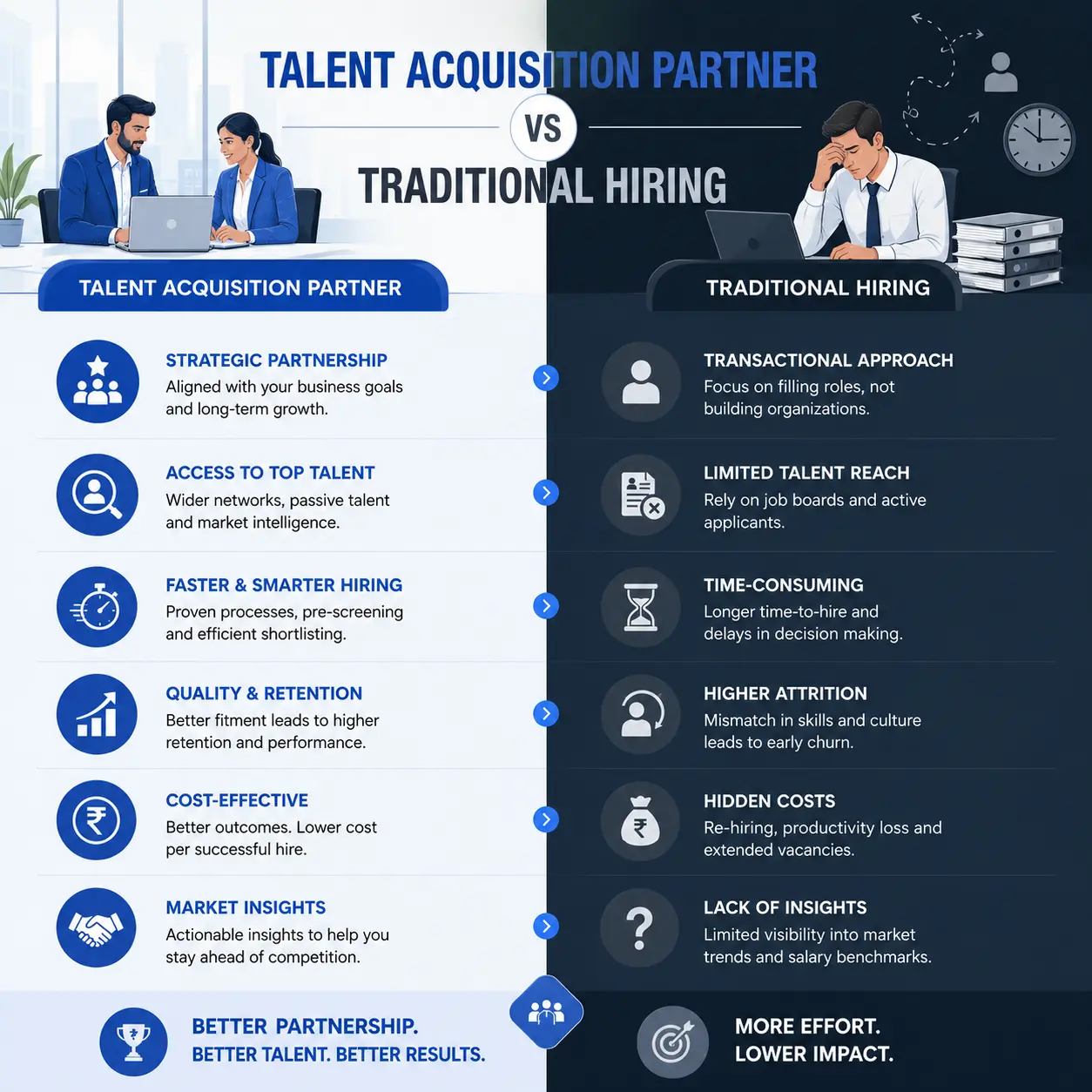
Talent Acquisition Partner vs Traditional Hiring
Why Growing Businesses Need a Talent Acquisition Partner Instead of Traditional Hiring Methods
15-06-2026 Monday
Table of Contents
ToggleWhy Growing Businesses Need a Talent Acquisition Partner Instead of Traditional Hiring Methods
There is a moment every growing business reaches where the way it has always hired stops working. The job posting that used to attract 50 relevant applicants now attracts 200 irrelevant ones and three worth interviewing. The hiring manager who used to handle recruitment between other responsibilities is now spending 30% of their week on it — and still filling roles slower than the business needs. The offer that went out to the candidate who seemed perfect was declined because a competitor moved three weeks faster.
Traditional hiring methods — post a job, screen applications, interview, offer — were designed for a talent market that no longer exists. They work when candidates come to employers. They fail when employers must go to candidates. They work when time-to-fill is a preference. They fail when it is a business constraint. They work at 20 employees. They fail at 120 — and they fail expensively, in ways that are not always visible until the damage is already done.
A talent acquisition partner is the answer — not a recruiter who fills a vacancy when asked, but a strategic partner who manages the complete hiring function, brings market intelligence to every search, and treats finding the right person as a business priority rather than an administrative task.
This blog explains exactly why growing businesses in Chennai and across India need a talent acquisition partner in 2026 — and what the difference in outcomes actually looks like.
“Compliance is not a cost center. It is a trust signal — to your employees, your investors, your bank, and
your clients. In Chennai’s competitive business landscape, the companies that comply consistently are the ones that scale consistently.”
— VIRIKSHA HR SOLUTION, CHENNAI
What Traditional Hiring Methods Actually Cost — The Numbers Most Businesses Don't Track
Before examining what a talent acquisition partner delivers, it helps to understand what traditional hiring is actually costing — because most businesses track the fees they pay to recruiters but do not track the far larger costs that traditional hiring creates.
The cost of a vacant role — every day a revenue-generating role stays vacant, the business loses output. A sales manager vacancy at ₹12 lakhs per year CTC that stays open for 60 days costs the business the contribution that person would have generated — typically two to three times their salary in revenue impact. A technology lead vacancy in a product team delays a product release. A finance manager vacancy delays month-end close. The cost of the vacancy is never the salary. It is the output the business is not getting.
The cost of a bad hire — the most expensive outcome of traditional hiring under pressure is a wrong hire. A candidate who was selected because they were the best of the applicants — not the best available in the market — and who leaves within twelve months takes with them the recruitment cost, the onboarding investment, the institutional knowledge accumulated, the productivity ramp-up period, and triggers the entire cycle again. Research consistently shows that a failed hire at mid-management level costs between one and three times the annual salary of the role. At senior level, it costs significantly more.
The hidden management cost — when hiring managers manage recruitment alongside their primary responsibilities, both suffer. A technology director spending 10 hours a week screening CVs, scheduling interviews, and chasing candidates is not spending 10 hours a week directing technology. That management bandwidth cost never appears on a recruitment budget — but it is real, it compounds across every open role, and it is entirely recoverable by engaging a talent acquisition partner who owns the process.
The employer brand cost — candidates who experience a disorganised, slow, or inconsistent recruitment process share that experience. In Chennai’s connected professional networks — particularly in IT, BFSI, and the manufacturing corridors — employer reputation travels fast. Every candidate who has a poor experience with your hiring process tells others. Over time, traditional hiring that is managed poorly makes the next search harder — because the best candidates have heard about the experience and choose not to engage.
Most businesses that have only worked with traditional recruitment agencies are surprised by how different a genuine talent acquisition partner engagement is. The difference is not in the output — both produce candidates. The difference is in the process, the intelligence, the accountability, and the strategic value that comes alongside the candidates.
Market mapping before sourcing
Market mapping before sourcing — a talent acquisition partner does not begin with a job posting. They begin by mapping the available talent universe for the specific role — identifying who holds equivalent positions at comparable organisations, what the competitive compensation landscape looks like, where the best candidates are likely to be found, and what their current situation and career motivations are. This market intelligence shapes the search strategy and the candidate approach before a single outreach is made.
Proactive outreach to passive candidates
Proactive outreach to passive candidates — the best candidates for most roles in 2026 are not actively looking. They are employed, performing well, and not responding to job advertisements. A talent acquisition partner reaches them through direct, personalised outreach — presenting the opportunity compellingly to someone who was not looking for it. This is not something a job portal or an internal HR team with a full workload can do effectively.
Structured screening before client introduction
Structured screening before client introduction — every candidate presented by a talent acquisition partner has been screened against the role's technical requirements, assessed for cultural and leadership fit where applicable, had their experience claims verified at a high level, and confirmed as genuinely interested in the specific opportunity. The client's time is spent evaluating fit between shortlisted candidates — not filtering out the unsuitable from a long list.
Compensation intelligence
Compensation intelligence — a talent acquisition partner brings current, role-specific compensation data to every search — not last year's salary survey range. They know what the market is paying for a senior data engineer in Chennai's OMR corridor right now, what the bonus structure looks like for a BFSI operations manager in 2026, and what a manufacturing plant head with 15 years of experience expects in total package. This intelligence is what makes offers that close rather than offers that are declined.
Timeline management
Timeline management — a talent acquisition partner understands India's notice period reality and builds it into every hiring timeline. A mid-level specialist needed by July requires an offer in May. A senior leader needed in October requires a search brief in June. Traditional hiring ignores this and consistently produces roles that are "in progress" for months while the business waits for someone who accepted an offer too late to join on time.
Accountability for outcomes
Accountability for outcomes — a talent acquisition partner is accountable for the quality of every placement, the accuracy of every assessment, and the validity of every market intelligence input they provide. When a placement does not work out, a genuine talent acquisition partner owns that outcome — not just the activity of having made an introduction.
The Five Specific Failures of Traditional Hiring That a Talent Acquisition Partner Prevents
Failure 1 — Hiring the Best Applicant Instead of the Best Candidate
Traditional hiring produces a shortlist from the applicant pool — the people who saw the job posting and applied. A talent acquisition partner produces a shortlist from the available talent market — everyone who meets the criteria, regardless of whether they were actively looking. The difference between these two pools is the difference between the best of who came to you and the best of who exists. For most roles in 2026, the best available candidate did not apply to your job posting. They are employed, and they need to be approached.
Failure 2 — Losing Candidates to Process Speed
The fastest-growing businesses in Chennai and across India have compressed their hiring cycles — from brief to offer in three to four weeks for mid-level roles. Businesses running traditional hiring processes — job posting, two-week collection window, initial screening, first interview, second interview, reference check, offer — take eight to twelve weeks. In a market where good candidates have multiple active processes, the traditional hiring timeline loses candidates consistently. A talent acquisition partner compresses the cycle by doing the screening before the client sees the candidate — so the client’s process starts at the shortlist stage, not the sourcing stage.
Failure 3 — Salary Misalignment at the Offer Stage
Traditional hiring frequently arrives at the offer stage without current market compensation data — resulting in offers that are declined because they are below what the candidate was expecting based on competing offers. This wastes every hour invested in the search up to that point and resets the process. A talent acquisition partner brings compensation intelligence into the search from the brief stage — so the offer that is made reflects what the market requires, not what the HR team approved six months ago.
Failure 4 — The Reactive Cycle That Never Breaks
Traditional hiring is reactive by design — it responds to vacancies as they open. This means every search starts from zero — no pipeline, no pre-qualified candidates, no market intelligence built from the previous search. The talent acquisition partner model is proactive — building and maintaining candidate pipelines for roles that recur, leveraging market intelligence from every completed search, and having qualified candidates ready to engage when a role opens rather than starting the search from scratch every time.
Failure 5 — No Employer Brand Building
Every interaction a candidate has with a hiring organisation is an employer brand moment — and traditional hiring frequently produces brand-damaging moments. The application that goes unacknowledged. The interview that starts 20 minutes late. The feedback that never comes. The offer that arrives two weeks after the verbal commitment. A talent acquisition partner manages the candidate experience as carefully as the client experience — because every candidate who has a positive experience, whether they take the role or not, becomes an advocate for the employer in the talent market.
When a Growing Business Needs a Talent Acquisition Partner — The Specific Triggers
There are specific business situations that make the move from traditional hiring to a talent acquisition partner urgent — not just beneficial.
Headcount is growing faster than the internal HR team can manage — when the volume of open roles exceeds what the internal team can manage with quality, reactive hiring takes over and quality falls. A talent acquisition partner absorbs the volume without sacrificing the rigour.
Critical roles are staying open beyond 60 days — any role that has been open for more than 60 days in a growing business is actively costing the business. It is not a recruitment process problem. It is a sourcing strategy problem — and the solution is a partner with the network and the proactive approach to reach candidates who are not coming to you.
Attrition is outrunning hiring — when the business is consistently adding headcount while losing people, the net growth is slower than the growth plan requires. Talent acquisition strategy — pipeline building, employer brand, structured onboarding — is as important as hiring speed in solving this problem.
The business is entering a new market or geography — opening an office in Bangalore, launching operations in Hyderabad, establishing a manufacturing facility in Gujarat — requires hiring in a talent market the internal team does not know. A talent acquisition partner with Pan India reach and local market knowledge in the target city is the fastest route to a functioning team in a new location.
A transformation programme requires specialist talent — a digital transformation, an ERP implementation, a GCC establishment, or a manufacturing automation programme requires talent profiles that are not in the business’s existing network. A talent acquisition partner who specialises in the relevant domain and has relationships with the relevant talent community reduces the search timeline from months to weeks.
Investor or board scrutiny is increasing — growing businesses approaching their next funding round, a pre-IPO stage, or a due diligence process need a talent acquisition track record that demonstrates quality hiring at scale. A talent acquisition partner who provides placement data, time-to-fill metrics, and candidate quality evidence gives the business a hiring story that withstands investor scrutiny.
Talent Acquisition Partner vs Recruitment Agency vs Internal HR — The Honest Comparison
Traditional Recruitment Agency |
Internal HR Team |
Talent Acquisition Partner | |
|---|---|---|---|
Candidate source
|
Primarily active candidates
|
Primarily job portals
|
Active and passive candidates
|
Screening depth
|
Variable
|
Variable
|
Structured — every candidate assessed before introduction
|
Market intelligence
|
Limited
|
Limited
|
Current — compensation, availability, competitor landscape
|
Process ownership
|
Introduction only
|
Full process, limited bandwidth
|
End-to-end process ownership
|
Timeline management
|
Reactive
|
Reactive
|
Proactive — notice periods built in from day one
|
Employer brand management
|
Minimal
|
Variable
|
Active — candidate experience managed throughout
|
Accountability
|
Introduction accountability
|
Output accountability
|
Outcome accountability
|
Scalability
|
Limited by contingency model
|
Limited by headcount
|
Scales with requirement
|
Cost structure
|
Per placement fee
|
Fixed salary cost
|
Per placement or RPO model
|
The honest comparison shows that internal HR teams and traditional recruitment agencies each solve part of the hiring challenge — but neither solves all of it. The talent acquisition partner model is the only one that combines proactive sourcing, structured assessment, market intelligence, process ownership, employer brand management, and outcome accountability in a single engagement.
How Viriksha HR Solutions Functions as a Talent Acquisition Partner for Growing Businesses in Chennai and Across India
Viriksha HR Solutions is a full-service talent acquisition partner serving growing businesses across Chennai, Tamil Nadu, and Pan India — providing end-to-end talent acquisition services that go significantly beyond what traditional recruitment agencies deliver.
What Viriksha’s talent acquisition partnership includes:
Financial year hiring plan development — at the start of every engagement, Viriksha works with HR leadership to translate business targets into a role-level hiring plan, classify every role by tier and sourcing model, build a quarter-by-quarter delivery timeline that accounts for notice periods and joining windows, and establish the compensation benchmarks for every role type.
Proactive candidate sourcing — Viriksha sources from active and passive pools — direct outreach to employed professionals, referral networks, specialist communities, and targeted headhunting for roles where the best candidates are not looking. Job portals are one channel among many — not the primary strategy.
Structured screening and assessment — every candidate Viriksha introduces has been interviewed, technically assessed, reference-verified at a high level, and confirmed as genuinely interested in the specific opportunity. The client’s interview process starts at the shortlist stage — not the screening stage.
Compensation benchmarking — current, role-specific compensation data for every search — covering base, variable, ESOP where applicable, and joining bonus expectations for critical hires. Offers built on this intelligence close at significantly higher rates than offers built on outdated salary surveys.
Notice period and timeline management — every search brief includes a joining date target, and the search timeline is built backwards from that date including notice period. Viriksha manages candidate engagement through the notice period — reducing drop-out risk and managing counter-offer situations proactively.
RPO for volume requirements — for growing businesses with more than 40 to 50 mid-level hires planned annually, Viriksha’s Recruitment Process Outsourcing model embeds the talent acquisition function within the HR team — managing sourcing, screening, interview scheduling, offer management, and onboarding coordination as a fully integrated service at a per-hire cost that outperforms the combination of internal recruiter headcount and ad-hoc agency usage.
Executive search for leadership — for CXO, VP, Director, and Business Head mandates, Viriksha’s executive search practice provides retained search with dedicated consultant oversight, direct outreach to senior professionals not actively looking, and a shortlist of assessed, genuinely qualified leaders within six to ten weeks of a confirmed brief.
Background verification — every placement includes BGV coordination — education, employment, address, and criminal verification — integrated into the offer timeline so joining is not delayed by verification that starts after the offer is accepted.
Pan India and international reach — Viriksha’s talent acquisition capability covers every city your business operates in — Chennai, Bangalore, Mumbai, Hyderabad, Pune, Delhi NCR — and for businesses with GCC or international requirements, cross-border talent acquisition coordination for India-based and international hiring mandates.
Integration with HR and compliance — for businesses that also need payroll management, statutory compliance, PF and ESI consultancy, and contract staffing, Viriksha manages the complete HR function alongside talent acquisition — so every hire is not only found correctly but onboarded, paid, and employed compliantly from day one.
The growing business that replaces traditional hiring with a talent acquisition partnership does not just hire faster. It hires better — with a structured process, market intelligence, and outcome accountability that produces placements who stay, perform, and contribute to the growth the business is trying to achieve.