

Viriksha HR Solution
TDS Calculation on Salary: Complete Guide for Employers in India
04-05-2026 Monday
Table of Contents
ToggleTDS Calculation on Salary: Complete Guide for Employers in India
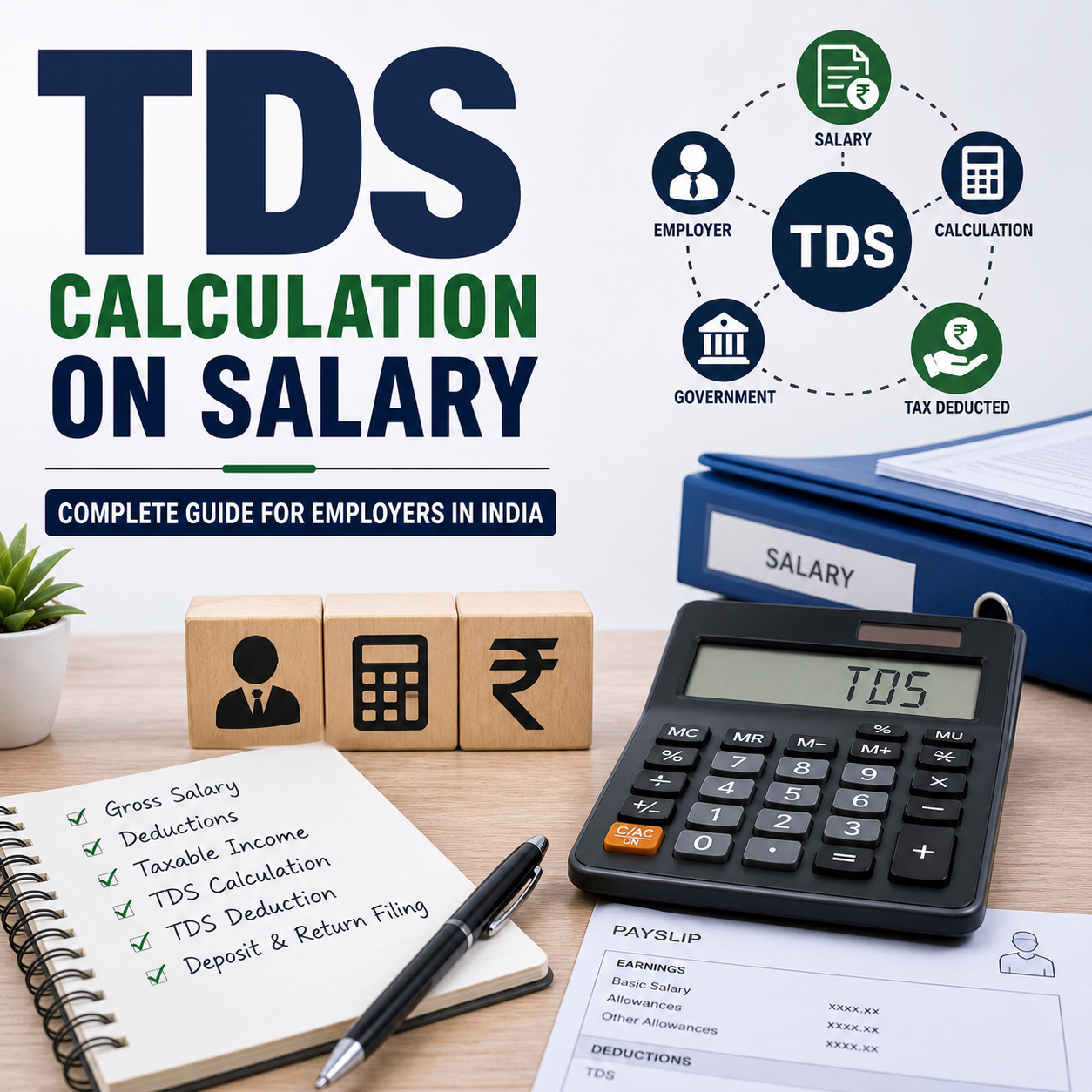
Tax Deducted at Source on salary is one of the most technically demanding components of payroll processing in India — and one of the most commonly mishandled. Every employer who pays salary above the basic exemption limit is required under Section 192 of the Income Tax Act to deduct TDS, deposit it with the government, file quarterly returns, and issue Form 16 to every applicable employee at the end of the financial year.
Get it wrong and the consequences land on both sides. The employer faces interest, penalties, and prosecution under the Income Tax Act. The employee faces a tax demand they weren’t expecting — because the TDS that should have been deducted wasn’t, or wasn’t deducted correctly.
This guide covers everything employers in Chennai and across India need to know about TDS on salary — the legal framework, the calculation methodology, both tax regimes, deductions, quarterly filing obligations, and the penalties for non-compliance.
“Compliance is not a cost center. It is a trust signal — to your employees, your investors, your bank, and
your clients. In Chennai’s competitive business landscape, the companies that comply consistently are the ones that scale consistently.”
— VIRIKSHA HR SOLUTION, CHENNAI
What Is TDS on Salary Under Section 192?
Section 192 of the Income Tax Act, 1961 requires every person responsible for paying salary to deduct income tax at source at the time of payment. Unlike other TDS provisions that apply at fixed rates, Section 192 TDS is calculated at the applicable income tax slab rate for the individual employee — based on their estimated total income for the financial year.
This distinction is important. TDS on salary is not a flat rate. It is a projection. At the start of the financial year, the employer estimates each employee’s total taxable income for the year, applies the applicable tax slabs, arrives at the annual tax liability, and divides it into equal monthly deductions. When circumstances change — a mid-year salary revision, a bonus, an additional income declaration — the TDS calculation is revised and the remaining months absorb the adjustment.
This is why TDS on salary requires active monthly management, not a set-and-forget calculation from April.
The Two Tax Regimes — Old and New — and Why They Change Everything
From FY 2023-24, the new tax regime became the default under Section 115BAC. Employees who want to opt for the old regime must explicitly declare their choice to their employer — failing which the employer must deduct TDS under the new regime.
New Tax Regime (Default) — FY 2024-25 slabs:
Income Slab |
Tax Rate |
|---|---|
Up to ₹3,00,000
|
Nil
|
₹3,00,001 to ₹7,00,000
|
5%
|
₹7,00,001 to ₹10,00,000
|
10%
|
₹10,00,001 to ₹12,00,000
|
15%
|
₹12,00,001 to ₹15,00,000
|
20%
|
Above ₹15,00,000
|
30%
|
Under the new regime, the basic exemption limit is ₹3,00,000. The rebate under Section 87A is available for income up to ₹7,00,000 — meaning employees with income up to ₹7 lakhs under the new regime have zero net tax liability after rebate.
Income Slab |
Tax Rate |
|---|---|
Up to ₹2,50,000
|
Nil
|
₹2,50,001 to ₹5,00,000
|
5%
|
₹5,00,001 to ₹10,00,000
|
20%
|
Above ₹10,00,000
|
30%
|
Under the old regime, the basic exemption limit is ₹2,50,000. The Section 87A rebate applies for income up to ₹5,00,000. The key advantage of the old regime is access to deductions and exemptions — HRA, LTA, standard deduction, Section 80C, 80D, 80CCD, and others — that are not available under the new regime.
The employer’s obligation: collect regime declarations from every employee at the start of the financial year. Employees who do not submit a declaration are taxed under the new regime by default. Employees who opt for the old regime must submit investment declarations under Form 12BB.
How TDS on Salary Is Calculated — Step by Step
Here is the exact calculation sequence every payroll team in India must follow for each employee:
Step 1 — Compute gross salary for the year Annual basic pay plus all allowances, perquisites, and other salary components. Include all variable pay components — bonuses, incentives, arrears — in the month they are paid or in the annual projection if known.
Step 2 — Reduce exemptions (old regime employees only) HRA exemption — calculated as the lower of: actual HRA received, 50% of basic salary (metro cities Chennai, Mumbai, Delhi, Kolkata) or 40% (non-metro), or rent paid minus 10% of basic salary. LTA exemption for travel within India — twice in a block of four years. Standard deduction of ₹75,000 (available in both regimes from FY 2024-25).
Step 3 — Arrive at net taxable salary Gross salary minus applicable exemptions equals net taxable salary.
Step 4 — Apply Chapter VI-A deductions (old regime only) Section 80C — up to ₹1,50,000 for PF contribution, LIC premium, ELSS, PPF, home loan principal. Section 80D — health insurance premium up to ₹25,000 (₹50,000 for senior citizens). Section 80CCD(1B) — additional NPS contribution up to ₹50,000. Section 80E — interest on education loan. Section 24(b) — home loan interest up to ₹2,00,000. Other applicable deductions from Form 12BB declaration.
Step 5 — Compute tax on taxable income Apply the applicable slab rates — new or old regime — to the net taxable income after all deductions. Add surcharge where applicable (income above ₹50 lakhs). Add 4% Health and Education Cess on the tax amount.
Step 6 — Reduce Section 87A rebate if applicable Under the new regime, if net taxable income does not exceed ₹7,00,000, the full tax liability is reduced to zero under Section 87A rebate. Under the old regime, the rebate applies for income up to ₹5,00,000.
Step 7 — Divide by remaining months Divide the annual tax liability by the number of remaining months in the financial year. This is the monthly TDS amount to deduct from salary.
Step 8 — Adjust for mid-year changes When salary is revised, a bonus is paid, or an employee submits a revised investment declaration, recalculate the annual tax liability and redistribute the remaining tax across remaining months.
Perquisites — The TDS Component Most Employers Miss
Perquisites are non-cash benefits provided by the employer that are taxable in the hands of the employee — and the TDS obligation extends to them.
Taxable perquisites include: rent-free or concessional accommodation provided by the employer, company car used for personal purposes, employer contribution to superannuation fund above ₹1,50,000 per year, interest-free or concessional loans above ₹20,000, gift vouchers and non-monetary gifts above ₹5,000 per year, and club membership fees paid by the employer.
The value of perquisites must be added to the employee’s taxable salary for TDS calculation purposes. Many payroll teams in Chennai and across India compute TDS on cash salary alone — missing the perquisite component entirely. This creates a TDS shortfall that surfaces as a demand on the employee and a default notice on the employer.
Form 12BB — The Employee Declaration That Drives TDS Accuracy
Form 12BB is the statement of claim for deductions and exemptions submitted by an employee to their employer at the start of the financial year. The employer’s TDS calculation can only be as accurate as the declarations in Form 12BB.
Form 12BB covers: HRA claim with landlord details and rent amount, LTA claim for travel undertaken, home loan interest and principal details for Section 24(b) and 80C, and all Chapter VI-A investment details — 80C, 80D, 80CCD(1B), 80E, and others.
For the old regime, employers should collect Form 12BB in April and collect proof of actual investments in January or February — before the final TDS reconciliation for the year. Declarations without proof should be treated as provisional and TDS adjusted when proof is submitted.
For new regime employees, Form 12BB is not applicable — TDS is calculated on gross salary minus only the standard deduction of ₹75,000, with no other deductions.
TDS Deposit Deadlines — Non-Negotiable
TDS deducted from salary must be deposited with the government through challan ITNS 281 by the 7th of the following month. For March salary, the deadline is April 30.
Late deposit attracts interest under Section 201(1A) at 1.5% per month from the date of deduction to the date of deposit. Failure to deduct TDS where it was required attracts interest at 1% per month from the date it should have been deducted to the date it is actually deducted.
These are simple percentages with material consequences. A monthly payroll with TDS liability of ₹3 lakhs that is deposited 30 days late incurs ₹4,500 in interest — every month it is late. Over a year, consistent late deposit on a payroll of this size accumulates over ₹50,000 in interest liability alone.
Quarterly TDS Returns — Form 24Q
TDS on salary must be reported quarterly through Form 24Q — filed on the TRACES portal.
Filing deadlines: Q1 (April to June) — July 31. Q2 (July to September) — October 31. Q3 (October to December) — January 31. Q4 (January to March) — May 31.
Form 24Q has two annexures. Annexure I captures the quarterly salary and TDS details for all employees. Annexure II — filed with Q4 only — captures the full-year salary, exemptions, deductions, taxable income, and TDS details for every employee. Annexure II is the source document for Form 16.
Late filing of Form 24Q attracts a fee of ₹200 per day under Section 234E — subject to a maximum of the TDS amount for that quarter.
Form 16 — Annual TDS Certificate for Employees
Form 16 is the annual TDS certificate that every employer must issue to employees from whose salary TDS was deducted during the financial year. The deadline for Form 16 issuance is June 15 following the end of the financial year.
Form 16 has two parts. Part A is generated from the TRACES portal — covering employer and employee details, TDS deducted and deposited quarter-by-quarter, and PAN verification. Part B is prepared by the employer — covering gross salary, exemptions, deductions, taxable income, and tax computation in detail. Both parts must be digitally signed by the employer.
Failure to issue Form 16 by June 15 attracts a penalty of ₹100 per day of default under Section 272A(2)(g).
Quarterly TDS Returns — Form 24Q
These are the most common TDS errors our payroll team encounters when reviewing client payroll records:
Using the wrong tax regime
Defaulting to the old regime when the employee has not opted for it, or calculating old regime TDS for a new regime employee. Both create incorrect TDS deduction and a subsequent demand or refund.
Missing perquisite valuation
Computing TDS on cash salary alone and omitting the taxable perquisite component. Creates systematic TDS shortfall every month.
Not revising TDS after bonus payment
A bonus paid in October changes the annual tax projection. Payroll teams that do not revise TDS after the bonus payment create a large shortfall that surfaces in February and March — requiring high deductions in the final months that employees did not plan for.
Collecting Form 12BB but not verifying proof
Accepting investment declarations in April and reducing TDS accordingly, but never collecting proof. When proof is not submitted, the deduction should be reversed and TDS adjusted — but often isn't.
Late Form 24Q filing
₹200 per day per quarter adds up quickly. Q1 filed two months late costs ₹12,000 in filing fees alone — with no tax shortfall involved.
Need TDS on salary process guide ?
If your TDS on salary process has any of the gaps described in this guide — find out before the Income Tax Department does.
How Viriksha HR Solutions Manages TDS on Salary for Businesses in Chennai and Pan India
TDS on salary is the payroll component that requires the most active monthly management — and the one most frequently mishandled when payroll is managed by a team without dedicated income tax expertise.
Viriksha HR Solutions manages complete TDS on salary compliance for businesses across Chennai and Pan India — as part of integrated payroll management and payroll outsourcing engagements.
Our TDS management service covers Form 12BB collection and regime declaration management at financial year start. Monthly TDS calculation for every employee under the correct regime — including perquisite valuation. TDS revision after every mid-year change — salary revision, bonus, revised declaration. Challan ITNS 281 preparation and deposit before the 7th of every month. Quarterly Form 24Q filing before each deadline. Q4 Annexure II preparation reconciling full-year salary and TDS for every employee. Form 16 Part A generation from TRACES and Part B preparation — issued to every employee before June 15.
For businesses that have received an income tax notice related to TDS on salary — short deduction notice under Section 201, interest demand under Section 201(1A), or late filing fee demand under Section 234E — our payroll compliance team reviews the notice, computes the correct liability, prepares the response, and manages the Income Tax Department engagement through to resolution.
For MNCs and large corporates in Chennai with complex salary structures — senior executive perquisites, ESOP taxation, expat payroll, and dual-country TDS obligations — our payroll management team handles the full complexity with dedicated income tax and payroll specialists.