
Rate this post
Viriksha HR Solution
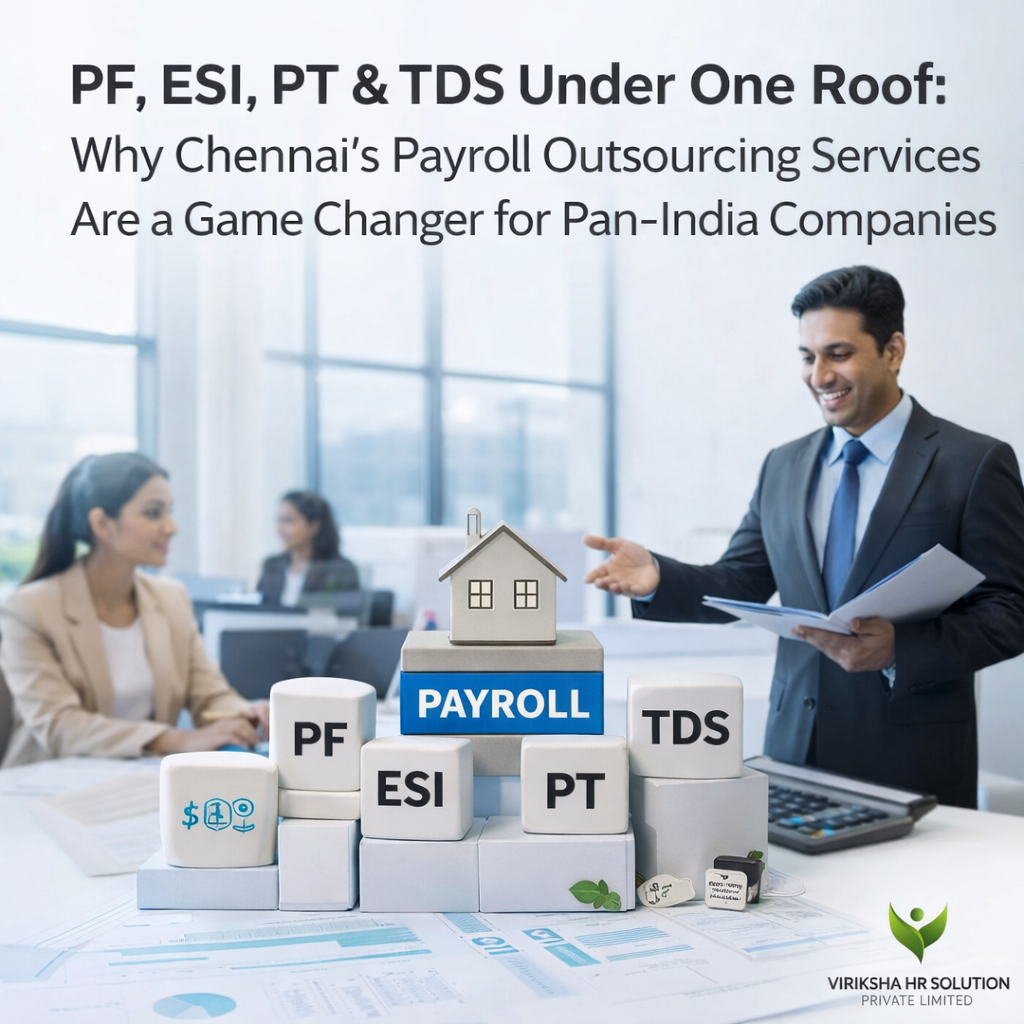
PF, ESI, PT & TDS Under One Roof: Why Chennai’s Payroll Outsourcing Services Are a Game Changer for Pan-India Companies
26-02-2026 Thursday
Table of Contents
ToggleIntroduction
The complexity of managing statutory compliance in the multi-state payroll environment of India has become a challenge. Organizations that have operations in different states of India are confronted with a maze of regulations, including Provident Fund (PF), Employee State Insurance (ESI), Professional Tax (PT), and Tax Deduction at Source (TDS), each with its own calculation formula, due dates, and penalties.
For expanding businesses, this complexity means increased operational costs, risks, and exposure. Chennai has become a destination for niche payroll outsourcing services that bring all these tasks under one umbrella management system, providing a game-changing option for pan-India businesses to consider instead of managing the payroll function internally.
This is not merely an issue of convenience. It is a critical business choice that has a direct bearing on cash flow, compliance, talent retention, and growth.
The Multi-State Payroll Challenge: Why In-House Compliance Is Becoming Unsustainable
Understanding the Complexity
The Indian payroll compliance environment is a federal system where state governments have their own set of rules in addition to central government regulations. This leads to a compounding problem for companies with employees in multiple states.
Provident Fund (PF)
Provident Fund (PF) is applicable in a salary band-dependent manner (currently ₹15,000 for new employees in EPFO). The calculation varies for subscriber and non-subscriber states. States have their own PF schemes, necessitating separate registrations and compliance.
Employee State Insurance (ESI)
Employee State Insurance (ESI) is state-specific with different contribution rates. A company with manufacturing facilities in Gujarat and service delivery in Karnataka has a completely different ESI contribution rate and claims process. The ESI wage calculation excludes certain allowances, adding another layer of complexity.
Professional Tax (PT)
Professional Tax (PT) is state-specific only. Maharashtra imposes PT based on an income slab system, while Tamil Nadu has a completely different system. Some states do not impose PT at all. An employee earning ₹50,000 per month may not be liable for PT in one state and ₹500 in another.
Tax Deduction at Source (TDS)
Tax Deduction at Source (TDS) under Sections 192, 193, and 194 involves complex calculations based on projected annual income, applicable deductions, and variations in income during the financial year. Any error in TDS calculations leads to employee complaints and government penalties.
With 200 employees distributed over 5 states, handling these four different compliance processes in-house would mean either hiring an in-house team or an outsourcing option. Mid-market companies lack the specific expertise to handle this in-house without incurring heavy recruitment costs.
The Cost of Non-Compliance
Penalties for non-compliance in the Indian payroll industry are tough and increasing:
- Non-compliance with PF regulations invites penalties between ₹5,000 and ₹25,000 per instance, along with imprisonment for defaulters, under the EPF Act.
- ESI non-compliance invites penalties of 10% of the default amount, along with 12% interest per annum.
- PT non-filing invites prosecution under state laws, with penalties ranging from ₹5,000 to ₹10,000.
- TDS penalties under Section 272B can go up to 100% of the tax amount in case of intentional default.
In addition to the legal costs, the delay or inaccuracies in compliance result in operational inefficiencies, such as employee complaints regarding deductions from their salaries, internal queries from departments, and audits that occupy management time out of proportion to the size of the company.
Businesses Served Across Tamil Nadu & Pan India
0
+
Statutory Penalties for Our Compliance Clients
0
Average Monthly Time Saved Per Business
0
+
What Sets Chennai’s Payroll Outsourcing Services Apart
The Regional Advantage
Chennai is home to one of the largest payroll and HR outsourcing centers in India, with regional headquarters of global BPO giants and niche domestic players. This regional advantage boils down to the following key benefits for pan-India businesses.
In-depth knowledge of regulations across states.
Payroll outsourcing service providers in Chennai have experience with payroll compliance across all major states in India, which has given them an edge in understanding the regional idiosyncrasies—how regulatory interpretations evolve, changes in departmental procedures, and new challenges on the horizon before they become a broader problem.
Cost-effectiveness without sacrificing quality.
The competitive payroll outsourcing services market in Chennai ensures high service quality standards and affordable prices, which are generally 15-25% lower than similar services offered in Delhi or Mumbai for a pan-India solution.
Experience with multiple tax jurisdictions.
The PT compliance in Tamil Nadu, along with experience in managing employees across India, provides a natural laboratory for service providers to develop best practices for multi-state compliance.
Consolidation Under One Roof: The Operational Model
Instead of dealing with different vendors for each compliance stream, consolidated payroll outsourcing solutions offer the combined functionality of all four streams—PF, ESI, PT, and TDS—using a common technology platform.
Consolidated payroll data management.
The same employee master record is processed through the system, thereby preventing the possibility of data discrepancies that exist in the case of the fragmented vendor approach. Any changes in the employee’s salary, designation, or employment status automatically generate updates in all four compliance calculations.
Integrated software infrastructure.
Contemporary payroll solutions employ a common database that computes all statutory deductions simultaneously, validating interdependencies and pointing out discrepancies in real-time. For instance, if an employee’s income exceeds the ESI exemption limit, the system automatically generates updates in both ESI and TDS calculations.
Consolidated reporting and audit trails.
All types of compliance reports, including GSTR filing, ESI registration, PF statements, and PT returns, are produced from a single source, making audit trails and reconciliation easier.
Unified relationship management.
There is no need to coordinate with different vendors. Organizations have a single point of contact for all payroll-related matters, reducing resolution times and improving the quality of services.
The Four Pillars of Consolidated Payroll Compliance
1
Provident Fund (PF) Management
What it covers: Compulsory retirement and social security contribution for eligible employees.
Compliance requirements: Calculation of contributions on the basis of basic salary and dearness allowance on a monthly basis, employer-employee reconciliation, annual reporting, and maintenance of member portals (UAN-based accounts).
State-specific complexity: The applicability of PF varies depending on the size of the payroll and the state of jurisdiction. Unorganized sector employees or states where PF is not applicable need to be handled separately.
How consolidated outsourcing helps: The vendor has updated eligibility matrices for each state, which automatically identify the employees who need to be enrolled in the PF scheme, determine the right contribution percentage (which is 12% from the employer and 12% from the employee for most categories), handle both EPFO and State PF schemes, and provide reconciliation statements that have resulted in a 85% decrease in audit disputes.
2
Employee State Insurance (ESI) Administration
What it entails: Health and disability insurance for employees earning less than ₹21,000 per month (as of 2024).
Compliance obligations: ESI premium filing on a monthly basis, processing employee benefit claims, maintaining statutory registers, and filing annual returns.
State-specific complexity: The ESI contribution rate differs from state to state (ranging from 0.75% to 1.5% of the covered wages), and the calculation of covered wages does not include some allowances, making it a computation-intensive process.
How consolidated outsourcing helps: The outsourcing partner provides real-time wage calculation engines that automatically segregate the covered and excluded portions, state-specific premium calculation engines that adjust for changes in rates on an overnight basis, and benefit claim processing engines that ensure employees receive timely payments while also helping the organization keep track of compliance records.
3
Professional Tax (PT) Compliance
What it entails: State income tax on salary, which is mandatory only in certain states (Maharashtra, Tamil Nadu, Karnataka, Delhi, and Himachal Pradesh).
Compliance requirements: Monthly deduction of PT at prescribed income slabs, quarterly/annual returns, communication with employees, and maintenance of a statutory register.
State-specific complexities: Slab rates, exemptions, and returns are completely different in each state. An employee earning ₹80,000 pays ₹0 PT in Bihar but ₹500 in Maharashtra.
How consolidated outsourcing helps: The service provider has state-specific slab modules that are automatically updated whenever the state government announces a change in tax slabs. The software determines the PT applicable to employees based on their location and salary, prepares state-specific returns in the prescribed format, and keeps a record of previous returns to enable employees to ask questions about their deductions.
4
Tax Deduction at Source (TDS) on Salary
What it entails: The Central Government’s income tax deduction on employees’ salaries, as per Section 192 of the Income Tax Act.
Compliance challenges: Correct TDS calculation on a monthly basis, based on annual projections, quarterly TDS statements (Form 24Q), annual TDS reconciliation, and submission of Form 16.
Complexity points: Varying income on a monthly basis, different deduction entitlements for employees (standard deduction, HRA, interest on home loan, insurance premiums, and investment deductions), and different taxation rules for non-resident and NRI employees.
How consolidated outsourcing simplifies: AI-powered income projection systems make TDS adjustments on a monthly basis based on fluctuating employee incomes, thereby avoiding both over-deduction (which leads to delayed refunds) and under-deduction (which leads to penalties).
How to Assess Chennai Payroll Outsourcing Companies
Assessment Criteria
Regulatory compliance and audits. When assessing companies, ensure they are certified in ISO 27001 (information security), SOC 2 (service organization controls), and have a clean audit record from state tax authorities.
Technology infrastructure. Evaluate their technology infrastructure for cloud-based processing (allowing for real-time processing), API connectivity to your HRIS system, and automated disaster recovery backup systems.
State expertise depth. Ask for case studies or client references regarding payroll management in the particular states where you conduct business.
Service response times. Specify SLAs regarding the closure of payroll processing services, response times for missed deadlines, and times for departmental inquiry responses. Standard SLAs in the industry are:
- Payroll processed by 5th of the following month
- Statutory deadline misses: ₹0 liability (service provider pays the penalties)
- Departmental inquiry response: within 3 business days
Pricing transparency. Per-employee pricing (usually ₹300-800 per employee per month, depending on complexity) should be clear, with no surprise fees for compliance updates or changes in regulations.
Data security and confidentiality. Ensure that the service providers have strict data protection policies, employee NDA compliance, and business discontinuation clauses regarding payroll data security.
Trends in Payroll Outsourcing
AI-Powered Compliance Automation
The latest payroll software employs AI to forecast potential compliance risks before they arise, point out unusual payroll trends that could be a sign of errors, and automatically correct common errors such as incorrect ESI wage rates.
Blockchain-Enabled Compliance Documentation
Innovative payroll service providers are working on blockchain-verified compliance documentation, which enables the creation of an unalterable audit trail, thereby minimizing the need for verification by the concerned department.
Financial Planning Integration
The consolidated payroll data is used for financial planning, enabling CFOs to better forecast compensation expenses and statutory liability risks.
Real-Time Regulatory Updates
Payroll service providers now subscribe to regulatory updates, which automatically notify them of changes in tax rates, ESI rates, or PT slabs, and immediately inform clients.