

Engineering Recruitment Services for Technical and Leadership Hiring: What Businesses Need to Know
Viriksha HR Solution Engineering Recruitment Services Engineering Recruitment Services for Technical and Leadership Hiring: What Businesses Need to Know Engineering Recruitment Services Engineering talent drives some of India’s most critical industries — manufacturing, construction, infrastructure, automation, electronics, oil and gas, civil engineering, and industrial operations. Yet hiring the right engineering professional — whether a Senior Mechanical Engineer, a Production Manager, a VP Engineering, or a Chief Engineer — remains one of the most consistently difficult talent challenges businesses face across these sectors. The difficulty is not a shortage of engineering graduates. India produces hundreds of thousands annually. The difficulty is finding engineers who combine verified technical competency with hands-on experience, genuine problem-solving capability, and — at leadership levels — the organizational, people management, and strategic skills that technical expertise alone does not guarantee. This is precisely why specialist engineering recruitment services exist. And why businesses across manufacturing, MNC, GCC, and infrastructure sectors that rely on generalist recruitment agencies for senior engineering hiring consistently experience longer vacancy periods, higher mis-hire rates, and greater attrition than those working with a dedicated engineering executive search firm or professional engineering recruitment consultancy. Viriksha HR Solution is a specialist white-collar engineering recruitment agency in Chennai — providing mid-to-senior engineering recruitment, C-suite engineering executive search, and technical leadership hiring for manufacturing companies, MNCs, GCCs, and infrastructure businesses across Chennai and pan-India. Why Senior Engineering Hiring Requires a Specialist Recruitment Partner Technical Depth That Generic Recruiters Cannot Evaluate A recruiter without engineering domain knowledge cannot distinguish between a Structural Design Manager experienced in high-rise residential projects and one who has managed industrial plant design. A generalist agency cannot assess whether a Senior Process Engineer’s experience in batch chemical manufacturing is transferable to a continuous flow petrochemical environment. A non-specialist engineering staffing firm applying keyword matching to engineering leadership roles consistently misses the technical specificity that makes the difference between a good-fit hire and a costly mis-hire. Specialist engineering headhunters in India bring domain knowledge that allows genuine technical evaluation — not vocabulary matching against a job description, but substantive assessment of whether a candidate’s experience profile actually fits the engineering environment the client operates in. Senior Engineering Leadership Is Rarely Actively Job-Hunting Plant Heads, Factory Heads, VP Engineering, Technical Directors, Operations Heads, and R&D Heads are not refreshing job portals between meetings. They are running production lines, managing commissioning projects, presenting to boards, and leading engineering teams — open to the right opportunity, but accessible only through proactive outreach and professional networks that take years to develop. A senior engineering recruitment agency relying on active job board candidates for leadership searches consistently misses the top tier of available engineering talent. Engineering executive search requires passive candidate engagement as the primary sourcing approach — identifying, approaching, and evaluating professionals who are performing well in current roles, not those who are available because they need to leave. Engineering Vacancies Have Direct Operational Consequences A vacant Production Manager role doesn’t slow output — it stops it. A missing Quality Head doesn’t just create a leadership gap — it creates compliance and audit exposure. An absent Plant Maintenance Manager doesn’t just leave a department without leadership — it creates equipment reliability risk that compounds daily. The operational cost of vacant senior engineering roles in manufacturing, construction, and industrial businesses consistently exceeds the cost of structured engineering talent acquisition by a significant margin. Mid-to-Senior Engineering Recruitment Requires a Different Evaluation Lens Mid-to-senior engineering recruitment demands evaluation across two distinct dimensions simultaneously: technical domain competency and organizational leadership capability. The best senior engineering leaders combine deep technical expertise with the ability to manage teams, align engineering output with business objectives, communicate technical decisions to non-technical stakeholders, and drive operational performance at scale. Engineering leadership hiring consultants who evaluate only technical credentials consistently miss the organizational and interpersonal dimensions that separate strong individual contributors from effective engineering leaders — producing technically qualified hires who underperform in leadership roles within months. Engineering Executive Search: Leadership Roles We Place As a specialist engineering executive search firm in Chennai and pan-India engineering executive search partner, Viriksha HR Solution conducts structured, confidential leadership searches across the full spectrum of senior engineering and operations roles: C-Suite and Executive Leadership COO Manufacturing executive search — Chief Operating Officers for manufacturing businesses requiring leadership across production, quality, maintenance, supply chain, and engineering functions simultaneously. VP Engineering executive search — Vice Presidents of Engineering for product companies, GCC technology centres, manufacturing businesses, and MNCs requiring senior engineering leadership with both technical credibility and organizational scale. Technical Director recruitment — Technical Directors for manufacturing, industrial, and engineering businesses requiring senior technical authority alongside business leadership capability. Chief Engineer executive search — Chief Engineers for industrial, infrastructure, and manufacturing businesses requiring the highest level of technical domain authority combined with engineering team leadership. Plant, Factory, and Operations Leadership Plant Head executive search — Plant Heads for manufacturing facilities requiring end-to-end operational leadership across production, quality, maintenance, and HSE functions. Factory Head recruitment — Factory Heads for discrete and process manufacturing businesses requiring strong operational management and people leadership. Head of Manufacturing recruitment — Manufacturing Heads for businesses scaling production operations, new plant commissioning, or operational restructuring. Operations Head executive search — Operations Heads for manufacturing, logistics, and industrial businesses requiring cross-functional operational leadership. General Manager Operations recruitment — General Managers of Operations for mid-to-large manufacturing and industrial businesses requiring P&L accountability alongside functional engineering leadership. Production, Quality, and Maintenance Leadership Production Head recruitment — Production Heads and Production Directors for discrete manufacturing, process manufacturing, and industrial production environments. Quality Head executive search — Quality Heads and Quality Directors for manufacturing businesses with ISO, IATF, or sector-specific quality management system requirements. Maintenance Head recruitment — Maintenance Heads for manufacturing facilities requiring structured preventive and predictive maintenance program leadership. Plant Maintenance Manager hiring — Plant Maintenance Managers for manufacturing businesses requiring engineering asset reliability and maintenance team management. Production Manager recruitment — Production Managers for manufacturing units across automotive, electronics, precision engineering, and industrial sectors. Quality
Hire to Retire: Managing the Complete Employee Lifecycle
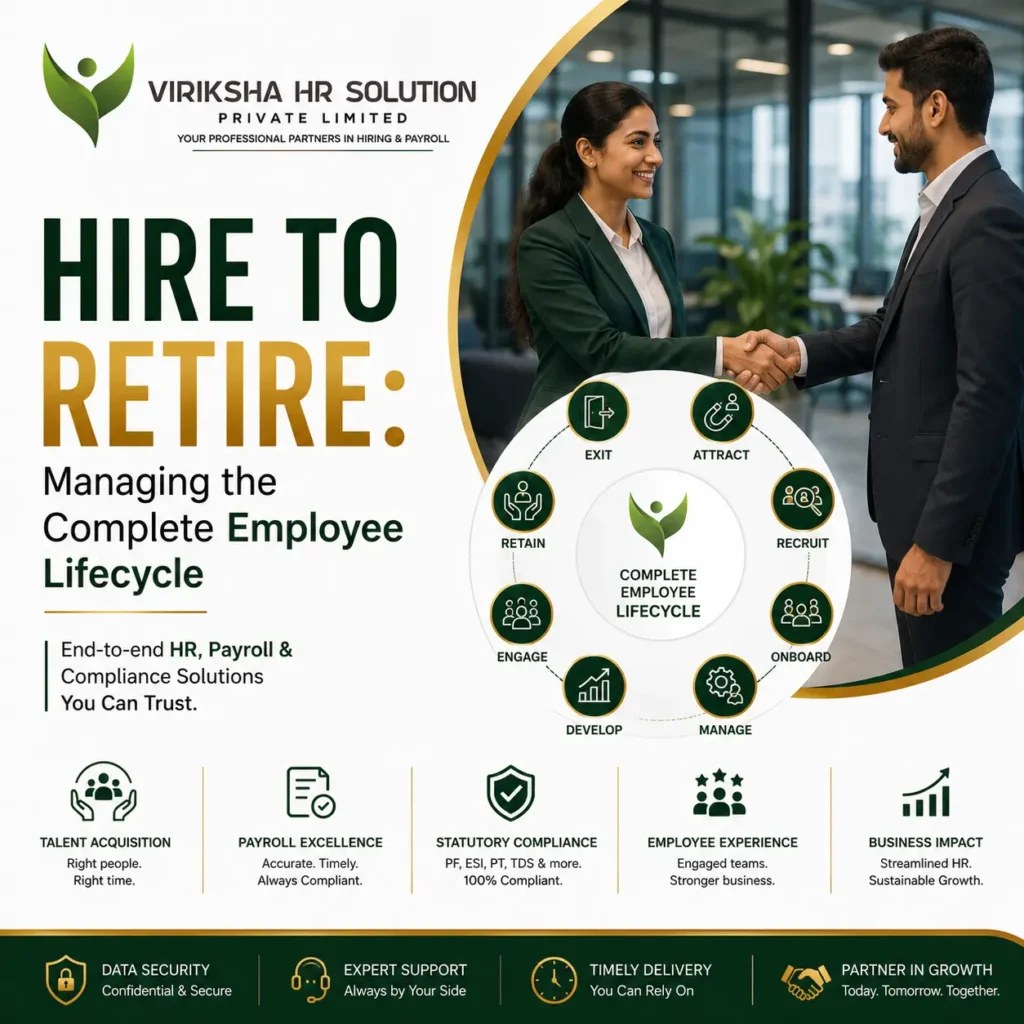
Viriksha HR Solution Hire to Retire: Managing the Complete Employee Lifecycle Hire to Retire Most businesses think about HR in fragments. Recruitment happens when a role opens. Payroll runs monthly. Compliance gets attention when a notice arrives. Performance reviews happen once a year — or not at all. Exit formalities are figured out when someone resigns. This fragmented approach to HR isn’t just inefficient. It creates compounding risk at every stage of the employee journey — compliance gaps that accumulate silently, performance issues that aren’t caught early enough, compensation structures that quietly erode retention, and exit processes that leave businesses exposed to disputes and documentation failures. The businesses that consistently build stronger, more stable workforces take a fundamentally different approach: they manage the complete employee lifecycle as one connected, structured process — from the moment a candidate accepts an offer to the day an employee retires or exits the organization. This is the hire-to-retire model. And for growing businesses across Chennai and pan-India — in manufacturing, IT, healthcare, finance, architecture, and professional services — it is the difference between reactive HR management and a workforce function that actively supports business growth. What Does “Hire to Retire” Actually Mean? The hire-to-retire model refers to end-to-end HR management that covers every stage of an employee’s professional journey within an organization: Joining and onboarding Performance management and development Compensation, salary reviews, and career growth Statutory compliance and employee benefits Retirement planning and exit management Full and final settlement Each of these stages connects to the next. Poor onboarding undermines performance. Weak performance management makes compensation decisions arbitrary. Compliance gaps at the payroll stage create problems at exit. A disorganized full and final settlement process turns a professional departure into a dispute. The hire-to-retire model treats these not as separate HR tasks but as a single, integrated employee journey — one that the business is responsible for managing with consistency, accuracy, and care from beginning to end. Stage 1: Employee Onboarding — Starting the Journey Right Onboarding is the first HR process an employee experiences — and the impression it creates shapes engagement, productivity, and early retention in ways that are difficult to reverse if the experience is poor. Structured onboarding covers far more than an induction presentation and a laptop handover. A complete onboarding process includes: Joining formalities and documentation — offer letter acceptance, appointment letter issuance, identity and qualification document collection, and background verification where applicable. Statutory registrations — UAN generation and PF enrollment, ESI registration for eligible employees, professional tax enrollment, and TDS declaration collection. These must be completed before the first payroll run — delays here create compliance gaps that require retroactive correction. Company policy orientation — leave policy, attendance requirements, code of conduct, IT and data security policies, and HR escalation processes communicated clearly at joining, not discovered gradually over months. Role clarity — documented Key Responsibility Areas (KRAs), reporting structure, performance expectations, and 30-60-90 day objectives established from day one, giving new employees a clear framework for early contribution. When a manufacturing client in Chennai engaged Viriksha HR Solutions to restructure their onboarding process, new joiner statutory registrations — previously completed inconsistently and often delayed — were brought into a structured workflow that completed all PF, ESI, and professional tax enrollments within the employee’s first week. The result was cleaner payroll from day one and significantly fewer first-month payroll corrections. A well-structured onboarding process doesn’t just create a positive first impression — it builds the HR foundation that every subsequent stage of the employee lifecycle depends on. Contact Viriksha HR Solution today Contact Viriksha HR Solution today and let’s build the HR foundation your workforce needs. Contact Us Stage 2: Performance Management — Aligning People with Business Goals Performance management is one of the most underinvested areas of HR in growing businesses. Many organizations rely on annual appraisals as their sole performance mechanism — a single conversation per year that attempts to cover twelve months of contribution, development gaps, and future planning simultaneously. The result is rarely useful for the employee or the business. Effective performance management is an ongoing process built on four elements: Goal setting — KRAs and KPIs defined at the beginning of each performance cycle, aligned with department objectives and the broader business direction. Employees who understand what they are being measured against perform more consistently than those working without defined targets. Regular feedback — structured feedback conversations that identify challenges, recognize contribution, and course-correct early — before performance gaps become performance problems. Development planning — identifying skill requirements and growth opportunities that motivate employees and build organizational capability simultaneously. Performance improvement frameworks — structured, documented processes for addressing underperformance that protect both the employee and the business, with clear timelines, support mechanisms, and outcome criteria. Stage 3: Quarterly and Half-Yearly Reviews — The Cadence That Makes Performance Management Work The frequency of performance conversations determines their usefulness. Annual reviews are too infrequent to be corrective — by the time problems are formally discussed, they have typically been operating for months without intervention. Quarterly reviews focus on short-term goal progress — what has been achieved, what is behind, what obstacles exist, and what immediate corrective actions are needed. They are forward-looking conversations, not retrospective judgments. Half-yearly reviews take a broader lens — evaluating overall performance trajectory, identifying development requirements, assessing skill improvement against plans established at the beginning of the year, and setting objectives for the second half of the cycle. Together, quarterly and half-yearly reviews create a performance rhythm that identifies issues early, supports continuous development, and gives employees regular, structured engagement with their growth within the organization — one of the most consistent drivers of retention that businesses frequently undervalue. Stage 4: Skill Mapping and Competency Development As businesses grow, the skills that built them are not always the skills that will scale them. Skill mapping addresses this gap systematically — giving organizations a clear picture of existing employee capabilities, where those capabilities align with current and future role requirements, and
How Viriksha HR Solutions Delivers HR’s Payroll & Compliance That Businesses Can Actually Rely On
Viriksha HR Solution How Viriksha HR Solutions Delivers Payroll and Statutory Compliance That Businesses Can Actually Rely On Zero Errors. Zero Compliance Issues. HR’s Payroll & Compliance Services Payroll errors are not minor administrative inconveniences. A salary processed incorrectly erodes employee trust in ways that take months to rebuild. A missed PF filing triggers penalty interest that compounds silently until a government notice arrives. An ESI computation error for contract staff creates principal employer liability that surfaces during a labour department inspection — not at a convenient moment. For businesses managing payroll in-house with stretched HR teams, or outsourcing to vendors who treat payroll as a transactional monthly task rather than a compliance-critical function, these aren’t hypothetical risks. They are recurring operational realities. At Viriksha HR Solution, payroll and statutory compliance is managed differently — with a two-level validation process, a structured compliance calendar, and a five-year track record of zero payroll errors and zero compliance issues across 3,600+ employees managed monthly across Chennai and pan-India. Here is exactly what our payroll and compliance process looks like — and what five years of clean delivery actually requires. Explore more Why Most Payroll Outsourcing Falls Short Most payroll vendors process what they receive. If attendance data arrives late, payroll runs late. If a salary revision isn’t communicated correctly, it gets processed incorrectly. If a new joiner’s PF registration is delayed, their first month’s contribution is missed — and the correction process begins. This reactive model — process inputs, file outputs, flag errors after they occur — is the standard payroll outsourcing approach. It produces the vast majority of compliance issues that businesses face: not through deliberate negligence, but through the absence of structured validation, proactive compliance management, and accountability for output accuracy. Viriksha HR Solutions was built on a different model. Our payroll process is defined by two principles: validate before processing, not after, and manage compliance proactively, not reactively. Our Payroll Process: What Zero Errors Actually Requires Input Collection and Validation Every monthly payroll cycle begins with structured input collection — attendance data, leave records, variable pay inputs, new joiner information, salary revision notifications, and exit processing requirements. But collection alone isn’t enough. Every input is validated against the previous month’s data and the employee master before processing begins — identifying discrepancies, missing information, and inconsistencies before they enter the payroll calculation. This upstream validation step is where most payroll errors originate when skipped — and where Viriksha HR Solutions eliminates them before they reach the calculation stage. Two-Level Validation Before Processing Before any payroll output is finalized — before a single payslip is generated or a statutory challan is computed — every payroll run goes through two independent validation checks: First-level validation — the processing team reviews computed outputs against inputs: gross salary calculations, statutory deduction computations, variable pay integrations, and net pay figures are checked line by line against source data. Second-level validation — a senior payroll specialist independently reviews the first-level validated output, specifically checking statutory computation accuracy — PF employee and employer contributions, ESI eligibility and deduction, TDS computation against each employee’s current tax working, and professional tax deduction per state schedule. Only after both validation levels clear does payroll proceed to output generation. This two-gate process is what produces zero-error payroll at scale — not technology alone, but structured human verification at two independent stages before any output leaves the system. Payslip Generation and Distribution Every employee receives a detailed monthly payslip reflecting gross salary, all statutory and voluntary deductions, reimbursement components, and net pay — generated and distributed within the agreed payroll timeline without exception. Payslip accuracy is verified as part of the second-level validation before distribution. Statutory Filing — On Time, Every Time The compliance calendar doesn’t move. PF ECR filing and challan submission by the 15th. ESI challan by the 15th. TDS deposit by the 7th. Professional tax per state schedule. These are non-negotiable deadlines with penalty consequences for delay — and Viriksha HR Solutions has not missed a statutory filing deadline across 3,600+ employees managed over five years. This isn’t achieved through reminders. It is achieved through a structured compliance calendar built into every client engagement — with filing preparation beginning well in advance of each deadline, not on the deadline date. Partner With Viriksha HR for Your Next Design Hire Whether you need a single senior hire, a complete project team, or ongoing talent acquisition support as your studio scales, Viriksha HR is ready to bring the right candidates to your table. Contact Us Statutory Compliance: What Five Years of Zero Issues Covers PF / EPF Compliance PF registration services and establishment code management Monthly PF contribution computation — employee 12% and employer 12% (EPF + EPS split) PF ECR filing — electronic challan receipt submitted monthly without delay PF return filing and annual compliance UAN generation for every new joiner before their first payroll cycle EPF consultant support for employee claims, transfer requests, and KYC approvals PF compliance management across permanent and contract workforce categories ESI Compliance ESI registration services — 24 companies registered for ESI across client engagements over five years Monthly ESI contribution computation for all eligible employees ESI monthly filing and ESI return filing — zero delayed submissions Employee State Insurance consultant support for claim and benefit processing Professional Tax Compliance Professional tax registration — 24 companies registered for PT across client engagements Monthly PT deduction and payment per state schedule Professional tax consultant support for multi-state payroll clients TDS and Income Tax Compliance Monthly TDS computation under the Income Tax Act across all employee categories Quarterly TDS return filing — Form 24Q submitted without delay every quarter Year-end Form 16 issuance for all employees Investment proof collection and final tax computation at year-end TDS advisory for GCC clients managing deputed employees and expat payroll components Labour Law Compliance Shops and Establishments Act compliance for all registered client establishments Contract Labour Act compliance management — principal employer obligation support for clients engaging contract workforce Maternity
What Makes Viriksha HR Solutions Different from Other Recruitment Consultancies in Chennai and Across India

Viriksha HR Solution What Makes Viriksha HR Solution Different from Other Recruitment Consultancies in Chennai and Across India What Makes Viriksha HR Solution Different from Other Recruitment Consultancies in Chennai and Across India Every HR consultancy in Chennai will tell you they find great candidates. Every recruitment firm will promise speed, quality, and fit. But when a business has had three poor hires in a row, missed a critical project deadline because a role stayed vacant for four months, or onboarded a “qualified” candidate who left within 90 days — those promises start to sound identical. The real question isn’t what an HR consultancy says it does. It’s what it can prove, consistently, over time. At Viriksha HR Solution, we don’t lead with promises. We lead with a process — a structured, three-tier screening methodology that has produced 1,250+ successful placements at executive and senior management level over the last five years, across manufacturing, IT, healthcare, finance, architecture, and GCC clients in Chennai and pan-India. Here is exactly what our recruitment process looks like — and why it consistently delivers results that other HR consultancies in Chennai don’t. Explore more The Problem with Most Recruitment Consultancies Most recruitment firms operate on volume logic: send as many profiles as possible, as fast as possible, and let the client do the filtering. The result is hiring managers spending hours reviewing mismatched resumes, conducting interviews that should never have been scheduled, and making compromised hiring decisions under time pressure — because the recruitment partner didn’t do its job properly upstream. This approach costs businesses far more than the recruitment fee. The real cost is in management time lost, roles that stay vacant while unsuitable profiles are cycled through, and — worst of all — poor-fit hires that underperform, disrupt teams, and leave within months, restarting the entire cycle. Viriksha HR Solutions was built to solve this problem — not with a different pitch, but with a different process. Our Three-Tier Screening Process: What Happens Before You See a Resume Tier 1: Basic Screening Every candidate entering our pipeline is first screened against the exact parameters of the job description — role requirements, experience range, technical qualifications, industry background, and location alignment. This is the entry gate, not the finish line. Candidates who don’t meet the fundamental role criteria are filtered out at this stage — before any interview time is consumed, on either side. This sounds obvious. In practice, most recruitment firms skip rigorous first-tier filtering in the interest of speed, sending profiles that technically match a keyword search but don’t actually fit the role. Tier 2: Mid-Level Assessment — The Candidate Assessment Report This is where Viriksha HR Solutions’ process diverges most significantly from standard recruitment practice. Every candidate who passes basic screening undergoes a comprehensive mid-level assessment — and every client receives a structured Candidate Assessment Report covering: Stability — career tenure analysis assessing whether the candidate demonstrates consistent commitment or a pattern of short tenures that predicts early attrition. We flag instability patterns explicitly, rather than leaving clients to discover them during reference checks. Family Background — a contextual understanding of the candidate’s personal stability factors that influence long-term commitment to a role and location. This is particularly relevant for senior and executive placements where relocation or extended travel is involved. Previous Employment Verification — direct verification of the candidate’s employment history, designation, and exit circumstances — not a resume read, but an active check that surfaces discrepancies before they become post-hire problems. Core Skill Analysis — structured assessment of the candidate’s primary technical and functional skills against role requirements, going beyond qualification claims to verify actual competency depth. Communication Assessment — evaluation of the candidate’s professional communication — written, verbal, and interpersonal — calibrated to the communication demands of the specific role and organizational level. Reason for Career Change — a structured understanding of why the candidate is considering a move. Motivations driven by genuine growth alignment produce better long-term retention than those driven purely by compensation pressure — and we distinguish between them explicitly. Education and Career Gap Analysis — any gaps in education or employment history are identified, explained, and assessed for relevance to the role — presented transparently in the assessment report rather than left for the client to discover independently. This level of pre-screening depth is what eliminates the resume-to-regret cycle that most businesses experience with standard recruitment vendors. Tier 3: Manager-Level Screening For senior, leadership, and executive placements, every candidate undergoes an additional manager-level screening round conducted by Viriksha HR Solutions’ senior consultants — assessing leadership capability, strategic thinking, stakeholder management, and organizational cultural alignment before the candidate ever meets the client. This third tier exists because executive hiring mistakes are disproportionately expensive — in compensation, onboarding investment, team disruption, and the time cost of restarting a senior search. Manager-level pre-screening at our end means clients’ leadership time is spent evaluating genuinely shortlisted candidates, not conducting preliminary filtering that should have happened earlier. Contact Viriksha HR Solution today If your business is ready to experience what structured, accountable recruitment actually looks like — contact Viriksha HR Solution today and let’s discuss your next hiring requirement. Contact Us What You Receive: Resume Plus Assessment Report Plus Tracker After all three screening tiers are complete, clients receive not just a resume — but a complete hiring package: Candidate Resume — updated, formatted, and verified against our employment checks. Candidate Assessment Report — the structured mid-level assessment covering stability, background, employment verification, core skills, communication, career change rationale, and gap analysis. This report gives hiring managers everything they need to make an informed interview decision before the first meeting. Candidate Tracker — a live pipeline tracker showing every candidate’s current status — screened, shortlisted, interview scheduled, offer stage, joined — giving clients complete visibility on the hiring pipeline without chasing updates. This is what a genuine recruitment partnership looks like in practice: not profiles in an email, but a structured, documented, trackable process that respects clients’
Digital Marketing Agencies’ Payroll and Compliance Services in India

Viriksha HR Solution Digital Marketing Agency Payroll & Compliance in India It Is the 14th of the Month. Your PF Filing Is Due Tomorrow. Where Is Your Agency’s Compliance? Picture this. Your performance marketing team just closed a record month — ROAS is up, client retention is strong, and the leadership team is finally breathing easy after a brutal Q3. Then someone in accounts mentions the PF ECR filing is overdue. The ESI return for last quarter was never reconciled. And the three freelance content writers your agency has been paying monthly for eight months? Nobody is sure whether they should have been on payroll all along. This is not a hypothetical. It is the reality inside dozens of digital marketing agencies and in-house marketing teams across India — businesses so focused on campaigns, clients, and content that the compliance calendar quietly slips until a notice from the EPFO or a labour department inspection makes it impossible to ignore any longer. Viriksha HR Solution provides dedicated payroll outsourcing services and HR payroll and statutory compliance services built specifically for digital marketing agencies, digital staffing companies, and in-house digital marketing teams — so your leadership stays focused on campaigns and client growth, not compliance catch-up. Explore more Why Digital Marketing Firm Payroll Is More Complex Than It Looks The Freelancer Problem Nobody Talks About Digital marketing agencies run on a hybrid workforce model that creates compliance exposure almost by default. Full-time social media managers and SEO executives sit on payroll alongside freelance content writers, contract graphic designers, project-based video editors, and influencer marketing consultants engaged per campaign. This model is operationally smart — it keeps fixed costs manageable and gives agencies the flexibility to scale creative capacity up and down with client demand. But it creates a minefield of payroll and statutory compliance questions that most agency owners are not thinking about until something goes wrong. Are your freelance content writers genuinely independent, or have they effectively become employees through the nature and regularity of their engagement? If the latter, your agency carries retrospective PF, ESI, and gratuity liability that compounds for every month the misclassification continues. Multi-City Teams and Remote Work Complications Digital marketing teams are among the most distributed in any industry. A Chennai-headquartered agency might have an SEO manager working from Bengaluru, a content strategist based in Mumbai, and a performance marketing specialist operating remotely from Coimbatore. Each location triggers state-specific Professional Tax obligations, and depending on the nature of the office arrangement, potentially Shops and Establishment registrations that most agencies have never filed. Influencer and Creator Payments Agencies managing influencer marketing campaigns make payments to creators, bloggers, and social media personalities — often in significant volumes across a single campaign. These payments attract TDS under Section 194H (commission) or Section 194J (professional fees) depending on the nature of the arrangement. Getting this wrong is one of the most common compliance errors in digital marketing — and one of the most likely to trigger an income tax notice. Variable and Performance-Based Compensation Digital marketing professionals — particularly at the performance marketing and growth specialist level — frequently carry compensation structures tied to campaign results, client retention, or revenue targets. Structuring and processing this variable pay correctly within salary processing services and ensuring accurate TDS computation on total annual earnings requires payroll management that goes beyond a standard monthly salary run. The Digital Marketing Agency Compliance Calendar — What Needs to Happen Every Month This is what your agency’s compliance calendar should look like — and what Viriksha HR manages on your behalf so none of it gets missed. By the 7th of every month TDS deposit for the previous month — covering salary TDS under Section 192, professional fee TDS under Section 194J for freelance consultants, and commission TDS under Section 194H for influencer payments. By the 15th of every month PF ECR filing and challan deposit. This is non-negotiable — late filing attracts interest at 12 percent per annum and damages at up to 25 percent of arrears. Missing this deadline during a busy campaign month is one of the most common and expensive compliance errors digital agencies make. By the 15th of every month ESI contribution deposit for covered employees — typically junior marketing executives, content writers on payroll, and administrative staff earning up to ₹21,000 per month. Quarterly TDS return filing (Form 24Q for salary, Form 26Q for non-salary payments). Errors here affect your employees’ Form 26AS and create downstream tax filing complications for your team. Half-yearly ESI return filing reconciled against actual payroll data for the six-month period. Annually Bonus computation and disbursement under the Payment of Bonus Act, professional tax annual returns where applicable, and gratuity liability review for employees completing five or more years with the agency. As triggered New employee UAN generation, ESI IP number creation, KYC approvals, PF transfer approvals, and full and final settlement processing for exiting staff — all of which need to happen quickly and accurately regardless of what the campaign calendar looks like. Viriksha HR manages every one of these deadlines as your dedicated payroll consultant — so your team never has to choose between a client deliverable and a compliance filing. The Real Penalty Exposure — What Non-Compliance Actually Costs a Digital Agency PF Default Interest on delayed PF deposits: 12 percent per annum on outstanding amount. Damages for continued default: 5 to 25 percent of arrears depending on delay duration. For an agency with 20 employees and a six-month filing gap, this exposure runs into lakhs before legal costs are added. ESI Default Similar interest and penalty structure as PF, with the added risk of ESIC inspection that can disrupt operations and consume significant management time to resolve. Freelancer Misclassification If a content writer or graphic designer engaged as a freelancer is later determined to be a disguised employee, your agency faces retrospective PF contributions, ESI liability, and gratuity obligations for the entire engagement period — potentially spanning years. TDS Non-Compliance Failure to deduct
Digital Marketing Job Agency in India — Because Your Brand Cannot Afford the Wrong Hire
Viriksha HR Solution Digital Marketing Job Agency in India — Because Your Brand Cannot Afford the Wrong Hire Every Rupee You Spend on Digital Marketing Is Only as Good as the Person Managing It Let that sink in for a moment. Your Google Ads budget. Your Meta campaigns. Your SEO investment. Your content calendar. Your social media presence. Every single one of these is being managed — or mismanaged — by the people you hired to run them. And here is the uncomfortable truth most businesses discover too late: a mediocre digital marketing hire does not just underperform. They actively waste your budget, erode your brand positioning, and create a false sense of activity that masks the absence of real results. Vanity metrics go up. Revenue does not follow. The difference between a digital marketing team that drives measurable business growth and one that keeps producing reports that look busy without moving the needle is almost always a hiring problem — not a strategy problem, not a budget problem, and not a platform problem. This is why choosing the right digital marketing job agency is one of the highest-leverage decisions a growing business can make. Viriksha HR Solution is a dedicated digital marketing recruitment agency operating across Chennai and India — built specifically to help companies and agencies hire digital marketing talent that delivers real outcomes, not just impressive-sounding job titles. Explore more The Problem With How Most Companies Hire Digital Marketers Here is what typically happens when a company decides to hire a digital marketer without a specialist recruitment partner. They write a job description that lists every digital marketing skill in existence — SEO, paid media, social media, content, email, analytics, and more — because they are not sure exactly what they need and they want to cover all bases. They post it on a job portal and receive three hundred applications within a week. Sixty percent of applicants have listed every skill in the job description on their resume because they know that is what gets through the filter. The hiring manager — who is not a digital marketer themselves — shortlists based on years of experience and the names of companies on the resume. Three interviews happen. The candidate who presents most confidently gets the offer. Six months later, the ROAS has not improved, organic traffic is flat, and the social media engagement looks good on a dashboard but has not converted a single lead. This is not a hypothetical. It is the most common digital marketing hiring story in Indian businesses today. The root cause is always the same — hiring without genuine domain evaluation capability. And the solution is a digital marketing staffing agency that evaluates candidates the way a strong CMO would, not the way a generalist HR team can. What Viriksha HR Does Differently as a Digital Marketing Job Agency We Evaluate Results, Not Resumes When Viriksha HR screens a Performance Marketing Specialist, we ask for campaign data. We want to see ROAS trends, cost-per-acquisition benchmarks, and what optimizations the candidate made when performance dropped. When we screen an SEO Manager, we look at organic traffic growth timelines, keyword ranking progressions, and how they handled algorithm updates. A resume can say anything. Campaign data does not lie. We Understand Each Digital Sub-Discipline Independently Digital marketing is not one skill. It is ten distinct disciplines that happen to share a category name. Our recruiters understand the difference between: An SEO specialist who understands technical site architecture versus one who only writes meta descriptions A performance marketer who can scale campaigns profitably versus one who can only manage small budgets A social media manager who builds genuine community versus one who schedules posts and reports follower counts A content strategist who drives organic authority versus a content writer who produces volume without direction This sub-discipline understanding directly translates into better shortlists and fewer wasted interview cycles for your hiring team. We Reach Digital Talent That Is Not Looking The strongest digital marketers — the ones delivering real results for their current employer — are not scrolling job boards. They are running campaigns, optimizing funnels, and building audiences. Reaching them requires a digital marketing headhunter approach built on genuine industry relationships, not just job postings. Viriksha HR’s network across Chennai’s digital marketing community — spanning agencies on OMR, brand marketing teams in Nungambakkam and Anna Nagar, and digital-first companies across the city — gives us access to passive talent that standard job portals simply cannot surface. We Move at the Speed the Market Demands Strong digital marketing professionals receive multiple interview requests within days of becoming available. Companies that take three weeks to schedule a second interview lose consistently. As a focused digital staffing agency, Viriksha HR’s average shortlist turnaround for mid-level digital roles is 5 to 8 days, with most positions closed within 2 to 4 weeks. Digital Marketing Roles We Place — Every Function, Every Level As a full-spectrum digital marketing staffing agency, Viriksha HR recruits across every digital marketing function for both in-house teams and agencies. Leadership and Senior Roles We help you hire: Chief Marketing Officer (CMO) Vice President – Marketing Marketing Director Director of Digital Marketing Head of Digital Marketing Head of Growth Growth Marketing Director Digital Marketing Manager Marketing Communications Manager Brand Manager Performance Marketing Manager E-commerce Marketing Manager Digital Marketing Roles We help you hire: Digital Marketing Manager Digital Marketing Executive Digital Marketing Specialist Senior Digital Marketing Executive Digital Marketing Analyst Growth Marketing Specialist Marketing Automation Specialist Online Marketing Executive Internet Marketing Specialist SEO Roles We help you hire: SEO Manager Senior SEO Specialist SEO Executive SEO Analyst Technical SEO Specialist Local SEO Specialist E-commerce SEO Specialist SEO Content Strategist Link Building Specialist Search Engine Marketing (SEM) & PPC Roles We help you hire: SEM Manager PPC Manager PPC Specialist Google Ads Specialist Paid Search Specialist Paid Media Manager Performance Marketing Executive Campaign Manager Display Advertising Specialist Social Media Marketing Roles We help you hire: Social Media Manager
How to Set Up Payroll for a GCC in India: A Complete Guide for MNCs and Global Capability Centers
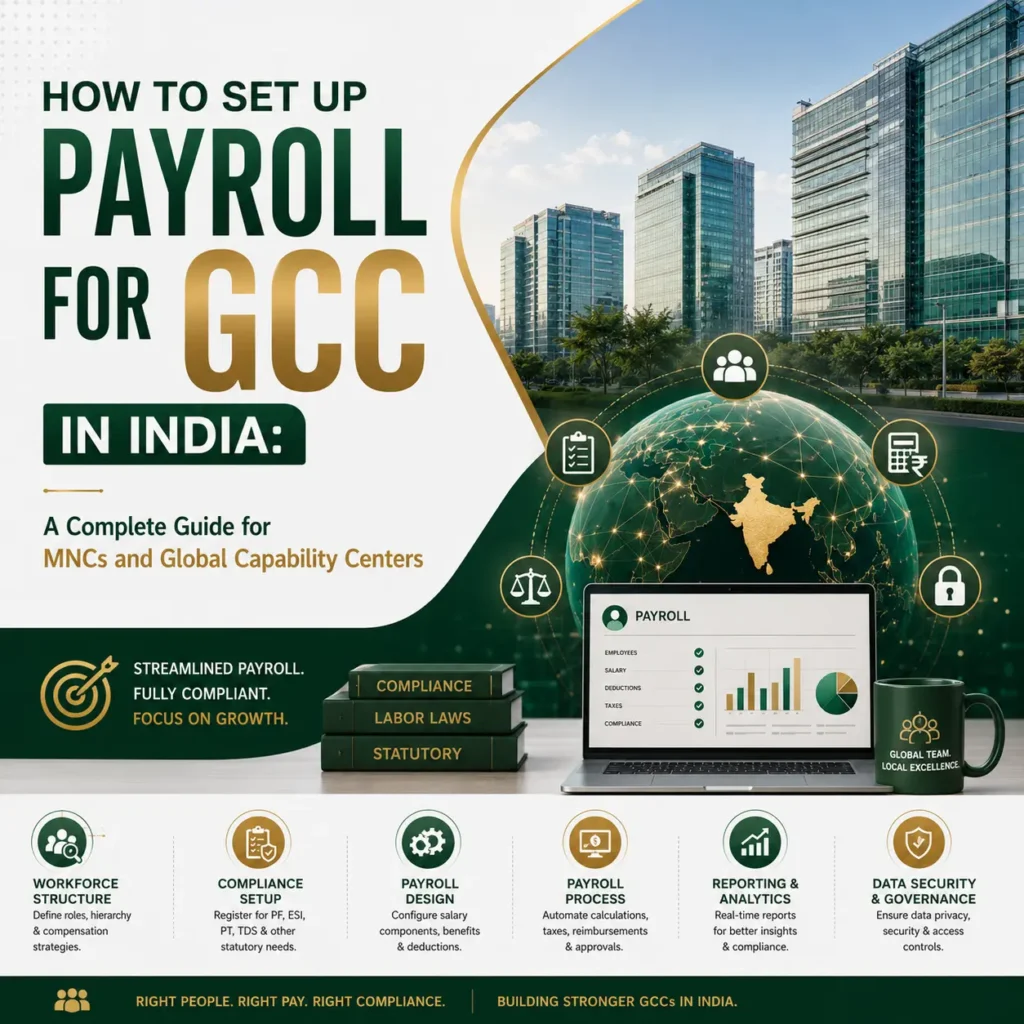
Payroll for GCC in India A Complete Guide for MNCs and Global Capability Centers Get a Consultation Talk to Our Experts Specialist Recruitment Right talent for your business Payroll Support Accurate and confidential Statutory Compliance Stay compliant with confidence Pan-India Services Support across India How to Set Up Payroll for GCC in India India is home to over 1,700 Global Capability Centers, with hundreds more in setup phases across Chennai, Bengaluru, Hyderabad, Mumbai, and Pune. For every MNC establishing a GCC in India, the operational priorities are clear: hire the right talent, deliver capability on schedule, and manage the India entity compliantly from day one. Payroll sits at the intersection of all three. Get it right from the start and the GCC builds a stable, compliant, operationally sound foundation. Get it wrong — through incorrect deductions, late statutory filings, or misclassified workforce categories — and the GCC spends its first critical years correcting compliance errors instead of delivering on its capability mandate. This guide covers everything an MNC or GCC leadership team needs to know about setting up payroll in India correctly — from entity registration and CTC structuring to PF, ESI, TDS compliance, and the payroll outsourcing model that most GCCs adopt for ongoing management. Explore more Simpler PayrollStronger Business Step 1: Understand India’s Payroll Compliance Framework Before processing a single salary, GCC leadership teams need to understand that India’s payroll environment is significantly more complex than most global markets. Unlike jurisdictions where payroll involves straightforward income tax withholding and a small number of employer contributions, India’s statutory framework layers multiple obligations across both employer and employee: Provident Fund (PF/EPF) Every month, each employee receives a clear, compliant payslip showing their gross salary, all deductions with amounts, and net salary. This is compliant with your salary structure and all your official filings. Monthly Compliance Report A single document summarising payroll headcount, total payroll cost, all statutory liabilities for the month, and proof of every filing. Delivered to your finance or HR contact before the 5th of the following month. ESI Contribution and Filing ESI is calculated correctly on gross salaries, paid before the 15th, and ESI challan and payment confirmation is retained. Professional Tax Calculated based on the correct Tamil Nadu slab for the respective employees and paid to the state in a timely manner. Labour Welfare Fund The share of the fund for the employee and employer is calculated and paid based on the Tamil Nadu schedule. Monthly Salary Processing Attendance data is received, checked, verified, and processed. Each employee receives their correct salary, with all deductions correctly applied. Pro-rated salaries for new joiners and those leaving the company are processed automatically. Your only role is to sign off on the final payroll summary, which is then sent to the bank. 500+ Businesses Served Across Tamil Nadu & Pan India 5+ Years of expertise 40+ Average Monthly Time Saved Per Business Step 2: Complete Entity and Establishment Registrations Payroll compliance in India begins with the correct registrations for the GCC entity. Before the first payroll run, the following registrations must be in place: 01 PF Registration Mandatory for establishments with 20 or more employees. In practice, most GCCs register immediately on incorporation given anticipated headcount. PF registration services through a specialist consultant ensure correct establishment code allocation and sub-code setup for multiple office locations. 02 ESI Registration Mandatory for establishments with 10 or more employees in applicable industries. ESI registration services must be completed before any ESI-eligible employee joins payroll. 03 Professional Tax Registration State-specific registration required in Tamil Nadu and most other states where GCC employees are based. 04 Shops and Establishments Act Registration Required for all commercial establishments in the state of operation, typically one of the first registrations completed for a new GCC entity. 05 TAN Registration Tax Deduction Account Number required for TDS deduction and deposit, typically obtained as part of the broader entity setup process. Delays in any of these registrations create downstream payroll compliance gaps — particularly PF and ESI, where retroactive corrections for missed contribution periods involve penalty interest and administrative complexity. Step 3: Structure CTC Correctly for India’s Tax and Compliance Environment Cost-to-Company (CTC) structuring for GCC employees is one of the most consequential payroll decisions a new India centre makes — and one of the most frequently mishandled by MNCs applying global compensation frameworks to India payroll. An optimally structured India CTC typically includes: Basic Salary — typically 40-50% of gross CTC. Basic salary drives PF computation, gratuity provisioning, and leave encashment — so the basic percentage has direct compliance and cost implications. House Rent Allowance (HRA) — tax-exempt component for employees paying rent, up to prescribed limits under Section 10(13A) of the Income Tax Act. Special Allowance — fully taxable but flexible component used to balance the CTC structure. Reimbursement Components — meal allowances, telephone reimbursements, and leave travel allowance components that provide tax efficiency within prescribed limits. Variable Pay — performance-linked component paid quarterly or annually, requiring careful TDS planning to avoid year-end tax spikes. Employer PF Contribution — typically shown as a CTC component, representing the employer’s 12% contribution to EPF/EPS. Gratuity Provisioning — typically shown as a CTC component representing annual gratuity accrual. Salary optimization services from a specialist payroll partner ensure GCC compensation packages are structured to maximize tax efficiency for employees while remaining fully compliant — a combination that directly impacts offer acceptance rates in Chennai’s competitive GCC talent market. Step 4: Set Up Monthly Payroll Processing Workflows Once registrations are complete and CTC structures are defined, the monthly payroll processing workflow needs to be established. A correctly structured GCC payroll cycle typically involves: Attendance and leave data collection Integration between the GCC’s attendance management system and payroll processing, capturing loss of pay, overtime, and leave encashment components accurately. Variable pay inputs Collection and validation of performance bonus, incentive, and commission inputs from business unit heads before payroll processing. New joiner onboarding UAN generation, PF nomination form collection, ESI enrollment, professional tax
GCC Payroll Outsourcing & Statutory Compliance Services for Global Capability Centers in India
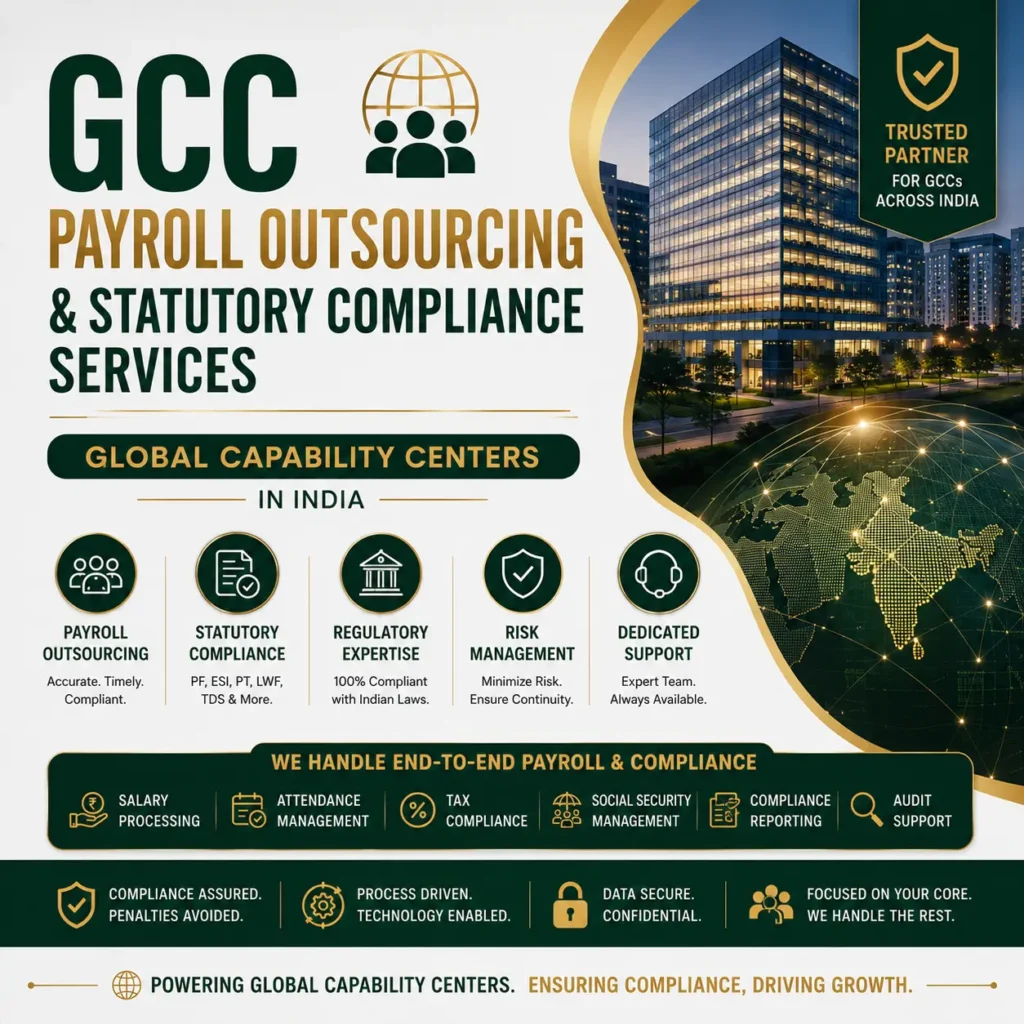
GCC Payroll Outsourcing & Statutory Compliance Services GCC Payroll Outsourcing & Statutory Compliance Services for Global Capability Centers in India Get a Consultation Talk to Our Experts Specialist Recruitment Right talent for your business Payroll Support Accurate and confidential Statutory Compliance Stay compliant with confidence Pan-India Services Support across India GCC Payroll Outsourcing & Statutory Compliance Setting up a Global Capability Center in India is a strategic milestone. Managing its India workforce compliantly, accurately, and at scale — month after month, across a payroll environment that is complex by global standards — is the operational challenge that follows immediately after. India’s statutory compliance framework for GCC and MNC employers is among the most layered in the world: Provident Fund, Employee State Insurance, Tax Deducted at Source, gratuity, professional tax, labour welfare fund, and a range of state-specific and establishment-specific obligations that apply simultaneously across permanent employees, contract staff, and deputed professionals. Getting any of these wrong — through incorrect deductions, late filings, or misclassified workforce categories — carries financial penalties, regulatory scrutiny, and reputational consequences that no GCC leadership team wants to manage alongside their core capability delivery mandate. Viriksha HR Solution provides end-to-end GCC payroll outsourcing and statutory compliance services for Global Capability Centers and MNCs operating in Chennai and across India — managing the complete payroll and compliance lifecycle with the accuracy, timeliness, and regulatory expertise that India’s statutory environment demands. Explore more Simpler PayrollStronger Business Why GCC Payroll in India Requires Specialist Management Before processing a single salary, GCC leadership teams need to understand that India’s payroll environment is significantly more complex than most global markets. Unlike jurisdictions where payroll involves straightforward income tax withholding and a small number of employer contributions, India’s statutory framework layers multiple obligations across both employer and employee: Complexity That Global Payroll Systems Don’t Anticipate Most MNCs entering India underestimate the gap between their global payroll infrastructure and India’s statutory reality. Global HRIS and payroll platforms — Workday, SAP, Oracle — are not natively configured for India’s compliance requirements. PF ECR filing formats, ESI contribution calculations, professional tax state schedules, and TDS computation under Indian Income Tax rules require India-specific payroll expertise that global platforms alone cannot provide. Mixed Workforce Categories Add Compliance Layers GCCs typically manage multiple workforce categories simultaneously — permanent employees on direct payroll, contract professionals engaged through staffing vendors, deputed employees from the parent organization, and consultants on fixed-term agreements. Each category carries distinct statutory obligations, and misclassifying workers across these categories is one of the most common — and costly — compliance errors GCC operations make in their early years. Rapid Headcount Growth Creates Payroll Scaling Pressure GCCs in build-out and scaling phases add headcount rapidly — sometimes 20 to 50 new joiners per month. Each new joiner requires UAN generation, PF registration, ESI enrollment, TDS onboarding, and payroll integration within tight timelines. Without a payroll outsourcing partner with structured onboarding workflows, this volume creates errors, delays, and compliance gaps that compound quickly. Parent Organization Reporting Requires India-Specific Translation GCC finance and HR leadership must regularly translate India payroll data — CTC structures, statutory deduction breakdowns, compliance status reports — into formats that parent organization finance teams, global HR systems, and external auditors can interpret accurately. This translation layer requires both India payroll expertise and structured reporting capability. Viriksha HR Solution: GCC Payroll Outsourcing Services Architecture and interior design projects increasingly depend on strong MEP and HVAC coordination to move from design intent to functional execution. Viriksha HR provides dedicated MEP recruitment services and HVAC recruitment services for architecture firms, interior design studios, and project execution teams. Payroll Processing and Salary Management Viriksha HR Solution manages end-to-end monthly payroll processing for GCC clients — covering salary computation, variable pay integration, reimbursement processing, payslip generation, and net pay disbursement coordination. CTC structuring services and salary optimization services ensure GCC compensation packages are structured competitively while remaining tax-efficient and compliance-aligned. PF / EPF Compliance Services PF registration services for new GCC entities and additional establishment registrations UAN generation and KYC verification for all new joiners Monthly PF contribution computation — employee and employer components PF ECR filing — monthly electronic challan receipts filed accurately and on time PF return filing and annual compliance EPF consultant support for claim processing, transfer requests, and employee queries PF compliance services across permanent and contract workforce categories ESI Compliance Services ESI registration services for GCC establishments Monthly ESI contribution computation across eligible employee categories ESI monthly filing and ESI return filing with zero-delay compliance Employee State Insurance consultant support for claim and benefit queries ESI compliance management across mixed workforce categories TDS and Income Tax Compliance Monthly TDS computation under the Indian Income Tax Act across all employee categories Form 16 issuance for all employees at year-end Quarterly TDS return filing Tax declaration management — investment proof collection and final tax computation TDS advisory for deputed employees and expat payroll components where applicable Professional Tax Compliance Professional tax registration for GCC establishments in Tamil Nadu and other states Monthly professional tax computation and deduction Professional tax consultant support for multi-state GCC operations State-specific professional tax schedule management across all locations where GCC employees are based Payroll Compliance and Labour Law Adherence Labour law compliance services across Shops and Establishments Act, Maternity Benefit Act, and applicable state-specific labour regulations HR payroll and statutory compliance services integrated into every payroll cycle Payroll compliance services including filing calendars, deadline tracking, and proactive compliance alerts Contract labour compliance management for GCCs engaging staffing vendors HR Documentation and Onboarding Support Employment contract templates aligned with Indian labour law Offer letter and appointment letter management Statutory onboarding documentation — PF nomination forms, ESI registration, professional tax enrollment Exit documentation — full and final settlement computation, gratuity calculation, relieving letters How We Helped a GCC Restructure Payroll and Achieve Full Compliance A mid-sized GCC in Chennai — a technology captive of a European MNC — approached Viriksha HR Solution 18 months after launch with a significant payroll and compliance challenge.
GCC Recruitment & MNC Hiring Solutions in Chennai | Executive Search, Bulk Hiring & Talent Acquisition for Global Capability Centers
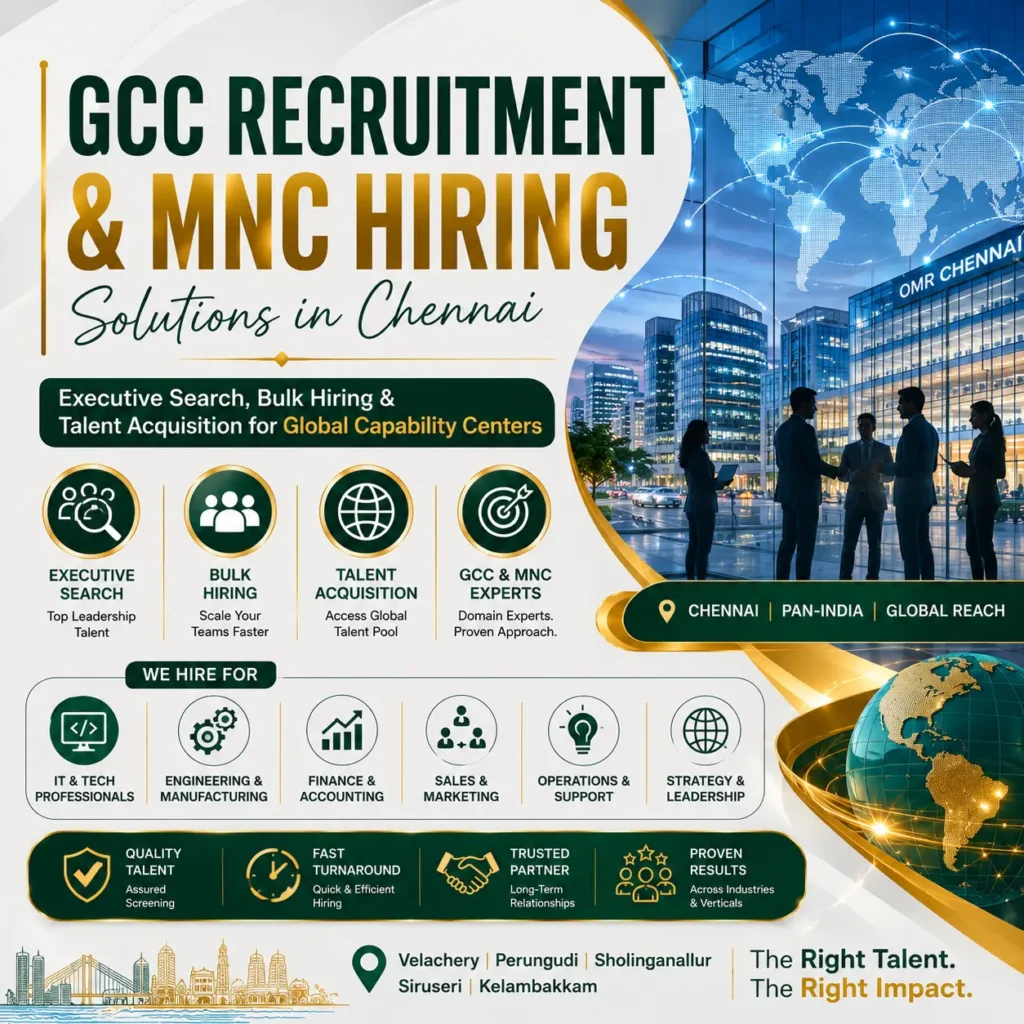
Viriksha HR Solution GCC Recruitment & MNC Hiring Solutions in Chennai | Executive Search, Bulk Hiring & Talent Acquisition for Global Capability Centers GCC Recruitment & MNC Hiring Solutions in Chennai India has become the world’s most preferred destination for Global Capability Centers. With over 1,700 GCCs already operating across the country and hundreds more in various stages of setup, the India GCC market is expanding at a pace that has fundamentally reshaped how MNCs think about talent, operations, and long-term capability building. Chennai, in particular, has emerged as one of India’s top GCC destinations — combining a deep engineering and technology talent pool, competitive operating costs, strong infrastructure, and a business-friendly environment that attracts Fortune 500 companies and mid-sized multinationals alike. But setting up and scaling a GCC in India isn’t just a real estate and legal exercise. The single most critical success factor for any GCC — and the one most frequently underestimated during the planning phase — is talent. Getting the right people into the right roles, at speed, with cultural alignment to both the parent organization and the India operating context, is what separates GCCs that hit their capability targets from those that spend their first two years in constant hiring catch-up. Viriksha HR Solution is a dedicated GCC recruitment and MNC hiring solutions partner in Chennai — providing executive search, bulk technology hiring, talent acquisition, payroll outsourcing, and statutory compliance support for Global Capability Centers at every stage: pre-launch talent planning, initial team build-out, scaling phases, and ongoing leadership hiring. Explore more Why GCC Recruitment in India Is Uniquely Challenging GCC hiring in India presents a specific set of challenges that standard recruitment approaches consistently underestimate: Speed-to-talent pressure is extreme GCCs operate against parent organization timelines — go-live dates, capability delivery commitments, and board-level visibility that leaves little room for extended hiring cycles. Missing a 90-day team build-out target doesn’t just delay operations; it delays value delivery to the global parent, with reputational consequences for the India leadership team. Role profiles are highly specialized GCCs don’t hire generalists. They hire analytics leads, cloud architects, cybersecurity specialists, finance transformation professionals, supply chain technology experts, and niche engineering profiles that require sourcing from specific, often passive talent pools. Competition for GCC talent is fierce Chennai’s GCC talent market is contested — every major MNC setting up or expanding in the city is competing for the same experienced technology and operations professionals. Without active pipelines and passive candidate relationships already in place, GCC hiring teams consistently lose top candidates to faster-moving competitors. Cultural alignment is non-negotiable GCC talent must align with both the parent organization’s global standards and the India centre’s operational culture. A technically excellent hire who cannot bridge global-local expectations creates friction that compounds across teams and timelines. Compliance complexity is significant GCCs managing large India headcounts navigate PF, ESI, TDS, gratuity, and labour law obligations across permanent employees, contract staff, and deputed professionals simultaneously — requiring a recruitment and HR partner who handles compliance as an integrated function, not an afterthought. Viriksha HR Solution: Chennai’s Trusted GCC Recruitment Partner As a specialist GCC recruitment and executive search firm in Chennai, Viriksha HR Solution brings together three capabilities that GCC and MNC clients require simultaneously: Speed Active talent pipelines across technology, analytics, finance, and operations roles that reduce sourcing time dramatically compared to starting searches cold. Quality Structured evaluation through the 5 C’s framework (Competency, Character, Chemistry, Culture, Consistency) that ensures every candidate presented is aligned on dimensions that predict long-term GCC success, not just immediate role fit. Compliance Integrated payroll, statutory compliance, and HR documentation support that ensures the GCC’s India workforce is managed correctly from day one. GCC Recruitment Services Offered by Viriksha HR Solution Bulk Technology & Operations Hiring For GCCs in build-out phase — hiring 20, 50, 100, or more professionals within defined timelines — Viriksha HR Solution deploys structured bulk hiring frameworks: dedicated sourcing teams, pre-screened candidate pools, parallel interview pipelines, and ATS-integrated tracking that gives GCC leadership complete visibility on hiring progress against targets at every stage. Executive Search for GCC Leadership Building the right GCC leadership team is the single most consequential set of hiring decisions a parent organization makes for its India centre. The wrong GCC Head, VP of Engineering, or Finance Director doesn’t just underperform individually — they shape the culture, capability, and credibility of the entire centre for years. Contract Staffing and Flexible Workforce Solutions GCCs managing project-based workloads, transition phases, or capability pilots often require contract professionals alongside permanent headcount. Viriksha HR Solution provides compliant contract staffing solutions for GCC clients — managing contractor agreements, statutory compliance, and payroll processing for flexible workforce components. Talent Acquisition for GCC Scaling Phases Post-launch GCCs scaling from initial team to full operating capacity require a talent acquisition partner who understands the centre’s evolving capability needs — not just a staffing vendor filling requisitions. Viriksha HR Solution supports GCC scaling phases with workforce planning alignment, proactive pipeline building for anticipated roles, and structured hiring cadences that keep scaling on track. As a specialist executive search firm in Chennai, Viriksha HR Solution conducts confidential, structured leadership searches for GCC Head roles, functional leadership positions, and senior specialist appointments — combining deep Chennai market knowledge with passive candidate networks developed across years of GCC and MNC hiring. How We Helped a GCC Hire 50 Engineers in 60 Days A global technology MNC establishing its first GCC in Chennai approached Viriksha HR Solution with a critical challenge: build a 50-member engineering team — spanning software engineers, DevOps specialists, QA leads, and data engineers — within 60 days of engagement, aligned with the parent organization’s go-live commitment to its global board. The challenge was significant. The GCC had no existing India talent brand, no local HR infrastructure, and was competing directly against established MNC captive centres and well-funded product companies for the same Chennai engineering talent pool. What Viriksha HR Solution did: Within the first week, Viriksha HR Solution deployed a dedicated GCC
Strategic Recruitment Partner for IT, MNC, GCC, Manufacturing & SMBs | Chennai & Pan-India
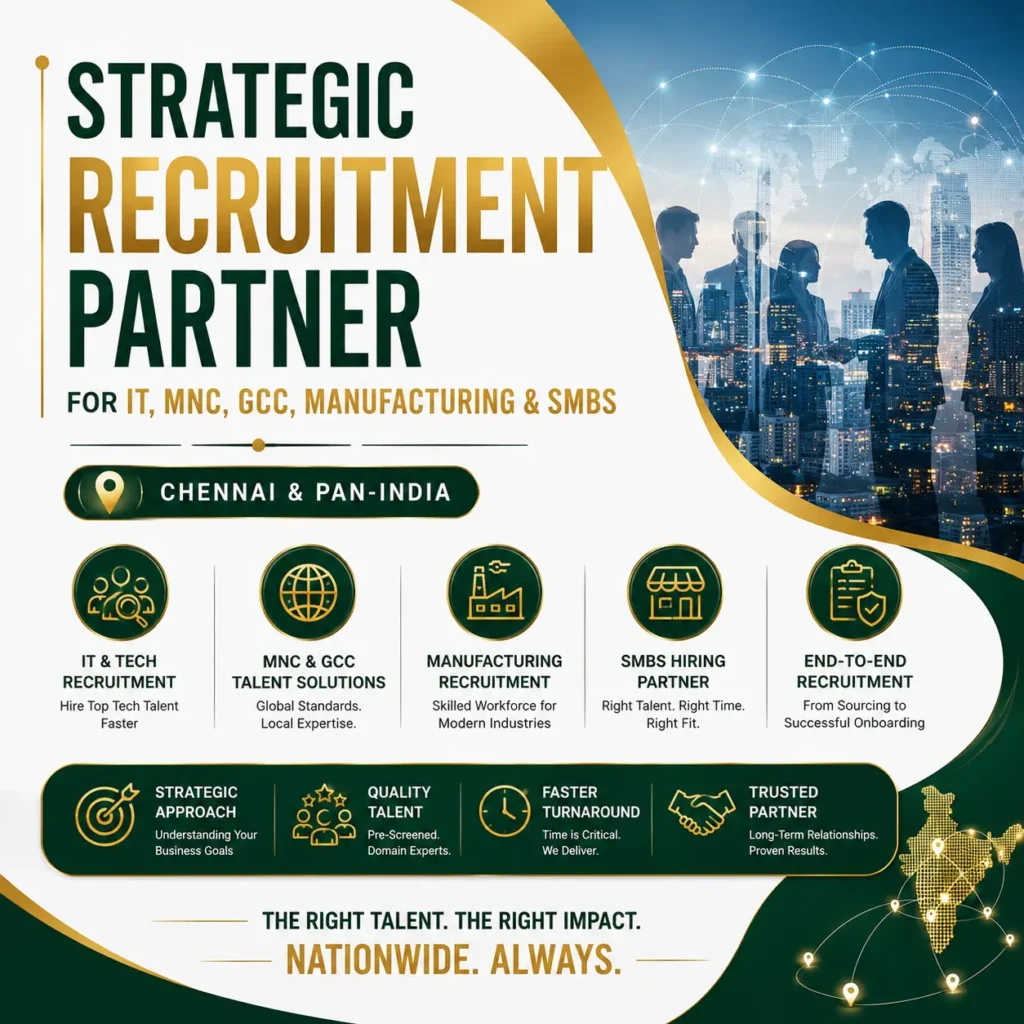
Home›Services›GCC Recruitment Partner Recruitment Partner for IT, MNC, GCC, Manufacturing & SMBs in India Get a Consultation Talk to an Expert Faster Hiring Access to Top Talent Scalable Hiring Solutions DevelopmentCloudDataCybersecurityIT Support PeopleTechnologyGrowthTogether Recruitment Partner for IT, MNC, GCC, Manufacturing & SMBs Every business hires. Not every business hires well — consistently, efficiently, and in a way that actually builds long-term organizational strength rather than filling seats temporarily. The gap between these two outcomes usually comes down to one thing: whether a business is working with a recruiter or a genuine recruitment partner. This distinction sounds subtle. In practice, it shapes everything — candidate quality, hiring speed, cultural fit, retention, and ultimately, how well the workforce supports where the business is actually heading. For IT companies, corporates, MNCs, GCC centres, manufacturing businesses, and small and medium enterprises across Chennai and pan-India, choosing the right talent acquisition partner is one of the highest-impact workforce decisions leadership teams make. Viriksha HR Solutions is a dedicated strategic talent partner — investing time in understanding how a business operates, where it is heading, and what type of talent will support those objectives, before a single candidate is sourced. Explore more What Is a Recruitment Partner — And How Is It Different from a Recruiter? A recruiter fills vacancies. The process is typically transactional: a job description arrives, candidates are sourced from active pools — job portals, databases, referrals — profiles are submitted, interviews are scheduled, and the recruiter moves to the next role. Speed is the primary metric. Fit is secondary. This approach works when requirements are simple, urgent, and volume-based. It consistently underperforms when requirements are complex, senior, or strategically important — because it treats every hire as an isolated transaction rather than a business decision with long-term consequences. A recruitment partner operates fundamentally differently. Rather than responding to a vacancy, a recruitment partner invests in understanding the business context first — organizational structure, growth trajectory, team dynamics, leadership expectations, and the specific talent profile that will genuinely succeed in each role. Discovery conversations go beyond job descriptions: What does success look like in this role after 90 days? What has caused previous hires in this role to fail? What is the leadership style the candidate will report into? These questions don’t slow down the hiring process. They accelerate it — because they ensure that every candidate sourced is genuinely aligned with what the business actually needs, not just what the job description technically describes. A vendor recruitment partner operating at this level also brings structured market intelligence to each engagement: what talent is realistically available, at what compensation, with what notice periods, and against how much hiring competition. This gives business leaders the information to make better decisions — not just faster ones. The 5 C’s of Recruitment: How Viriksha HR Solutions Evaluates Every Candidate Most recruiters assess technical qualifications and move on. Viriksha HR Solutions applies a structured 5 C’s of Recruitment framework across every search — evaluating the five dimensions that consistently predict long-term hiring success: 01 Competency Does the candidate have verified skills, experience, and domain knowledge the role requires? Competency assessment goes beyond resume screening — it involves structured technical evaluation, role-specific questioning, and reference validation where applicable. Competency is the entry point, not the endpoint, of candidate evaluation. → 02 Character What are the candidate’s professional values, work ethic, and integrity? Character assessment uses behavioural interview techniques and situational evaluation — identifying candidates whose professional conduct aligns with the client organization’s standards, not just their technical profile. → 03 Chemistry Will the candidate work effectively with the existing team and direct leadership? Chemistry evaluation assesses interpersonal dynamics, communication style, and collaborative capacity within the specific team environment the candidate will join — a dimension that determines day-to-day performance far more than qualifications alone. 04 Culture Does the candidate’s working style, values, and professional approach align with the organization’s culture? Culture fit assessment considers pace, structure preference, leadership style, and long-term motivational alignment — the dimension most often underweighted in transactional recruitment and most responsible for early attrition when misaligned. → 05 Consistency Does the candidate demonstrate a track record of sustained performance, reliability, and progressive achievement across their career? Consistency evaluation distinguishes candidates who perform under observation from those who deliver results reliably over time — a critical differentiator for senior and strategic hires. This 5 C’s framework is applied consistently across every role — from entry-level manufacturing positions to C-suite executive searches — ensuring that every candidate Viriksha HR Solutions presents has been evaluated on what actually predicts long-term success, not just short-term availability. Technology That Makes Recruitment Partnership Stronger ATS-Integrated Hiring Workflows Viriksha HR Solutions operates with Applicant Tracking System (ATS) integration across every recruitment engagement — providing complete transparency on candidate pipeline status, interview stage progression, and hiring timelines. Client businesses receive structured visibility into every stage of the search, eliminating the opacity that characterizes transactional recruitment relationships where clients are left chasing updates rather than receiving proactive communication. HVAC Roles We Recruit For Viriksha HR Solutions leverages AI recruitment tools to enhance — not replace — human evaluation. AI-powered sourcing identifies relevant candidates across active and passive talent pools faster and more comprehensively than manual search alone. AI-assisted screening flags competency and experience alignment at scale, allowing Viriksha HR Solutions’ experienced recruiters to focus evaluation time on the human dimensions — Character, Chemistry, Culture, and Consistency — that technology cannot assess. The result is unparalleled data processing, active listening, and unbiased evaluation across every search: AI delivering sourcing speed and volume coverage, experienced recruiters delivering the contextual judgment and human understanding that defines genuine talent acquisition partnership. Structured Talent Market Intelligence Beyond individual searches, Viriksha HR Solutions provides clients with structured talent market intelligence — salary benchmarking, candidate availability mapping, skills gap analysis, and competitive hiring landscape data — giving leadership teams the information to make better workforce planning decisions, not just faster hiring decisions. The Real Cost of Getting Recruitment Wrong