

How Businesses Should Plan Hiring Strategy for the Financial Year

Viriksha HR Solution How Businesses Should Plan Hiring Strategy for the Financial Year 04-05-2026 Monday How Businesses Should Plan Hiring Strategy for the Financial Year Most businesses in India approach hiring the same way they approach a fire — they respond when it starts, not before. A role opens. Urgency builds. The search begins under pressure. Compromises get made on quality, speed, or both. The hire is made. The cycle repeats. A hiring strategy is the opposite of that. It is the decision — made at the start of the financial year, before any specific vacancy exists — about how the business will acquire the people it needs to grow. Which roles will be filled, through which sourcing model, at what cost, on what timeline, and with what quality standard. Businesses that plan their hiring strategy at the start of the financial year consistently hire better, hire faster, and spend less per hire than businesses that don’t. This guide shows exactly how to build that strategy — for businesses in Chennai and across India. “Compliance is not a cost center. It is a trust signal — to your employees, your investors, your bank, andyour clients. In Chennai’s competitive business landscape, the companies that comply consistently are the ones that scale consistently.”— VIRIKSHA HR SOLUTION, CHENNAI Why the Financial Year Start Is the Right Moment to Plan Hiring The new financial year brings three things that are essential for hiring strategy: confirmed business targets, approved headcount, and a twelve-month horizon that is clear enough to plan against but recent enough to be accurate. Business targets tell you where growth is coming from — which functions need to expand, which new markets or products need teams, which leadership gaps need to be filled. Approved headcount translates those targets into specific roles. The twelve-month horizon gives you the time to plan sourcing models, budget allocation, and hiring timelines by quarter — before the first urgent vacancy compresses all of those decisions into a single panicked brief. Wait until June to start planning and you have already lost Q1. Wait until a business unit escalates a critical vacancy and you are planning under pressure — which means you are not planning at all. Step 1 — Build the Headcount Plan Before You Build Anything Else Every hiring strategy starts with a confirmed headcount plan. Not a wish list. Not a provisional approval. A role-by-role, function-by-function, quarter-by-quarter plan that has been signed off by business unit heads and finance. The headcount plan has two components that most businesses undercount. Growth hiring — net new roles the business needs to create to deliver its targets. These are the roles that appear in business unit plans and headcount approval requests. Backfill hiring — roles that need to be refilled due to attrition. In India, average corporate attrition across industries runs between 15% and 25% annually. For IT companies in OMR and Sholinganallur, BFSI firms in Chennai, and manufacturing businesses in Ambattur and Sriperumbudur, attrition-driven backfill can equal or exceed growth hiring in volume. A hiring strategy that plans only for growth and ignores attrition runs out of sourcing capacity by Q2. Once the headcount plan is confirmed, classify every role by tier — junior and volume, mid-level specialist, senior management, and leadership or CXO. The tier determines the sourcing model, the cost per hire, the time-to-fill estimate, and the budget allocation. Without this classification, every role gets managed the same way — which means expensive channels are used for volume roles and inadequate channels are used for leadership mandates. Step 2 — Match the Sourcing Model to the Role Tier The single biggest efficiency lever in hiring strategy is sourcing model alignment — making sure the right channel is used for the right role type, rather than defaulting to the same approach for every vacancy. Junior and volume roles — direct sourcing through job portals, campus hiring, employee referral programmes, and walk-in drives. For businesses in Chennai with regular volume requirements — manufacturing, retail, logistics, BPO — campus partnerships established at the start of the year deliver a consistent supply of candidates at significantly lower cost per hire than reactive portal usage. Mid-level specialist roles — recruitment agency or RPO model. For businesses with more than 40 to 50 mid-level hires planned for the year, Recruitment Process Outsourcing consistently outperforms ad-hoc agency usage on cost, speed, and quality. RPO embeds the recruitment function within the HR team — managing sourcing, screening, interview coordination, and offer management — at a per-hire or monthly management fee that is substantially lower than combined internal recruiter cost and ad-hoc agency fees. Senior management roles — retained recruitment agency search. Senior roles in Chennai’s competitive talent market — IT directors, BFSI heads, operations leaders, manufacturing plant managers — are not filled by job postings. They are filled by direct outreach to employed professionals who are not actively looking. A retained search brief with a specialist recruitment agency delivers a shortlist of evaluated, genuinely interested candidates within two to four weeks — faster and at lower total cost than a three-month internal search that ends with the same candidates. Leadership and CXO mandates — executive search. Leadership vacancies are the most expensive to leave open — in lost momentum, team uncertainty, and deferred decisions. Executive search firms with genuine networks in the relevant sector and function should be briefed at the start of the year on anticipated leadership needs — including succession planning gaps — so searches begin before urgency drives every decision. Step 3 — Build the Recruitment Budget From the Bottom Up A recruitment budget built from the top down — “we spent ₹X last year, let’s add 10%” — is a budget that has no relationship to what the business actually needs to hire. A recruitment budget built from the bottom up — role by role, tier by tier, sourcing model by model — is a budget that finance will approve because it is defensible, and that HR will
Labour Compliance Strategy for Companies: Avoid Penalties in the Financial Year
Viriksha HR Solution Labour Compliance Strategy for Companies: Avoid Penalties in the Financial Year 04-05-2026 Monday Labour Compliance Strategy for Companies: Avoid Penalties in the Financial Year Every financial year, thousands of businesses across India receive notices, penalties, and demand orders from labour departments, EPFO, ESIC, and state authorities — not because they set out to be non-compliant, but because they had no strategy for compliance. They managed it reactively — filing when reminded, updating registers when inspected, fixing problems when penalised. A reactive approach to labour compliance is not a compliance approach. It is a penalty payment plan. This guide provides a practical labour compliance strategy for businesses in Chennai and across India — covering every major compliance risk area, how penalties accumulate, and what a proactive compliance framework looks like in practice. Why Financial Year End HR Compliance Matters More Than Most Businesses Realise Most businesses treat payroll and statutory compliance as a monthly routine — and it is. But the financial year end is different. It is the point at which monthly compliance actions consolidate into annual returns, annual reports, and annual filings that carry their own deadlines, their own formats, and their own penalty exposure if they are missed or filed incorrectly. A business that has been compliant month-to-month throughout the year can still attract a notice if the annual return is filed late, if Form 16 is not issued by the prescribed date, or if the annual PF return doesn’t reconcile with the monthly ECR filings. Financial year end HR compliance is not a formality — it is the annual audit of everything the business has done in the previous twelve months. Why Labour Compliance Penalties Are Higher Than Most Businesses Expect Before building the strategy, it helps to understand what non-compliance actually costs. Most business owners think of labour penalties as small administrative fines. They are not. EPFO penalties Under Section 14B of the EPF Act, damages for delayed PF remittance are levied at rates between 5% and 25% of the arrear amount per annum depending on the period of delay — in addition to interest at 12% per annum under Section 7Q. For a business with a monthly PF liability of ₹2 lakhs that has been remitting three months late consistently, the accumulated damages can exceed ₹1.5 lakhs in a single year — without any principal shortfall. Minimum Wages Act violations Prosecution under the Minimum Wages Act carries imprisonment of up to five years and fines. In practice, inspectors compound the offence — but the compounding amount per violation per employee per month is significant, and the reputational exposure of a criminal prosecution is not recoverable by payment. Labour inspection findings A labour inspector who finds non-compliant registers, missing records, or incorrect overtime payments does not issue a warning. They issue a notice that requires a compliance response within a fixed window — and non-response escalates to prosecution under the applicable Act. POSH Act penalties Non-constitution of the ICC or failure to conduct inquiries carries a penalty of up to ₹50,000 for first violations and double for repeat violations — plus potential cancellation of business licences for the establishment. ESIC penalties Late ESI remittance attracts 12% per annum interest from the due date. In addition, ESIC can levy damages under Section 85B. Failure to register an eligible establishment or failure to cover eligible employees creates retrospective liability for the full period of non-compliance — going back three years. Understanding these numbers changes how leadership thinks about the investment in compliance infrastructure. A statutory compliance retainer that prevents ₹5 lakhs of annual penalty exposure is not a cost. It is a 500% return on a risk management investment. The Six Pillars of a Labour Compliance Strategy A complete labour compliance strategy for the financial year rests on six pillars. Miss any one of them and the structure is vulnerable. Pillar 1 — Know Every Law That Applies to Your Business The first and most commonly skipped step is mapping every applicable law to your specific establishment — by industry, by state, by headcount, and by the nature of the workforce. A manufacturing company in Chennai with 150 employees and contract labour on-site operates under the Factories Act, the Tamil Nadu Shops & Establishments Act, the EPF Act, the ESI Act, the Minimum Wages Act, the Payment of Bonus Act, the Payment of Gratuity Act, the Contract Labour (Regulation and Abolition) Act, the Labour Welfare Fund Act, and the POSH Act — at minimum. Each Act has its own registration requirements, its own filing calendar, its own register formats, and its own inspection framework. A software company in OMR, Chennai with 80 employees operates under a different but overlapping set — the Shops Act instead of the Factories Act, but the same PF, ESI, Bonus, Gratuity, and POSH obligations. Compliance strategy starts with an accurate, establishment-specific compliance map — not a generic list of laws that applies to every business. Pillar 2 — Build a Compliance Calendar and Own Every Deadline The second pillar is a month-by-month compliance calendar that captures every filing, every remittance, every return, and every renewal — with a named owner and a completion deadline that is earlier than the statutory deadline. The golden rule of compliance deadlines: your internal deadline must be at least five working days before the statutory deadline. A business whose PF ECR target is the 15th will miss the 15th when the 14th falls on a Saturday. A business whose internal target is the 10th never misses. A complete annual compliance calendar for a Chennai business includes: Monthly — PF ECR and remittance by the 10th. ESI challan by the 10th. TDS deposit by the 7th. PT deduction and remittance by state deadline. Statutory register updates by month end. Quarterly — Form 24Q filing within 31 days of quarter end. Half-yearly — ESI half-yearly return by November 12 and May 12. Annually — Form 16 issuance by June 15. Shops Act renewal before expiry date.
New Financial Year HR Planning Guide for Corporates and MNCs in India

Viriksha HR Solution New Financial Year HR Planning Guide for Corporates and MNCs in India 04-05-2026 Monday New Financial Year HR Planning Guide for Corporates and MNCs in India The new financial year is the most consequential planning window in the corporate HR calendar. Every headcount decision, every compliance framework, every payroll structure, every recruitment strategy — the choices made in April define whether the organisation runs smoothly for the next twelve months or spends the year firefighting problems that could have been prevented in the first week. For corporates and MNCs operating in India — whether headquartered in Chennai, Bangalore, Mumbai, Delhi NCR, or managing India operations from overseas — the new financial year brings a specific and non-negotiable set of HR planning requirements. This guide covers all of them. “Compliance is not a cost center. It is a trust signal — to your employees, your investors, your bank, andyour clients. In Chennai’s competitive business landscape, the companies that comply consistently are the ones that scale consistently.”— VIRIKSHA HR SOLUTION, CHENNAI Why New Financial Year HR Planning Is Different for India India’s HR compliance framework is financial-year-driven. Annual returns, tax filings, headcount approvals, salary revisions, and compliance renewals all reset at April 1. For MNCs managing India operations from a global headquarters, this creates a planning cycle that does not align with the calendar year most global HR teams operate on — and the misalignment is where compliance gaps originate. For Indian corporates, the new financial year is the moment when last year’s decisions are visible in the numbers — attrition rates, cost per hire, payroll accuracy, compliance penalty exposure — and next year’s decisions need to be made before the operational calendar overtakes the planning calendar. The businesses that get this right do one thing consistently: they treat April not as the start of a new year but as the outcome of a planning process that began in February. The ones that struggle treat April as the beginning of that process — and spend Q1 catching up. 1. Headcount Planning — From Business Targets to Hiring Plan The first HR deliverable of the new financial year is a confirmed headcount plan — role by role, function by function, month by month — aligned to the business unit targets that finance and leadership have approved. For corporates, this means translating revenue targets and operational plans into specific people requirements. A sales team expanding into three new cities needs not just salespeople but regional managers, support staff, and compliance registrations in each new state. A manufacturing plant increasing capacity needs production supervisors, quality engineers, and HSE staff — not just line workers. For MNCs, headcount planning for India requires additional inputs: understanding which roles can be hired locally, which require expat or cross-border talent, what the India compensation benchmarks are for each function, and whether the India entity has the statutory registrations and employer infrastructure to hire in each state the business plans to expand into. What to lock down in April: Net new headcount approved by business unit. Backfill estimate based on last year’s attrition rate — for most Indian corporates, plan for 15% to 25% attrition-driven backfill. Role-level sourcing model — which hires go direct, which go through a recruitment agency, which require executive search. Timeline by quarter — Q1 hires versus Q3 hires have very different urgency profiles and budget implications. 2. Payroll Structure Review — The Changes That Must Happen at Year Start The new financial year is the cleanest point to implement salary structure changes — before twelve months of payroll runs on an outdated or non-compliant framework. Minimum wage compliance review — Tamil Nadu and every other state revise minimum wage rates periodically. Every salary structure must be verified against the current applicable minimum wage for each employee category in each state the business operates in. A structure that was compliant in March may not be compliant in April if a revision was notified. TDS restructuring for the new year — At the start of each financial year, employees should submit updated investment declarations under Form 12BB. TDS calculations for the year must be based on current declarations — not last year’s. Payroll teams that carry forward old declarations create TDS shortfalls that surface as painful salary deductions in February and March. Wage definition compliance — Code on Wages preparation — The Code on Wages, when enforced, will require that basic wages and dearness allowance together constitute at least 50% of total remuneration. Corporates and MNCs that have maintained artificially low basic pay structures to reduce PF contribution liability should use the new financial year to model the impact of this change and begin restructuring proactively — before enforcement creates a back-calculation liability. PF and ESI base verification — Confirm that PF contributions are being calculated on the correct wage base for every employee. Confirm that ESI coverage is correctly applied for all employees earning below ₹21,000 gross per month. Both are common sources of silent non-compliance that surface as EPFO and ESIC demand notices. 3. Statutory Compliance Calendar — Every Deadline for the Year, Set in Advance For HR and payroll teams, the new financial year is the right moment to map every statutory compliance deadline for the next twelve months — and assign ownership before the first deadline arrives. Monthly recurring deadlines: PF ECR filing and remittance — 15th of every month. ESI contribution and remittance — 15th of every month. TDS deposit on salary — 7th of the following month. Professional Tax — state-specific, typically monthly or quarterly. Quarterly deadlines: Form 24Q — TDS return for salary — due within 31 days of quarter end. Q1 (April–June) due July 31. Q2 due October 31. Q3 due January 31. Q4 due May 31. Annual and half-yearly deadlines: ESI half-yearly return (April–September) — November 12. ESI half-yearly return (October–March) — May 12. Form 16 issuance to employees — June 15. POSH annual report to District Officer — January 31. Professional Tax annual
May Day 2026: Beyond Celebration — Are Your Labour Practices Truly Compliant?

Viriksha HR Solution May Day 2026: Beyond Celebration — Are Your Labour Practices Truly Compliant? 30-04-2026 Thursday May Day 2026: Beyond Celebration — Are Your Labour Practices Truly Compliant? Every year on May 1st, businesses across India observe International Workers’ Day. Flags go up. Social media posts go out. Some organisations give employees a holiday. But for most employers, May Day passes without a single conversation about the question it was built to ask: are the people who work for your business actually being treated the way the law — and basic fairness — requires? This May Day, Viriksha HR Solutions invites businesses in Chennai and across India to go beyond the celebration and answer that question honestly. What May Day Actually Represents — And Why It Still Matters May Day traces its origins to the global labour movement’s fight for an eight-hour working day. The demand was simple: eight hours of work, eight hours of rest, eight hours of personal time. That fight, which began in the 1880s, eventually gave us the working hour limits, overtime regulations, minimum wage protections, and statutory benefits that Indian labour law now codifies. The irony is that more than a century later, many businesses in India — including businesses that post May Day tributes on LinkedIn — are not fully compliant with the very laws those movements produced. This is not always deliberate. Labour compliance in India is genuinely complex — spanning multiple central acts, state-specific rules, periodic revisions, and inspections that can arrive without warning. But complexity is not a defence when a notice arrives. And for employees, the consequences of employer non-compliance are real — missed PF contributions, denied ESI benefits, unpaid overtime, and wages that fall below the legal minimum. The Labour Compliance Checklist Every Employer Should Run Today Use May Day 2026 as the trigger to run a compliance self-audit. Here are the areas where gaps are most commonly found: Minimum Wages — Are You Actually Paying What the Law Requires? The Minimum Wages Act, 1948 mandates that every employee be paid at least the applicable minimum wage for their category of work in their state. Tamil Nadu revises its minimum wage rates periodically across scheduled employment categories — and many businesses, particularly in manufacturing, retail, and construction, are paying wages that have not been updated to reflect the latest revision. Paying below minimum wage is not a civil violation. It is a criminal offence under the Act — with penalties including imprisonment. Run your salary register against the current applicable Tamil Nadu minimum wage rates for every employee category today. Working Hours and Overtime — Are You Recording and Compensating Correctly? Under the Tamil Nadu Shops & Establishments Act, no employee can work more than 48 hours per week or 9 hours per day without overtime compensation. Overtime must be paid at double the ordinary rate of wages and separately recorded in the Overtime Register. Businesses where employees regularly work late — particularly in IT services, manufacturing, and retail — frequently maintain no Overtime Register, pay no overtime premium, or record attendance in ways that obscure actual working hours. Each of these is a direct violation. PF and ESI — Are Every Eligible Employee Enrolled and Every Contribution Filed on Time? The Employees’ Provident Fund Act and the ESI Act together represent the two most significant social security obligations for Indian employers. Both are routinely non-compliant — not because employers don’t know about them, but because execution breaks down. Common failures include employees who joined three months ago and have still not been enrolled on the EPFO portal. ESI contributions calculated on basic pay instead of gross wages — resulting in systematic underpayment. ECR filed every month but PF contributions remitted two days after the 15th deadline — attracting 12% per annum interest every single month. These are not edge cases. They are the standard findings in an EPFO or ESIC inspection. On May Day specifically — a day associated with worker rights — these gaps carry a particular irony. Statutory Registers — Can You Produce Them If an Inspector Arrives Tomorrow? Labour inspectors under the Tamil Nadu Shops & Establishments Act and the Factories Act are entitled to inspect your statutory registers at any time, without prior notice. The registers they will ask for: the Employee Register, the Wage Register, the Muster Roll, the Leave Register, the Overtime Register, and the Holiday Register. If any of these are not maintained — or are maintained in the wrong format, or have not been updated since last quarter — the inspection will result in a notice. The penalty for non-maintenance of prescribed registers is levied per register, per month of default. POSH Compliance — Is Your ICC Constituted and Your Policy Displayed? The Prevention of Sexual Harassment Act, 2013 requires every organisation with 10 or more employees to have a constituted Internal Complaints Committee, a written and displayed POSH policy, and a completed annual report submitted to the District Officer before January 31 each year. The POSH Act is one of the most commonly overlooked compliance obligations in India — and one of the most seriously enforced when a complaint surfaces. May Day is a workers’ rights day. A workplace without POSH compliance is a workplace where a significant worker right is not protected. Book a labour compliance audit Book a labour compliance audit with Viriksha HR Solutions — available for businesses in Chennai and across India. Contact Us The Honest Question to Ask on May Day Beyond the social media post and the holiday, one question is worth asking in every boardroom and HR meeting today: if a labour inspector walked in tomorrow, would your business be fully ready? For most businesses in Chennai and across India, the honest answer is: probably not entirely. Some registers are missing. Some contributions are slightly off. Some salary structures haven’t been reviewed since the last minimum wage revision. These are fixable problems — but only if they are identified. How
Recruitment Budget Planning for the New Financial Year: Strategy for Corporates
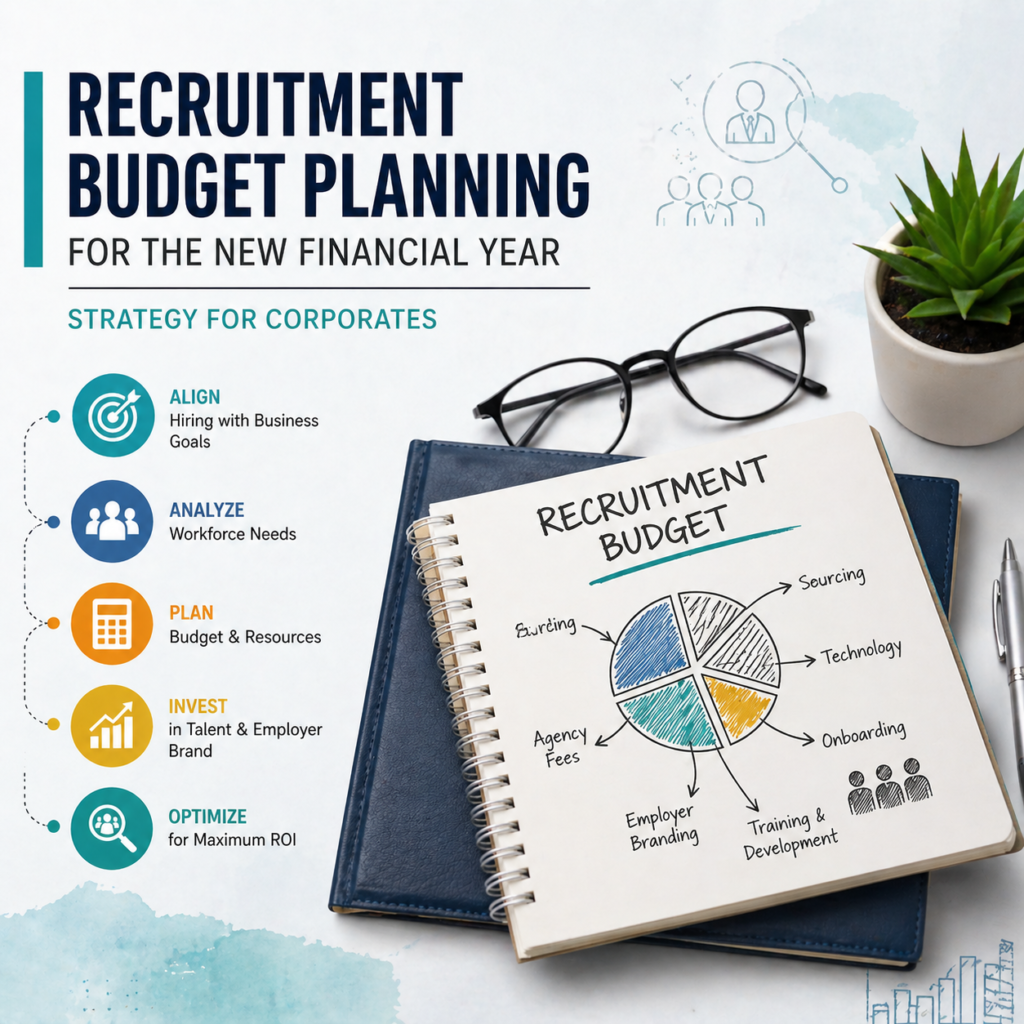
Viriksha HR Solution Recruitment Budget Planning for the New Financial Year: Strategy for Corporates 29-04-2026 Wednesday Recruitment Budget Planning for the New Financial Year The new financial year is the most important moment in the recruitment calendar — and the most underused. Most corporate HR and talent acquisition teams spend April finalising last year’s attrition numbers, chasing approvals for open headcount, and reacting to departures that were predictable six months ago. The businesses that consistently hire well are doing something different in April: they are planning. A well-structured recruitment budget for the new financial year does not just estimate what hiring will cost. It determines how the organisation will compete for talent, where it will invest in building capability, and how it will move faster than competitors when critical roles open. This guide covers how to build that plan — and how Viriksha HR Solutions helps corporate HR teams in Chennai and across India execute it. “Compliance is not a cost center. It is a trust signal — to your employees, your investors, your bank, andyour clients. In Chennai’s competitive business landscape, the companies that comply consistently are the ones that scale consistently.”— VIRIKSHA HR SOLUTION, CHENNAI Why Most Corporate Recruitment Budgets Are Built the Wrong Way Before building the right recruitment budget, it helps to understand why most corporate recruitment budgets fail to deliver. The most common approach is historical — take last year’s recruitment spend, adjust for headcount growth, and present the number to finance. The problem with this approach is that it optimises for what recruiting cost, not what recruiting should cost to achieve the organisation’s actual talent goals. A team that spent ₹80 lakhs on recruitment last year and averaged 55 days to fill roles is not a benchmark to repeat — it is a baseline to improve on. The second most common mistake is not accounting for the full cost of hiring. Direct recruitment costs — agency fees, job portal subscriptions, advertising — are the visible line item. But the total cost of a hire includes interviewer time across multiple rounds, the productivity gap during vacancy, the onboarding investment, and most significantly, the cost of a bad hire who exits within six months. Research across Indian markets consistently shows that the true cost of a mid-level hire is 1.5 to 3 times the annual salary of the role. A recruitment budget that doesn’t account for quality — not just volume — will consistently underspend on the things that produce good hires and overspend on the things that don’t. Step 1 — Start With Workforce Planning, Not Headcount The foundation of any effective recruitment budget is a workforce plan — a structured assessment of what the organisation needs from its people over the next 12 months, not just how many people it needs. A workforce plan for the new financial year asks: Which functions are growing and need to add headcount? Which roles are likely to open due to attrition based on historical patterns? Which capability gaps need to be addressed through hiring? Which locations are expanding? Which roles are hard to fill and need proactive sourcing rather than reactive posting? For corporate HR teams in Chennai and Pan India, the answers vary significantly by function. Technology and IT roles in Chennai’s OMR corridor have average time-to-fill of 45 to 60 days for experienced professionals — meaning a role that opens in September needs sourcing to begin in July. Manufacturing roles in Ambattur and Sriperumbudur have seasonal availability patterns that affect when talent is most accessible. Leadership roles across any function have 8 to 14-week search timelines that cannot be compressed without compromising quality. A recruitment budget built from a workforce plan allocates spend in advance of need — not in response to it. Step 2 — Calculate True Cost Per Hire by Role Category Once the workforce plan is defined, cost per hire must be calculated by role category — not as a single average across the business. Entry and junior level roles typically lower direct recruitment cost but higher volume, higher attrition risk, and significant onboarding investment. Budget for portal advertising, bulk sourcing support, and structured onboarding programmes. Mid-level professional roles the most significant category for most corporate HR budgets. Agency fees typically range from 8% to 12% of annual CTC for contingency placement. Direct sourcing through internal recruiters reduces this cost but increases time-to-fill. The budget trade-off between agency speed and internal cost needs to be explicit — not assumed. Senior and leadership roles the highest cost per hire and the highest cost of an error. Retained executive search for Director-level and above typically runs from 12% to 20% of annual CTC. But the cost of a failed senior hire — including the search restart, the vacancy period, and team impact — consistently exceeds the search fee many times over. Senior hiring budgets should be built around quality and specialist capability, not cost minimisation. Step 3 — Build the Sourcing Channel Budget The sourcing channel budget determines where recruitment spend goes — and this is where most corporate budgets are misallocated. Job portal subscriptions — Naukri, LinkedIn Talent Solutions, Indeed — are the largest single line item for most corporate recruitment budgets. They are also the channels with the highest competition and the least access to passive candidates — the people performing well in their current roles and not actively looking. A balanced sourcing channel budget for Indian corporates should include: Employee referral programme investment referral hires have shorter time-to-fill, lower cost-per-hire, and significantly higher 12-month retention rates than portal hires. A structured referral incentive programme is consistently one of the highest-ROI recruitment investments available to any corporate HR team. Recruitment agency and RPO partnerships for roles where internal capacity or speed is insufficient, agency partnerships provide access to pre-screened candidates and passive talent pools. Budget for agency fees by role category and prioritise partners with genuine sector specialisation over generalist agencies. Employer branding LinkedIn company page investment, Glassdoor management, and content
New Labour Law Updates Every Employer Should Know in the New Financial Year

Viriksha HR Solution New Labour Law Updates Every Employer Should Know in the New Financial Year 29-04-2026 Wednesday New Labour Law Updates Every Employer Should Know in the New Financial Year India’s labour law framework is in the middle of its most significant structural overhaul in decades. The consolidation of 29 central labour laws into 4 Labour Codes — the Code on Wages, the Industrial Relations Code, the Code on Social Security, and the Occupational Safety, Health and Working Conditions Code — has been legislated and notified. While full enforcement is still pending at the central and state levels, several provisions are already in effect, others are being adopted by states progressively, and the compliance implications of the full implementation are significant enough that every employer in India — in Chennai, across Tamil Nadu, and Pan India — should be preparing now. This article covers every key labour law update your business needs to know entering the new financial year, what changes in practice, and how Viriksha HR Solutions helps businesses in Chennai and across India stay ahead of every update. “Compliance is not a cost center. It is a trust signal — to your employees, your investors, your bank, andyour clients. In Chennai’s competitive business landscape, the companies that comply consistently are the ones that scale consistently.”— VIRIKSHA HR SOLUTION, CHENNAI 1. The Four Labour Codes — Where Things Stand India’s four Labour Codes consolidate and replace 29 existing central labour laws. The current status as of the new financial year is this: all four codes have received Presidential assent and been notified. Most states have published draft rules. Several states have finalised their rules. But the Central Government has not yet notified a unified implementation date — which means the legacy laws remain in force until notification. What this means for employers: the old laws still apply. The Employees’ Provident Fund Act, ESI Act, Minimum Wages Act, Payment of Wages Act, Payment of Bonus Act, Factories Act, and Contract Labour Act are all still in full effect. But the new codes define the direction of compliance — and businesses that understand what is coming will transition without disruption when implementation is notified. The four codes at a glance: Code on Wages, 2019 Consolidates the Minimum Wages Act, Payment of Wages Act, Payment of Bonus Act, and Equal Remuneration Act. Introduces a universal minimum wage floor for all workers across India — a significant change from the current state-specific system. Redefines “wages” in a way that directly affects PF and ESI contribution calculations and salary structure design. Code on Social Security, 2020 Consolidates the EPF Act, ESI Act, Maternity Benefit Act, Payment of Gratuity Act, and others. Extends social security coverage to gig workers, platform workers, and unorganised sector workers — a major structural expansion. Changes to gratuity eligibility and fixed-term employment provisions are particularly significant for employers. Industrial Relations Code, 2020 Consolidates the Industrial Disputes Act, Trade Unions Act, and Industrial Employment (Standing Orders) Act. Introduces the concept of fixed-term employment directly in the code — allowing employers to hire workers on fixed terms with all statutory benefits, without prior notice period obligations, but with full access to gratuity from day one. Occupational Safety, Health and Working Conditions Code, 2020 Consolidates 13 laws including the Factories Act, Contract Labour Act, and Mines Act. Standardises working hour limits, mandates annual leave with wages, and extends safety obligations to a broader range of establishments. 2. The Redefined Definition of “Wages” — The Change That Affects Every Payroll Of all the provisions in the new codes, the redefinition of “wages” in the Code on Wages has the most immediate and material impact on payroll processing and salary structure design. Under the Code on Wages, total wages must not be less than 50% of the total remuneration paid to an employee. In plain terms: the sum of basic pay and dearness allowance — the components on which PF, ESI, gratuity, and bonus are calculated — cannot be structured below 50% of CTC. This directly challenges the salary structures many Indian companies currently use — where basic pay is kept artificially low to minimise PF contribution liability, with the balance paid through allowances that are excluded from the statutory wage base. What changes in practice: When this provision is enforced, businesses with low-basic salary structures will face significantly higher PF employer contributions, higher ESI liabilities on the corrected wage base, higher gratuity provisioning, and higher bonus calculations. For many mid-size businesses in Chennai, this will require a complete review and restructuring of salary components across the workforce. Employers who restructure proactively — before enforcement — avoid the back-calculation liability that comes from non-compliance discovered retrospectively. 3. Fixed-Term Employment — A Significant Flexibility Addition The Industrial Relations Code introduces fixed-term employment as a statutory concept available to all employers — not just those in specific sectors. A fixed-term employee is hired for a defined period, is entitled to all statutory benefits including ESI, PF, and proportionate gratuity from day one, and exits at the end of the term without any notice period obligation on either side. What this means for businesses in Chennai and Pan India: Fixed-term employment provides a legally clean model for project-based hiring, seasonal workforce requirements, and capacity expansion — without the ambiguity of contract labour arrangements or the notice period exposure of permanent employment. Businesses that currently use contractor arrangements for roles that don’t qualify as genuine contracting should review whether fixed-term employment under the new code is the appropriate model. 4. Gratuity for Fixed-Term and Gig Workers — Extended Eligibility Under the Code on Social Security, gratuity eligibility is extended to fixed-term workers on a proportionate basis from the first year of service — removing the existing five-year continuous service requirement for this category. Additionally, the Code extends social security obligations to gig and platform workers — a category that is growing rapidly across India’s digital economy. For businesses in Chennai’s growing EdTech, logistics, and food delivery adjacent
Financial Year HR Compliance Checklist for Businesses in India

Viriksha HR Solution Financial Year HR Compliance Checklist for Businesses in India: Payroll, PF, ESI & Tax Filing 29-04-2026 Wednesday Financial Year HR Compliance Checklist for Businesses in India: Every financial year end — March 31 — brings a defined set of HR and payroll compliance obligations that every business in India must complete. Miss them and the consequences range from interest and penalties to demand notices from EPFO, ESIC, and the Income Tax Department. Get them right and your business closes the year clean — with compliant records, filed returns, and no outstanding liability. This checklist covers every critical HR compliance action your business must complete before and after March 31 — across payroll, Provident Fund, Employee State Insurance, income tax, and statutory registers. “Compliance is not a cost center. It is a trust signal — to your employees, your investors, your bank, andyour clients. In Chennai’s competitive business landscape, the companies that comply consistently are the ones that scale consistently.”— VIRIKSHA HR SOLUTION, CHENNAI Why Financial Year End HR Compliance Matters More Than Most Businesses Realise Most businesses treat payroll and statutory compliance as a monthly routine — and it is. But the financial year end is different. It is the point at which monthly compliance actions consolidate into annual returns, annual reports, and annual filings that carry their own deadlines, their own formats, and their own penalty exposure if they are missed or filed incorrectly. A business that has been compliant month-to-month throughout the year can still attract a notice if the annual return is filed late, if Form 16 is not issued by the prescribed date, or if the annual PF return doesn’t reconcile with the monthly ECR filings. Financial year end HR compliance is not a formality — it is the annual audit of everything the business has done in the previous twelve months. The Complete HR Compliance Checklist — Financial Year 2024–25 PAYROLL COMPLIANCE Reconcile full-year payroll data Before any annual filing, reconcile your payroll records across all twelve months. Verify that salary registers align with bank transfer records, that deduction amounts are consistent month-over-month, and that any mid-year salary revisions, bonuses, or arrears have been captured correctly in the month they were paid — not the month they were approved. Compute full-year taxable income for every employee For every employee whose income exceeds the basic exemption limit, compute the full-year taxable income — including gross salary, all taxable allowances, perquisites, and any other income declared under Form 12BB. Apply applicable deductions under Chapter VI-A — 80C, 80D, 80CCD, and others — to arrive at net taxable income. Final TDS computation and reconciliation Compute total TDS deducted across all four quarters and compare against each employee’s actual tax liability for the year. If TDS falls short — because of a Q4 bonus, a salary revision, or an unaccounted perquisite — the shortfall must be deducted from the March salary before year close. Issue Form 16 to all applicable employees Form 16 must be issued to every employee from whose salary TDS was deducted during the year. The deadline is June 15 of the following financial year. Failure to issue Form 16 attracts a penalty of ₹100 per day of default under Section 272A of the Income Tax Act. File Form 24Q — Q4 return The Q4 TDS return for salary payments must be filed by May 31. The Q4 return includes Annexure II — the full-year salary and TDS detail for every employee — and must reconcile exactly with each employee’s Form 16. PROVIDENT FUND COMPLIANCE Verify full-year ECR filing completeness Confirm PF ECR has been filed for all twelve months — April to March — with every challan paid and confirmed on the EPFO portal. A missing month is a gap in the employee’s PF account and a direct compliance violation. Reconcile PF contributions against payroll Cross-verify PF contributions deducted and remitted each month against wages in the Wage Register. Wages reported in ECR must match payroll exactly — any mismatch is a red flag in an EPFO inspection and can trigger a Section 7A inquiry. Complete UAN KYC for all employees Every employee’s UAN must have Aadhaar, PAN, and bank account seeded and verified on the EPFO portal. Unverified KYC blocks withdrawal and transfer claims — and creates escalations that reach the employer. Year end is the right time to audit and complete all pending KYC. Process PF transfers for employees who joined during the year Employees who joined from another organisation must have their previous PF balance transferred to their current UAN. Identify all pending transfers and initiate them before year close. ESI COMPLIANCE File half-yearly ESI return — October to March period The ESI half-yearly return covering October to March must be filed with ESIC by May 12. This return captures all insured employees, wages, and contribution amounts for the six-month period. A missed return is a violation even if all monthly contributions were paid on time. Reconcile ESI contributions against gross wages Verify ESI contributions for every covered employee were calculated on total gross wages — including all allowances and overtime — not just basic pay. Shortfalls must be regularised before the return is filed. Update employee coverage status for wage ceiling crossovers Employees whose gross wages crossed ₹21,000 during the year must be moved out of ESI coverage at the end of the applicable contribution period. Employees added during the year must be verified for complete ESIC portal registration with IP number generation confirmed. Audit the Accident Register Review all workplace accidents recorded during the year — confirm every incident was reported to ESIC within the 24-hour window. An unrecorded accident discovered during an ESIC inspection creates significant liability. STATUTORY REGISTERS AND DOCUMENTATION Audit all statutory registers for the year Every register required under applicable labour laws — Employee Register, Wage Register, Muster Roll, Leave Register, Overtime Register, Holiday Register — must be complete for all twelve months. Identify and fill any gaps before records are finalised.
The Employees’ State Insurance Act, 1948
Viriksha HR Solution Employees’ State Insurance Act 1948 Explained The Employees’ State Insurance Act, 1948 — A Complete Guide for Businesses in Chennai and Across India 22-04-2026 Wednesday The Employees’ State Insurance Act, 1948 — A Complete Guide for Businesses in Chennai and Across India If your business employs 10 or more people in India, the Employees’ State Insurance Act, 1948 applies to you — and understanding it is not optional. The ESI Act is one of India’s most significant social security legislations, providing health, maternity, disability, and employment injury protection to millions of workers. For employers, it creates a set of clear obligations — and clear consequences when those obligations aren’t met. This guide explains the ESI Act in plain language — what it covers, who it applies to, how contributions work, what benefits employees receive, and what compliance looks like in practice for businesses in Chennai and across India. “Compliance is not a cost center. It is a trust signal — to your employees, your investors, your bank, andyour clients. In Chennai’s competitive business landscape, the companies that comply consistently are the ones that scale consistently.”— VIRIKSHA HR SOLUTION, CHENNAI What Is the Employees’ State Insurance Act, 1948? The Employees’ State Insurance Act, 1948 is a central legislation enacted by the Government of India to provide social security and health insurance coverage to workers employed in factories, shops, offices, and other establishments. The Act is administered by the Employees’ State Insurance Corporation — commonly known as ESIC — a statutory body under the Ministry of Labour and Employment. The ESI Act creates a self-financing social security fund — built from monthly contributions by both employers and employees — that provides covered workers with access to medical treatment, cash benefits during illness or maternity, compensation for employment-related injuries, and support for dependants in the event of a worker’s death caused by a workplace accident. For employers, the ESI Act is both a compliance obligation and a workforce protection mechanism. For employees, it is one of the most comprehensive social security safety nets available under Indian law. Who Does the ESI Act Apply To? Factories any factory as defined under the Factories Act, 1948, employing 10 or more persons, regardless of whether power is used in the manufacturing process. Establishments shops, hotels, restaurants, cinemas, road transport undertakings, newspaper establishments, and other commercial establishments employing 10 or more persons. In several states including Tamil Nadu, the threshold is 10 employees — making ESI registration mandatory for a significantly large base of Chennai businesses. Employees covered every employee of a covered establishment whose gross monthly wages do not exceed ₹21,000 is mandatorily covered under the ESI Act. For employees with disabilities, the wage ceiling is ₹25,000 per month. Once an employee crosses the wage ceiling, they exit ESI coverage at the next contribution period — but cannot re-enter even if their wages subsequently fall below the limit. Seasonal establishments, mines, and certain other categories are either excluded or governed by separate provisions. Businesses Served Across Tamil Nadu & Pan India 0 + Statutory Penalties for Our Compliance Clients 0 Average Monthly Time Saved Per Business 0 + ESI Contribution Rates — What Employers and Employees Pay ESI is funded through monthly contributions from both the employer and the employee, calculated as a percentage of the employee’s gross wages. Employer contribution — 3.25% of gross wages Employee contribution — 0.75% of gross wages The total ESI contribution is therefore 4% of gross wages for every covered employee. Both shares must be remitted to the ESIC by the 15th of the following month. A delay — even by a single day — attracts interest at 12% per annum on the outstanding amount. Employees earning gross wages up to ₹137 per day are exempt from the employee contribution — but the employer’s contribution of 3.25% still applies. ESI Benefits — What Covered Employees Receive The ESI Act provides a comprehensive package of benefits to insured employees and their dependants: Medical Benefit Full medical care for the insured employee and their family members — including outpatient treatment, specialist consultations, hospitalisation, surgery, and medicines — through ESIC dispensaries and empanelled hospitals across India. Sickness Benefit Cash payment at 70% of average daily wages for up to 91 days per year during certified illness — provided the employee has contributed for at least 78 days in the preceding contribution period. Funeral Expenses A lump-sum payment of ₹15,000 to meet the funeral costs of an insured employee. Dependants’ Benefit Monthly pension paid to dependants of an insured employee who dies as a result of an employment-related injury or occupational disease. Extended Sickness Benefit and Enhanced Sickness Benefit Cash payment at 70% of average daily wages for up to 91 days per year during certified illness — provided the employee has contributed for at least 78 days in the preceding contribution period. Disablement Benefit Permanent or temporary disablement caused by a workplace injury is compensated through a monthly cash payment calculated on the degree of disablement. This benefit has no minimum contribution requirement — it applies from day one of employment. Maternity Benefit Fully paid maternity leave for 26 weeks for insured women employees — funded through ESIC, not the employer — subject to a minimum contribution period of 70 days in the preceding two contribution periods. ESI Benefits — What Covered Employees Receive The ESI Act provides a comprehensive package of benefits to insured employees and their dependants: 1 Medical Benefit Full medical care for the insured employee and their family members — including outpatient treatment, specialist consultations, hospitalisation, surgery, and medicines — through ESIC dispensaries and empanelled hospitals across India. 2 Sickness Benefit Cash payment at 70% of average daily wages for up to 91 days per year during certified illness — provided the employee has contributed for at least 78 days in the preceding contribution period. 3 Maternity Benefit Fully paid maternity leave for 26 weeks for insured women employees — funded through ESIC, not the
Executive Search – Leadership Hiring That Drives Business Growth

Viriksha HR Solution Executive Search – Leadership Hiring That Drives Business Growth 27-03-2026 Friday Executive Search – Leadership Hiring That Drives Business Growth Executive Search is not simply the process of filling top positions, but it is about finding leaders that craft strategy, culture and long term success. The executive search services at Viriksha HR Solution have their central interest in identifying high-impact leadership talent that becomes aligned to the vision of the business. The appropriate executive does not only run operations, but he or she speeds up growth, innovativeness, and resiliency in an organization. What Is Executive Search and How It Works Executive search is an applied technique of recruiting senior-level professionals to leadership and critical roles through a specialized search technique. Executive recruitment is unlike the traditional hiring, which is proactive and focused. Executive search firms do not wait until an applicant comes forward but instead carry out thorough market research to come up with the most successful leaders, most of whom might not be in need of a new position. It starts with an in-depth comprehension of the objectives, leadership deficiencies, and values of the organization. Executive recruiting agencies then map the talent pool, narrow down to candidates who possess leadership experience, and they approach them in a discreet manner. All the candidates are thoroughly screened consisting of competency tests, leadership tests and background checks. Virksha HR Solution holds the opinion that executive search is a strategic alliance. We do not just recruit but assist organizations to make assured leadership choices which contribute to sustainable growth and long term success. Businesses Served Across Tamil Nadu & Pan India 0 + Statutory Penalties for Our Compliance Clients 0 Average Monthly Time Saved Per Business 0 + Roles Covered Under Executive Search Services The executive search services are usually concerned with the top jobs which are mission critical and have a direct impact on the business performance. These entail C-suite positions like CEOs, CFOs, COOs, and CTOs, and board positions. Also, executive recruitment encompasses top positions such as Vice Presidents, Directors, General Managers and Business Unit Heads. The executive search is also often used to fulfill industry based leadership positions: Plant Heads, Digital Transformation Leaders, CHROs and Strategy Heads. Top executive search companies would make sure that their candidates do not present only the technical skills, but also reflect leadership maturity, strategic thinking and team-driving change. Executive Search Methodology Used by Our Firm The executive search process used at Viriksha HR Solution is a people-centric research-based methodology. We start by getting into the hearts of the clients to learn their business strategy, leadership expectation and culture. This understanding makes it possible to outline success beyond job descriptions. Then, our team is engaged in thorough market mapping to determine the possible leaders in the industries and competing organizations. We also apply both data and contacts to acquire quality talent discreetly as one of the trusted executive recruiting firms. All the shortened candidates go through a multi-layered evaluation procedure, which comprises behavioral interviews, leadership competency assessment, and reference checks. We are concerned with potential in leadership, flexibility, and cultural fit- not previous successes. In the process, we are transparent, confidential and communicative. This is the way we will make sure that the companies are not hiring executives but recruiting leaders that are willing to make an instant and sustainable impact. Why Companies Use Executive Search Firms Companies enlist the services of executive search agencies to minimize the risk of hiring and acquire leadership talent more quickly and efficiently. The positions are senior and require a degree of accuracy, secrecy and familiarity with the industry industry, something that conventional methods of hiring the employees are usually ineffective. Top executive search firms expose access to passive talent, market expertise and objective assessment procedures. Through cooperation with Viriksha HR Solution, the companies have a strategic partner on recruitment who is familiar with the dynamics of leadership and business development. Executive search allows companies to concentrate on business and professional recruiters do leadership recruitment with competence and concern.
Why Chennai’s Payroll Outsourcing Services Are a Game Changer for Pan-India Companies

Viriksha HR Solution PF, ESI, PT & TDS Under One Roof: Why Chennai’s Payroll Outsourcing Services Are a Game Changer for Pan-India Companies 26-02-2026 Thursday Introduction The complexity of managing statutory compliance in the multi-state payroll environment of India has become a challenge. Organizations that have operations in different states of India are confronted with a maze of regulations, including Provident Fund (PF), Employee State Insurance (ESI), Professional Tax (PT), and Tax Deduction at Source (TDS), each with its own calculation formula, due dates, and penalties. For expanding businesses, this complexity means increased operational costs, risks, and exposure. Chennai has become a destination for niche payroll outsourcing services that bring all these tasks under one umbrella management system, providing a game-changing option for pan-India businesses to consider instead of managing the payroll function internally. This is not merely an issue of convenience. It is a critical business choice that has a direct bearing on cash flow, compliance, talent retention, and growth. The Multi-State Payroll Challenge: Why In-House Compliance Is Becoming Unsustainable Understanding the ComplexityThe Indian payroll compliance environment is a federal system where state governments have their own set of rules in addition to central government regulations. This leads to a compounding problem for companies with employees in multiple states. Provident Fund (PF) Provident Fund (PF) is applicable in a salary band-dependent manner (currently ₹15,000 for new employees in EPFO). The calculation varies for subscriber and non-subscriber states. States have their own PF schemes, necessitating separate registrations and compliance. Employee State Insurance (ESI) Employee State Insurance (ESI) is state-specific with different contribution rates. A company with manufacturing facilities in Gujarat and service delivery in Karnataka has a completely different ESI contribution rate and claims process. The ESI wage calculation excludes certain allowances, adding another layer of complexity. Professional Tax (PT) Professional Tax (PT) is state-specific only. Maharashtra imposes PT based on an income slab system, while Tamil Nadu has a completely different system. Some states do not impose PT at all. An employee earning ₹50,000 per month may not be liable for PT in one state and ₹500 in another. Tax Deduction at Source (TDS) Tax Deduction at Source (TDS) under Sections 192, 193, and 194 involves complex calculations based on projected annual income, applicable deductions, and variations in income during the financial year. Any error in TDS calculations leads to employee complaints and government penalties. With 200 employees distributed over 5 states, handling these four different compliance processes in-house would mean either hiring an in-house team or an outsourcing option. Mid-market companies lack the specific expertise to handle this in-house without incurring heavy recruitment costs. The Cost of Non-Compliance Penalties for non-compliance in the Indian payroll industry are tough and increasing: Non-compliance with PF regulations invites penalties between ₹5,000 and ₹25,000 per instance, along with imprisonment for defaulters, under the EPF Act. ESI non-compliance invites penalties of 10% of the default amount, along with 12% interest per annum. PT non-filing invites prosecution under state laws, with penalties ranging from ₹5,000 to ₹10,000. TDS penalties under Section 272B can go up to 100% of the tax amount in case of intentional default. In addition to the legal costs, the delay or inaccuracies in compliance result in operational inefficiencies, such as employee complaints regarding deductions from their salaries, internal queries from departments, and audits that occupy management time out of proportion to the size of the company. Businesses Served Across Tamil Nadu & Pan India 0 + Statutory Penalties for Our Compliance Clients 0 Average Monthly Time Saved Per Business 0 + What Sets Chennai’s Payroll Outsourcing Services Apart The Regional Advantage Chennai is home to one of the largest payroll and HR outsourcing centers in India, with regional headquarters of global BPO giants and niche domestic players. This regional advantage boils down to the following key benefits for pan-India businesses. In-depth knowledge of regulations across states. Payroll outsourcing service providers in Chennai have experience with payroll compliance across all major states in India, which has given them an edge in understanding the regional idiosyncrasies—how regulatory interpretations evolve, changes in departmental procedures, and new challenges on the horizon before they become a broader problem. Cost-effectiveness without sacrificing quality. The competitive payroll outsourcing services market in Chennai ensures high service quality standards and affordable prices, which are generally 15-25% lower than similar services offered in Delhi or Mumbai for a pan-India solution. Experience with multiple tax jurisdictions. The PT compliance in Tamil Nadu, along with experience in managing employees across India, provides a natural laboratory for service providers to develop best practices for multi-state compliance. Consolidation Under One Roof: The Operational Model Instead of dealing with different vendors for each compliance stream, consolidated payroll outsourcing solutions offer the combined functionality of all four streams—PF, ESI, PT, and TDS—using a common technology platform. Consolidated payroll data management. The same employee master record is processed through the system, thereby preventing the possibility of data discrepancies that exist in the case of the fragmented vendor approach. Any changes in the employee’s salary, designation, or employment status automatically generate updates in all four compliance calculations. Integrated software infrastructure. Contemporary payroll solutions employ a common database that computes all statutory deductions simultaneously, validating interdependencies and pointing out discrepancies in real-time. For instance, if an employee’s income exceeds the ESI exemption limit, the system automatically generates updates in both ESI and TDS calculations. Consolidated reporting and audit trails. All types of compliance reports, including GSTR filing, ESI registration, PF statements, and PT returns, are produced from a single source, making audit trails and reconciliation easier. Unified relationship management. There is no need to coordinate with different vendors. Organizations have a single point of contact for all payroll-related matters, reducing resolution times and improving the quality of services. The Four Pillars of Consolidated Payroll Compliance 1 Provident Fund (PF) Management What it covers: Compulsory retirement and social security contribution for eligible employees. Compliance requirements: Calculation of contributions on the basis of basic salary and dearness allowance on a