

HR Outsourcing Services: A Complete Guide for Business Owners
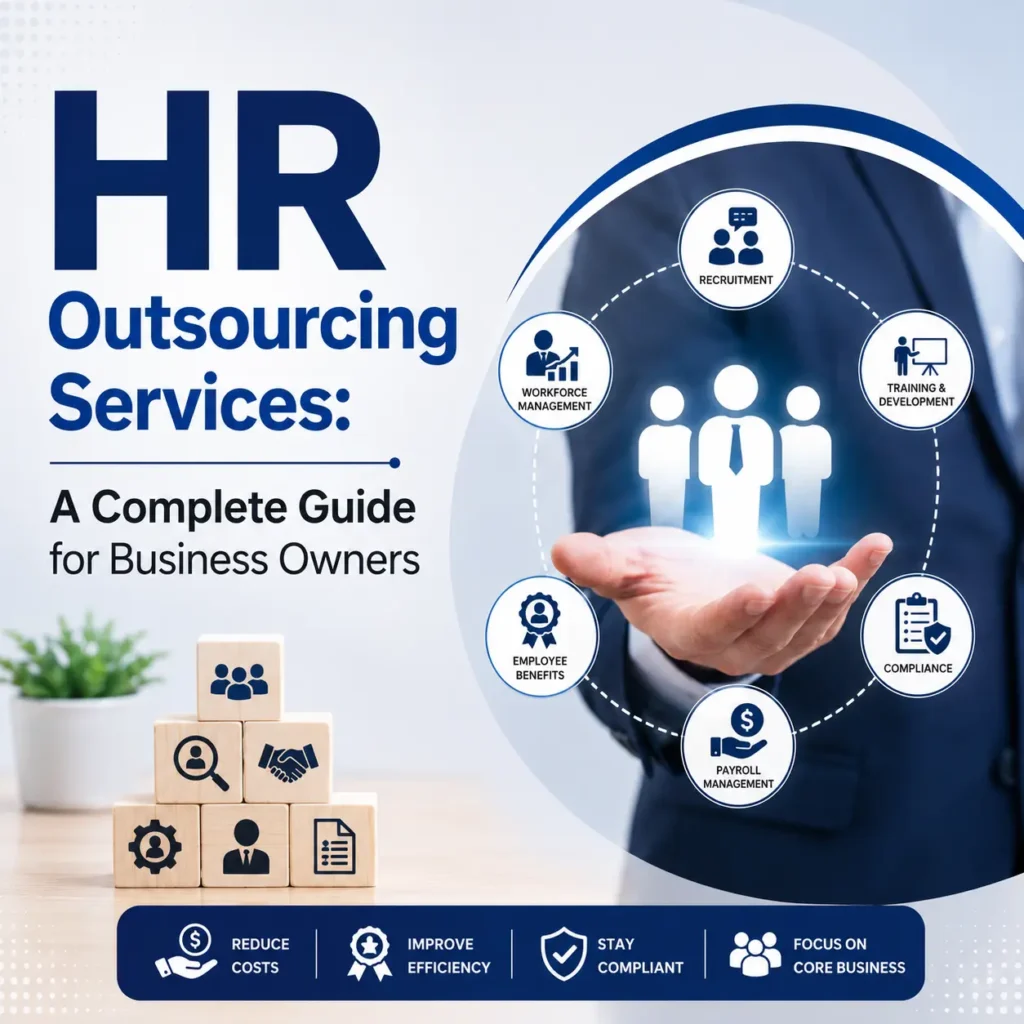
Viriksha HR Solution HR Outsourcing Services: A Complete Guide for Business Owners in India 15-06-2026 Monday HR Outsourcing Services: A Complete Guide for Business Owners in India Running a business in India means managing a workforce — and managing a workforce means managing everything that comes with it. Payroll that must be processed accurately every month. Statutory filings that must reach EPFO, ESIC, and state authorities before fixed deadlines. Labour law registers that must be maintained in prescribed format. Employment documents that must be legally compliant. Hiring that must produce the right people at the right time. HR policies that must reflect current law and be communicated to every employee. For most business owners, this is too much to manage well alongside everything else that running a business requires. Not because they are incapable — but because HR is a specialist discipline that spans payroll accounting, labour law, statutory compliance, recruitment, and people management simultaneously. No single internal hire covers all of it. No informal process manages all of it reliably as the business grows. HR outsourcing services exist to solve this — completely, professionally, and at a cost that is almost always lower than building the equivalent internal capability. This guide covers everything a business owner in Chennai and across India needs to know about HR outsourcing services — what they include, what they cost, who needs them, how to choose a provider, and how Viriksha HR Solutions delivers them. What Are HR Outsourcing Services? HR outsourcing services is the engagement of an external specialist firm to manage some or all of a business’s human resources functions — instead of building and maintaining that capability entirely in-house. HR outsourcing is not a new concept. Large enterprises have used it for decades — outsourcing payroll processing to specialist vendors, engaging recruitment firms for specific mandates, and bringing in HR consultants for specific projects. What has changed in India in 2026 is the breadth and integration of what can be outsourced, the quality of specialist providers who serve businesses of every size, and the recognition among growing businesses that partial HR outsourcing — doing some things internally and outsourcing the rest — frequently produces the worst of both models. The most effective HR outsourcing engagement for a growing business is one that covers the complete HR function — payroll, compliance, recruitment, staffing, documentation, and advisory — through a single integrated provider who owns every output and is accountable for every outcome. What HR Outsourcing Services Include — The Complete Scope HR outsourcing is not a single service. It is a collection of related functions that can be outsourced individually or together. Here is what a complete HR outsourcing services engagement covers. Payroll Outsourcing Payroll outsourcing is the most commonly outsourced HR function — and for good reason. It is technically demanding, deadline-driven, and directly connected to statutory compliance obligations that carry real penalties when missed. A complete payroll outsourcing service covers attendance data collection and reconciliation, gross salary calculation for every employee, application of all statutory deductions — Provident Fund, Employee State Insurance, Professional Tax, Labour Welfare Fund, and TDS under Section 192 — payslip generation and distribution, bank transfer file preparation, statutory filing and remittance for all applicable contributions, and a monthly compliance report covering every output and every filing. Payroll outsourcing also includes statutory register maintenance — the Wage Register, Muster Roll, Leave Register, Overtime Register, Employee Register, and Holiday Register — which most payroll software vendors do not provide but which every labour law inspection requires. Statutory and Labour Law Compliance Outsourcing Statutory compliance is the HR function that creates the most significant risk when managed poorly — and the one that most business owners are least equipped to manage themselves. Indian labour law spans more than a dozen central acts and an additional layer of state-specific legislation in every state the business operates in. Each act has its own filing calendar, its own inspection framework, and its own penalty regime. Statutory compliance outsourcing covers employer registration and licence maintenance under every applicable act — Shops & Establishments Act, Factories Act, Contract Labour Act, ISMW Act, BOCW Act. Monthly compliance management across PF, ESI, Professional Tax, and Labour Welfare Fund — with deadline discipline that ensures no remittance is ever late. Minimum wage monitoring and salary structure updates when revised rates are notified. Statutory register maintenance in prescribed format. POSH compliance management — ICC constitution, policy documentation, annual report filing. And inspection and notice management when any statutory authority visits or issues a demand. Recruitment and Talent Acquisition Outsourcing Recruitment outsourcing — from individual role mandates to full Recruitment Process Outsourcing — ensures the business can hire at the speed and quality its growth requires without building the internal recruiter headcount that volume hiring demands. Recruitment outsourcing covers permanent hiring across every function and level — junior and volume roles through direct sourcing, mid-level specialist roles through a combination of proactive sourcing and agency networks, and senior leadership mandates through retained executive search. It also covers background verification for every placement, onboarding support, and the market intelligence — compensation benchmarking, candidate availability data — that makes hiring decisions accurate rather than approximate. For businesses with 40 or more annual hires, RPO — Recruitment Process Outsourcing — embeds the recruitment function within the HR team, managing the complete hiring cycle as an integrated service. Contract Staffing Outsourcing Contract staffing outsourcing provides the business with a flexible workforce — contract employees, temporary workers, fixed-term staff, and zero-hour workers — employed and managed by the outsourcing provider rather than directly by the client business. When the staffing provider is the employer of record, every compliance obligation — PF, ESI, PT, LWF, statutory registers, payroll — is the provider’s responsibility. The client gets the workforce. The provider manages the employment. The compliance exposure is zero. HR Policy and Documentation Outsourcing Employment documentation is the compliance component that creates the most legal exposure when poorly managed — and the one that is
10 Signs It’s Time to Partner with a Recruitment Agency
Viriksha HR Solution 10 Signs It’s Time to Partner with a Recruitment Agency Form 16 Generation and Employee Income Tax Filing Guide for Companies in India 15-06-2026 Monday 10 Signs It’s Time to Partner with a Recruitment Agency Most businesses wait too long. They manage recruitment internally until the pain becomes undeniable — until roles have been open for three months, until the wrong hire has cost them a client relationship, until the HR team is spending more time on unfilled vacancies than on any other responsibility. By the time the decision to partner with a recruitment agency is made, the business has already paid a significant price for not making it sooner. The good news is that the signs are visible long before the pain becomes severe. Every business that is approaching the point where internal recruitment is no longer working — or no longer working well enough — shows the same set of signals. Recognising them early is the difference between engaging a recruitment services partner proactively and engaging one reactively under pressure. These are the ten signs that your business needs a recruitment agency partner — and what each one is really telling you about where your hiring is breaking down. “Compliance is not a cost center. It is a trust signal — to your employees, your investors, your bank, andyour clients. In Chennai’s competitive business landscape, the companies that comply consistently are the ones that scale consistently.”— VIRIKSHA HR SOLUTION, CHENNAI Sign 1 — Roles Are Taking Longer to Fill Than the Business Can Absorb The most obvious sign that something is wrong with recruitment is that it is taking too long. But “too long” is not the same number for every role. A junior support role that takes six weeks to fill is probably fine. A senior technology lead that has been open for four months is a business problem — not a recruitment inconvenience. The way to identify whether your time-to-fill is a problem is to ask one question: what is this vacancy costing the business every week it stays open? If the answer is measurable — in delayed output, in team overload, in deferred revenue, in customer experience impact — then the vacancy is costing more than a recruitment agency engagement would. Most businesses that calculate the true weekly cost of a critical vacancy for the first time are surprised. The cost of the vacancy is almost always higher than the cost of the recruitment service that would fill it. The economics of partnering with a recruitment agency are almost never about the fee. They are about the cost of not filling the role fast enough. If your critical roles are consistently taking longer than six to eight weeks for mid-level positions and ten to fourteen weeks for senior positions — inclusive of the notice period — your recruitment process is not keeping pace with what the business needs. Sign 2 — Your Internal Team Is Spending More Time on Recruitment Than on Their Primary Role When your HR manager is spending 40% of their week on recruitment administration — screening CVs, scheduling interviews, chasing candidates, managing offer letters — they are not spending 40% of their week on HR. When your hiring managers are spending hours reviewing irrelevant applications and conducting first-round interviews that should have been filtered out before they reached them, they are not managing their teams. This is the management bandwidth cost of traditional hiring — and it is one of the most significant and least-tracked costs in any growing organisation. Unlike a recruitment agency fee, which appears on an invoice, the management bandwidth cost is invisible. It shows up as slower decisions, as HR work that does not get done, and as hiring managers who are less available to the teams they are supposed to be leading. A recruitment agency partner absorbs the sourcing, screening, and initial assessment workload — delivering evaluated candidates to the hiring manager at the interview stage, not at the screening stage. The hiring manager’s time is spent on the decision, not on the process that should precede it. If your internal team’s recruitment workload is competing with their primary responsibilities — and both are suffering — that is the sign that you need a recruitment services partner to own the process. Sign 3 — You Are Hiring the Best Applicant Rather Than the Best Candidate This is the subtlest and most consequential sign on the list — and the one that is hardest to recognise from the inside. When recruitment is managed through job postings and inbound applications, the shortlist is built from the applicant pool — the people who saw the posting and applied. The best candidate available in the market may not be in that pool. They may be employed and not actively looking. They may not check job portals. They may have seen the posting and assumed the role was not right for them based on a job description that did not accurately represent the opportunity. The result is a hire that is the best of who applied — not the best of who exists. This distinction is invisible at the time of hire. It becomes visible over the following twelve to eighteen months, when the hired candidate’s ceiling is lower than the role requires, or when a conversation with a recruiter reveals that there were significantly stronger profiles available in the market that were never approached. If your hires are consistently good enough but rarely exceptional — if your recruitment process consistently produces candidates who perform adequately but rarely accelerate — you are probably hiring from the applicant pool rather than the talent market. A recruitment agency with proactive sourcing capability and genuine candidate relationships changes that. Sign 4 — You Have Lost Good Candidates to Competitors Who Moved Faster Speed is not a luxury in recruitment in 2026. It is a competitive requirement. The candidate who is right for your role is almost certainly in multiple processes
Talent Acquisition Partner vs Traditional Hiring
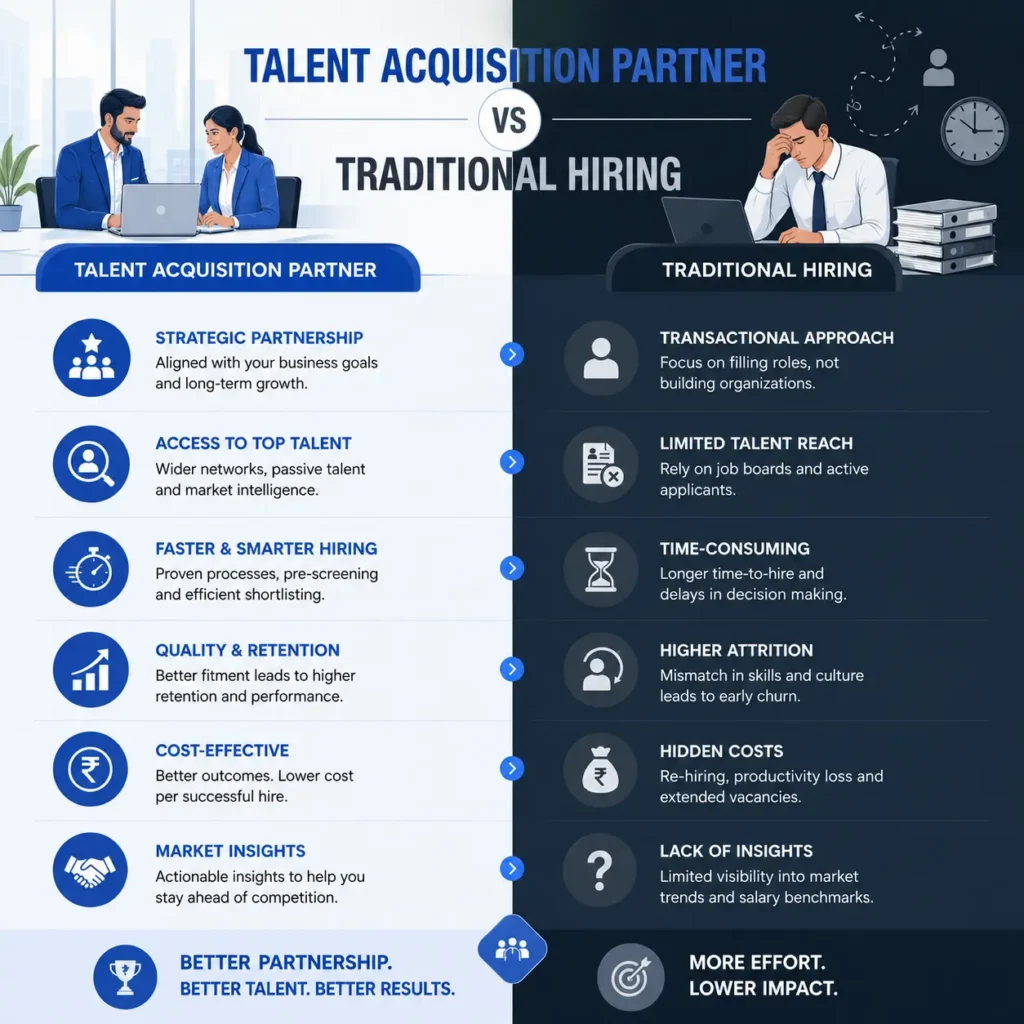
Viriksha HR Solution Talent Acquisition Partner vs Traditional Hiring Why Growing Businesses Need a Talent Acquisition Partner Instead of Traditional Hiring Methods 15-06-2026 Monday Why Growing Businesses Need a Talent Acquisition Partner Instead of Traditional Hiring Methods There is a moment every growing business reaches where the way it has always hired stops working. The job posting that used to attract 50 relevant applicants now attracts 200 irrelevant ones and three worth interviewing. The hiring manager who used to handle recruitment between other responsibilities is now spending 30% of their week on it — and still filling roles slower than the business needs. The offer that went out to the candidate who seemed perfect was declined because a competitor moved three weeks faster. Traditional hiring methods — post a job, screen applications, interview, offer — were designed for a talent market that no longer exists. They work when candidates come to employers. They fail when employers must go to candidates. They work when time-to-fill is a preference. They fail when it is a business constraint. They work at 20 employees. They fail at 120 — and they fail expensively, in ways that are not always visible until the damage is already done. A talent acquisition partner is the answer — not a recruiter who fills a vacancy when asked, but a strategic partner who manages the complete hiring function, brings market intelligence to every search, and treats finding the right person as a business priority rather than an administrative task. This blog explains exactly why growing businesses in Chennai and across India need a talent acquisition partner in 2026 — and what the difference in outcomes actually looks like. “Compliance is not a cost center. It is a trust signal — to your employees, your investors, your bank, andyour clients. In Chennai’s competitive business landscape, the companies that comply consistently are the ones that scale consistently.”— VIRIKSHA HR SOLUTION, CHENNAI What Traditional Hiring Methods Actually Cost — The Numbers Most Businesses Don’t Track Before examining what a talent acquisition partner delivers, it helps to understand what traditional hiring is actually costing — because most businesses track the fees they pay to recruiters but do not track the far larger costs that traditional hiring creates. The cost of a vacant role — every day a revenue-generating role stays vacant, the business loses output. A sales manager vacancy at ₹12 lakhs per year CTC that stays open for 60 days costs the business the contribution that person would have generated — typically two to three times their salary in revenue impact. A technology lead vacancy in a product team delays a product release. A finance manager vacancy delays month-end close. The cost of the vacancy is never the salary. It is the output the business is not getting. The cost of a bad hire — the most expensive outcome of traditional hiring under pressure is a wrong hire. A candidate who was selected because they were the best of the applicants — not the best available in the market — and who leaves within twelve months takes with them the recruitment cost, the onboarding investment, the institutional knowledge accumulated, the productivity ramp-up period, and triggers the entire cycle again. Research consistently shows that a failed hire at mid-management level costs between one and three times the annual salary of the role. At senior level, it costs significantly more. The hidden management cost — when hiring managers manage recruitment alongside their primary responsibilities, both suffer. A technology director spending 10 hours a week screening CVs, scheduling interviews, and chasing candidates is not spending 10 hours a week directing technology. That management bandwidth cost never appears on a recruitment budget — but it is real, it compounds across every open role, and it is entirely recoverable by engaging a talent acquisition partner who owns the process. The employer brand cost — candidates who experience a disorganised, slow, or inconsistent recruitment process share that experience. In Chennai’s connected professional networks — particularly in IT, BFSI, and the manufacturing corridors — employer reputation travels fast. Every candidate who has a poor experience with your hiring process tells others. Over time, traditional hiring that is managed poorly makes the next search harder — because the best candidates have heard about the experience and choose not to engage. What a Talent Acquisition Partner Actually Does — The Full Scope Most businesses that have only worked with traditional recruitment agencies are surprised by how different a genuine talent acquisition partner engagement is. The difference is not in the output — both produce candidates. The difference is in the process, the intelligence, the accountability, and the strategic value that comes alongside the candidates. Market mapping before sourcing Market mapping before sourcing — a talent acquisition partner does not begin with a job posting. They begin by mapping the available talent universe for the specific role — identifying who holds equivalent positions at comparable organisations, what the competitive compensation landscape looks like, where the best candidates are likely to be found, and what their current situation and career motivations are. This market intelligence shapes the search strategy and the candidate approach before a single outreach is made. Proactive outreach to passive candidates Proactive outreach to passive candidates — the best candidates for most roles in 2026 are not actively looking. They are employed, performing well, and not responding to job advertisements. A talent acquisition partner reaches them through direct, personalised outreach — presenting the opportunity compellingly to someone who was not looking for it. This is not something a job portal or an internal HR team with a full workload can do effectively. Structured screening before client introduction Structured screening before client introduction — every candidate presented by a talent acquisition partner has been screened against the role’s technical requirements, assessed for cultural and leadership fit where applicable, had their experience claims verified at a high level, and confirmed as genuinely interested in the specific opportunity. The client’s time is
Why Every Growing Business Needs a Reliable HR Vendor Partner
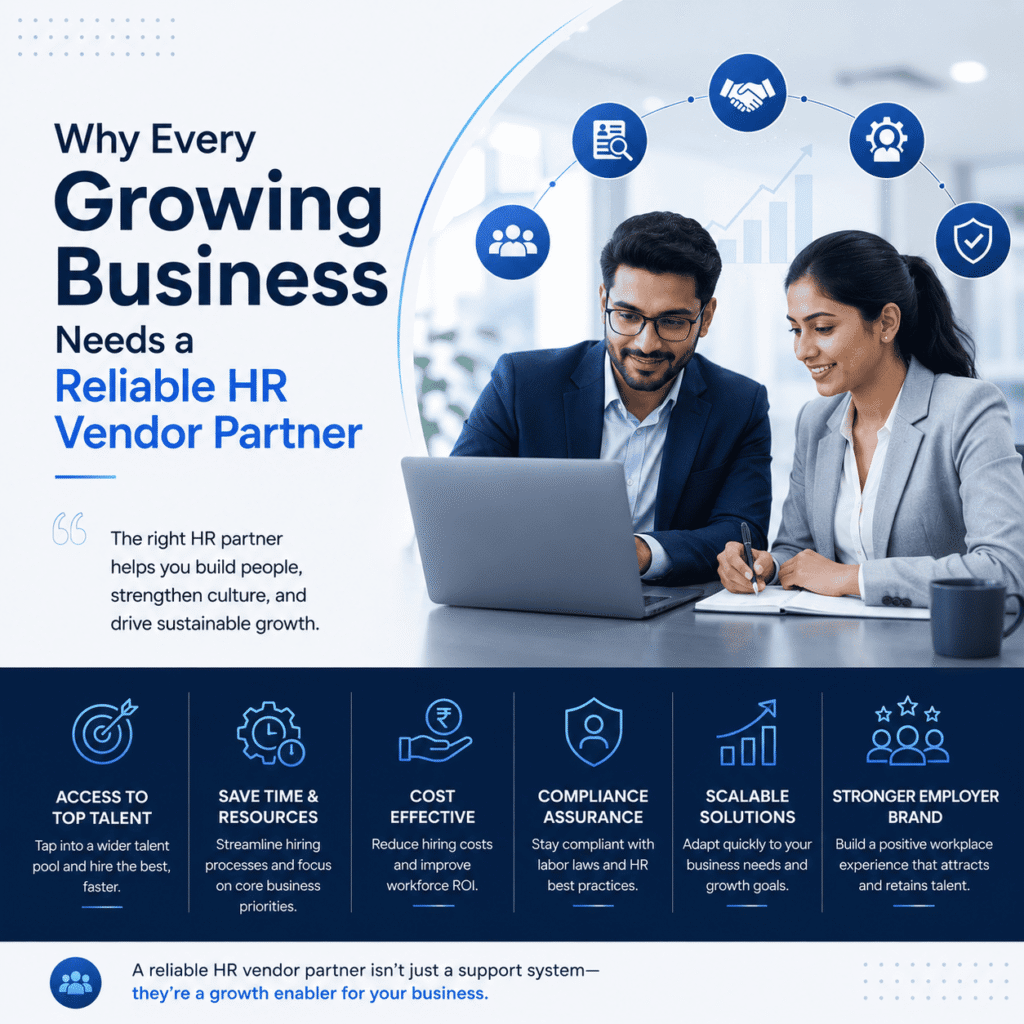
Viriksha HR Solution Why Every Growing Business Needs a Reliable HR Vendor Partner 11-06-2026 Thursday Why Every Growing Business Needs a Reliable HR Vendor Partner There is a specific moment in the life of every growing business when HR stops being manageable and starts being a problem. It is not always dramatic. It rarely announces itself. But it arrives — consistently and predictably — at the point where the business has grown beyond what informal HR management can handle, and has not yet built the internal HR infrastructure to manage what it has become. At 15 employees, the founder handles HR. Offer letters are drafted when needed. Payroll is processed on a spreadsheet. PF and ESI filings happen — usually. Registers are maintained — sometimes. This works because the complexity is low, the workforce is visible, and the founder knows everyone personally. At 60 employees, the same approach breaks. The payroll spreadsheet has formula errors that nobody catches until an employee complains. Three new joiners from last month still have not been enrolled in ESI. The Leave Register has not been updated since February. A labour inspector visited last week and the Wage Register was not in the prescribed format. And the founder is spending four hours every month on payroll administration instead of building the business. At 150 employees, the breakage is visible at every level. Compliance gaps have accumulated into real liability. The HR function is reactive — responding to problems rather than preventing them. And the business is paying for the absence of HR infrastructure in ways that show up in attrition numbers, compliance notices, and management time consumed by people problems that should have been solved structurally months ago. This progression is not a failure of intention. It is the predictable consequence of a business that grew without building the HR infrastructure to match. And the solution — consistently, across thousands of businesses in Chennai and across India — is a reliable HR vendor partner who manages the HR function professionally, compliantly, and at a cost that makes more sense than building it all in-house. What Is an HR Vendor Partner — and What Makes One Reliable? An HR vendor partner is an external organisation that manages some or all of a business’s HR functions — payroll, statutory compliance, recruitment, staffing, HR policy, and advisory — as a service partner rather than as an internal hire. The distinction between a vendor and a partner matters. A vendor provides a service when asked. A partner manages a function and owns the outcomes. A payroll vendor processes salary when you send them the inputs. A payroll partner reconciles attendance data, flags discrepancies before processing, manages statutory filings on time, maintains registers as standard, and tells you when a regulation has changed that affects your salary structure — without being asked. Reliability in an HR vendor partner has six specific dimensions — and every business evaluating an HR partner should assess all six before committing. Compliance depth — does the partner understand every labour law applicable to your establishment, track revisions proactively, and implement changes before they create liability? A partner who knows the PF Act but has never heard of the BOCW Act, the ISMW Act, or the specific requirements of the Tamil Nadu Shops & Establishments Act is not a reliable compliance partner for a business that needs all of those requirements managed. Process discipline — does the partner meet every deadline, every month, without the client having to follow up? PF ECR by the 15th. ESI challan by the 15th. TDS deposit by the 7th. Form 24Q within 31 days of quarter end. A partner who occasionally misses deadlines is not a compliance partner — they are a compliance risk. Communication transparency — does the partner proactively communicate changes, risks, and findings — or do they respond only when asked? The HR vendor partner who calls you in October to tell you that the Tamil Nadu minimum wage was revised in September — before your next payroll run — is protecting you. The one who waits for you to ask is not. Scalability — does the partner’s service quality hold as your headcount grows? A partner who handles 30 employees well but struggles at 150 will be a bottleneck at exactly the moment the business needs to accelerate. The right HR vendor partner scales with the business — providing more depth as complexity grows, not creating more problems. Accountability — when something goes wrong — and in HR, something occasionally will — does the partner own the problem and fix it, or find a reason why it was the client’s fault? A reliable HR vendor partner takes accountability for their outputs unconditionally. Integration — does the partner connect the functions they manage — payroll, compliance, recruitment, staffing — so that outputs from one function feed correctly into the next? Or does each service operate in isolation, creating the mismatches and gaps that fragmented vendor models always produce? The Seven Functions a Reliable HR Vendor Partner Manages 1. Payroll Management — The Foundation of Everything Payroll is the HR function that every employee notices directly — and the one that has the most compliance obligations attached to it. A reliable HR vendor partner does not just process salary. They manage the complete payroll cycle — attendance reconciliation, gross salary calculation, statutory deductions on the correct wage base, payslip generation, bank transfer file preparation, TDS calculation under the correct regime, and a monthly compliance report that gives management a complete picture of payroll cost and statutory liability. Critically, a reliable payroll partner also maintains the statutory registers that labour law requires — the Wage Register, Muster Roll, Leave Register, Overtime Register, and Employee Register — as a standard monthly deliverable, not as a separate service that has to be requested and chased. 2. Statutory Compliance — Every Law, Every Month, Every Filing India’s statutory compliance framework spans multiple central and state laws — EPF Act, ESI Act,
Executive Search for Manufacturing Industry Leaders | Chennai Recruitment Experts

Viriksha HR Solution Executive Search for Manufacturing Industry Leaders in Chennai Executive Search for Manufacturing Industry Leaders in Chennai — Finding the Leaders Who Keep Production Moving and Businesses Growing 10-06-2026 Wednesday Executive Search Manufacturing Industry Leaders in Chennai Manufacturing leadership is one of the most demanding executive profiles in India’s talent market — and one of the most under-served by general executive search firms. A plant head who cannot manage the complexity of simultaneous production, quality, safety, compliance, and people challenges is not a plant head. A supply chain director who cannot navigate the disruptions, supplier relationships, and cost pressures that define Indian manufacturing in 2026 is not in control of the supply chain. A manufacturing CEO who has not lived the operational realities of the shop floor cannot make the decisions that keep a manufacturing business competitive. The executives who can do all of this are rare, employed, and not on any job portal. Finding them — and convincing them to consider a move — requires an executive search partner with genuine relationships in India’s manufacturing leadership community, deep sector knowledge across the specific manufacturing verticals that matter, and a search process rigorous enough to assess whether a candidate who looks right on paper is actually the right leader for the specific organisation and challenge. Viriksha HR Solutions is a specialist executive search firm for manufacturing industry leaders — placing plant heads, operations directors, VP Supply Chain, VP Manufacturing, CHRO, CFO, and CXO-level leaders for manufacturing companies across Chennai, Tamil Nadu, and Pan India. This guide covers everything manufacturing organisations need to know about executive search in 2026 — the roles in demand, the assessment challenges, the market dynamics, and how to build a leadership search strategy that finds the right person, not just an available person. Why Manufacturing Executive Search Is Different From General Executive Recruitment Manufacturing leadership search is a specialist discipline — and treating it as general executive recruitment produces consistently poor outcomes. Understanding why is the starting point for every manufacturing organisation that has had a leadership search fail or deliver the wrong candidate. Operational credibility cannot be faked a manufacturing leader who has not run a large plant knows it — and the teams they lead know it within the first month. The operational credibility that makes a plant head effective is built over years of shop floor experience, not acquired through a leadership development programme. Assessing genuine operational depth — as opposed to impressive presentation of borrowed operational vocabulary — requires an executive search consultant who knows what genuine manufacturing leadership experience looks like from the inside. The domain is vertically specific TDS deposited through a challan is not correctly mapped to the employee deductioautomotive manufacturing leadership is not directly transferable to pharmaceutical manufacturing. Food processing leadership requires compliance knowledge — FSSAI, HACCP, GMP — that is irrelevant to metal fabrication. A petrochemical plant head manages safety and process engineering complexities that have no parallel in electronics assembly. Executive search for manufacturing must be conducted within the specific vertical — not across manufacturing as a generic category.ns in the Form 24Q return. The deposit appears in government records but the employee-level mapping is missing — creating a mismatch between Form 16 and Form 26AS. The passive candidate challenge is acute effective manufacturing leaders in 2026 are in very stable employment. The plant head of a 2,000-worker automotive component facility in Chennai is not updating their LinkedIn profile. The VP Supply Chain of a major FMCG company is not registered on Naukri. They are reachable only through a recruiter who has a genuine relationship with them — or through a network that connects to them through trusted intermediaries. Cold approaches without credibility are ignored or declined. Leadership assessment in manufacturing requires operational evaluation the standard executive search competency interview is necessary but insufficient for manufacturing leadership assessment. A plant head candidate must be assessed on operational problem-solving — how they would handle a quality escape that risks a customer shutdown, how they would manage a safety incident while maintaining production, how they would address a workforce performance issue in a unionised environment. This assessment requires manufacturing-specific evaluation frameworks that general executive search firms do not use. Manufacturing Leadership Roles Viriksha Recruits For Plant Head and General Manager — Manufacturing The plant head is the most consequential single hire a manufacturing organisation makes. They are accountable for everything that happens inside the plant boundary — production output, quality performance, safety record, cost management, workforce management, statutory compliance, and customer delivery. A strong plant head drives continuous improvement, builds team capability, and manages the complexity of running a large industrial operation without drama. A weak one creates problems that are visible to customers and leadership within months. Plant head searches require a candidate who has run a plant of comparable size, complexity, and technical nature — not one who has managed a function within a plant. The distinction between a plant head and a department head is significant — and it is frequently blurred in candidate CVs and in the briefings that less experienced executive search consultants receive from hiring organisations. VP and Director of Operations Manufacturing operations leadership at VP and Director level spans the breadth of the plant leadership role but typically covers multiple plants, business units, or product lines. The VP Operations in a large manufacturing organisation is managing a portfolio of operational performance — across plants, geographies, and product categories — while driving the transformation programmes that determine whether the business can compete on cost, quality, and delivery in 2026 and beyond. Executive search for VP Operations mandates requires assessment of multi-site management capability, strategic thinking alongside operational depth, and the stakeholder management capability to align business unit leadership, finance, supply chain, and customer-facing teams around operational priorities. Supply Chain and Logistics Leadership India’s manufacturing supply chain in 2026 operates in a permanently disrupted environment — geopolitical supply chain realignment, semiconductor and raw material availability volatility, logistics infrastructure transformation, and
Hiring Healthcare IT Professionals: A Complete Guide for Hospitals, Diagnostics, and Health Tech Companies in India
Viriksha HR Solution Hiring Healthcare IT Professionals Hiring Healthcare IT Professionals: A Complete Guide for Hospitals, Diagnostics, and Health Tech Companies in India 09-06-2026 Tuesday Hiring Healthcare IT Professionals Healthcare is the industry where technology failure has consequences that no other sector experiences. A banking system outage is a financial inconvenience. A healthcare IT failure can delay a diagnosis, disrupt a surgical schedule, or compromise patient safety. The stakes attached to healthcare IT — and by extension to the quality of the people who build and manage it — are uniquely high. In 2026, India’s healthcare sector is in the middle of the most significant technology transformation in its history. Hospital Information Systems are being replaced and integrated. Electronic Medical Records are being standardised. Telemedicine platforms are scaling from pandemic-era exceptions to permanent service delivery channels. Health data is being federated through the Ayushman Bharat Digital Mission. Diagnostics companies are deploying AI-assisted image analysis. Pharmaceutical companies are building digital clinical trial infrastructure. And health insurance companies are rebuilding their technology stacks around real-time claims processing and fraud detection. Every one of these transformations requires people — healthcare IT professionals who understand both the clinical environment and the technology that serves it. Finding those people is the challenge this guide addresses — for hospital groups, diagnostic chains, health tech companies, pharmaceutical IT teams, health insurance technology organisations, and medical device companies across Chennai and India. “Compliance is not a cost center. It is a trust signal — to your employees, your investors, your bank, andyour clients. In Chennai’s competitive business landscape, the companies that comply consistently are the ones that scale consistently.”— VIRIKSHA HR SOLUTION, CHENNAI Why Healthcare IT Recruitment Is Uniquely Difficult Recruiting for healthcare IT is harder than recruiting for general IT — and harder than recruiting for clinical roles — because it requires a professional who sits at the intersection of both worlds. A Hospital Information System implementation specialist who does not understand clinical workflows cannot configure the system around how doctors and nurses actually work. The result is a technically functional system that clinical staff resist — and eventually abandon. An EMR data analyst who does not understand medical coding — ICD-10, CPT, SNOMED — cannot produce analysis that the clinical team can act on. A telemedicine platform engineer who does not understand the regulatory requirements governing remote clinical consultation cannot build a compliant product. Healthcare IT professionals are rare because the combination of clinical domain knowledge and technology capability develops slowly — through years of working within healthcare environments, not through a course or a certification. The most experienced healthcare IT professionals in India have built that knowledge through exposure to large hospital implementations, diagnostic chain deployments, or health tech product development — and they are employed, performing well, and not actively looking. The second challenge is the regulatory complexity specific to healthcare technology in India. The Digital Information Security in Healthcare Act framework, the Ayushman Bharat Digital Mission standards for Health IDs and linked health records, CDSCO requirements for software as a medical device, and state-level clinical establishment regulations all affect how healthcare technology is designed, deployed, and governed. Professionals who understand these requirements are scarce and valuable. Healthcare IT Roles in Demand in 2026 Hospital Information System Professionals HIS specialists — who implement, customise, support, and upgrade the integrated software systems that manage hospital operations — are in sustained demand across India’s large hospital groups. HIS covers patient registration, bed management, OPD and IPD workflows, pharmacy management, billing, and integration with clinical systems — all of which must function without interruption in a 24-hour clinical environment. HIS roles in active demand include HIS implementation consultants, HIS support engineers, HIS integration architects, hospital IT managers, and HIS project managers for large-scale hospital group roll-outs and upgrades. EMR and Clinical Data Professionals Electronic Medical Record systems are the clinical documentation backbone of modern hospitals — and implementing, managing, and extracting value from them requires professionals who understand both the clinical workflows the system must support and the technology that implements them. EMR professionals in demand include EMR implementation specialists, clinical informatics managers, medical coding specialists — ICD-10, CPT, DRG — health data analysts, and clinical data managers for research and regulatory submission programmes. Telemedicine and Digital Health Platform Professionals India’s telemedicine market has grown from a pandemic emergency measure to a permanent healthcare delivery channel — with platforms serving rural health access, specialist consultation, chronic disease management, and mental health services. Building and operating these platforms requires a specific combination of healthcare domain knowledge and digital product capability. Telemedicine platform roles in demand include product managers with healthcare domain experience, backend engineers familiar with healthcare data standards — HL7, FHIR — telemedicine operations managers, patient experience designers, and regulatory affairs specialists for digital health products requiring CDSCO classification. Health Data and Analytics Professionals Healthcare data is the most complex and most valuable data in any industry — and the organisations that extract clinical and operational intelligence from it gain advantages in patient outcomes, operational efficiency, and population health management that are directly measurable. Health data roles in demand include healthcare data engineers, clinical data scientists, population health analysts, health economics specialists, and AI model developers for clinical decision support and medical imaging analysis applications. Health Insurance Technology Professionals India’s health insurance sector is rebuilding its technology infrastructure around real-time claims processing, AI-assisted underwriting, fraud detection, and customer digital experience. Health insurance technology roles in active demand include claims technology developers, underwriting technology specialists, health insurance product managers, fraud analytics professionals, and TPA integration engineers. Medical Device and Diagnostic IT Professionals Medical device companies and diagnostic chains are investing in connected device infrastructure, remote monitoring platforms, AI-assisted diagnostic tools, and laboratory information management systems. Roles in demand include LIS implementation specialists, medical device software engineers, regulatory affairs professionals for SaMD classification, and clinical validation specialists for AI diagnostic applications. Healthcare Cybersecurity Professionals Patient data is among the most sensitive personal data categories under the Digital Personal
How to Hire Top FinTech Talent in 2026
Viriksha HR Solution How to Hire Top FinTech Talent in 2026 The Complete Recruitment Guide for Banks, NBFCs, and FinTech Companies in India 09-06-2026 Tuesday The Complete Recruitment Guide for Banks, NBFCs, and FinTech Companies in India FinTech is no longer a disruption story. It is the mainstream financial services story. In 2026, the boundary between a bank and a technology company has blurred to the point of irrelevance — because the fastest-growing banks in India are technology-first, the most capable NBFCs run on proprietary technology stacks, and the FinTech companies that were startups five years ago are now regulated entities managing billions in transaction volume. What this convergence means for hiring is straightforward and demanding: the talent required to build, operate, and grow a financial technology organisation in 2026 sits at the intersection of deep financial domain knowledge and advanced technology capability. That intersection is narrow, competitive, and not well served by traditional recruitment approaches — job portals, CV databases, and generalist recruiters who work across every industry. This guide covers everything banks, NBFCs, payment companies, insurtech firms, wealthtech platforms, and financial services technology organisations in Chennai and across India need to know about FinTech recruitment in 2026 — the roles in demand, the skills that define them, the hiring challenges, the sourcing model that works, and how Viriksha HR Solutions helps financial technology organisations build the teams they need. Click here “Compliance is not a cost center. It is a trust signal — to your employees, your investors, your bank, andyour clients. In Chennai’s competitive business landscape, the companies that comply consistently are the ones that scale consistently.”— VIRIKSHA HR SOLUTION, CHENNAI Why FinTech Talent Is the Hardest Hire in India’s Technology Market India’s technology talent market is competitive across every domain. FinTech talent is specifically difficult — and understanding why is the starting point for building a recruitment strategy that works. The dual-domain requirement the most valuable FinTech professionals understand both technology and financial services. A payments engineer who understands the UPI stack and the regulatory environment governing payment systems is not the same as a software engineer who can learn payments. A risk technology professional who understands model risk management and can build the quantitative models that operationalise it is not findable on a job portal. These profiles are developed through years of domain-specific experience — and there are fewer of them than there is demand for them. The regulatory knowledge premium FinTech in India operates under one of the most dynamic regulatory environments in the world. RBI guidelines, SEBI regulations, IRDAI frameworks, NPCI requirements, and the evolving data protection obligations under the DPDP Act 2023 all directly affect how technology is built, deployed, and managed in financial services. Professionals who understand these regulatory requirements — and can translate them into technology specifications and compliance controls — carry a significant market premium. They know their value. They receive multiple competing offers. And they move for the right opportunity — not for any opportunity. The employer competition FinTech talent in India is competed for simultaneously by Indian banks building technology capability in-house, global banks running GCC technology centres in Chennai, Hyderabad, and Bangalore, Indian FinTech companies at every stage from seed to IPO, global FinTech organisations hiring remotely from India, and consulting and services companies building FinTech practices. The candidate who is right for your role is almost certainly in at least one other active process — which means your hiring process must be fast, structured, and compelling. The compensation complexity FinTech compensation in 2026 includes base salary, performance bonus, ESOPs or equity, and in some cases joining bonuses and retention structures. Organisations that benchmark only against base salary lose candidates at the offer stage to competitors who have modelled the total compensation package. FinTech recruitment in 2026 requires compensation intelligence — knowing the full market package for each role type, not just the salary range. FinTech Roles in Demand in 2026 — The Complete Talent Map Core Technology Roles Payments Technology Engineers — professionals who understand payment rails — UPI, IMPS, NEFT, RTGS, card networks, and international correspondent banking — and can build, maintain, and scale the technology systems that process payment transactions. In Chennai and across India, payment technology is one of the most active hiring areas in FinTech — driven by the continued expansion of UPI transaction volumes and the development of new payment products by both banks and FinTech companies. Core Banking Technology Specialists — professionals with deep knowledge of core banking platforms — Finacle, Temenos, Oracle FLEXCUBE, Mambu, and others — and the integration architecture that connects core banking to surrounding systems. Core banking modernisation is a major programme across Indian public sector and private sector banks in 2026 — creating sustained demand for professionals who can design, implement, and migrate between core banking platforms. API and Integration Engineers — FinTech operates on connectivity. Account aggregators, Open Banking APIs, payment gateway integrations, and third-party data service integrations all require engineers who specialise in API design, integration architecture, and the security frameworks that govern financial data exchange. Account Aggregator framework specialists — who understand both the technical implementation and the regulatory requirements of the AA framework — are particularly sought after in 2026. Cybersecurity and Information Security Professionals — financial services organisations are the primary target of cyber attacks — and the regulatory expectation of information security capability has never been higher. RBI’s IT Framework for Banks, the Digital Personal Data Protection Act, and PCI-DSS requirements all mandate specific security controls and governance frameworks. Cybersecurity professionals with financial services experience — CISO candidates, security architects, penetration testers with banking domain knowledge, and compliance-focused information security managers — are among the most difficult and highest-compensated hires in FinTech. Cloud and Infrastructure Engineers — the migration of core financial systems to cloud infrastructure is the largest IT transformation programme in Indian banking in 2026. Cloud engineers with financial services experience — who understand the regulatory constraints on data residency, the availability requirements of financial
Why IT Services Are Critical for Business Growth in 2026
Viriksha HR Solution Why IT Services Are Critical for Business Growth in 2026 08-06-2026 Monday Why IT Services Are Critical for Business Growth in 2026 Every business in India is now a technology business — whether it knows it or not. The manufacturer in Ambattur running production on an ERP system. The BFSI firm in Chennai processing transactions on cloud infrastructure. The logistics company in Oragadam tracking fleet movement through a real-time platform. The healthcare organisation managing patient records on a digital system. The startup in OMR building its entire business model on a software product. Technology is not a support function for these businesses. It is the operational backbone. And the IT services and managed IT solutions that keep that backbone functional, secure, and scalable are not discretionary investments. They are business-critical infrastructure — as essential to daily operations as the people who run them. In 2026, the businesses that grow are the ones that treat IT services strategically — not reactively. This article explains why IT services have become central to business growth in India, what the most critical IT service categories are, how they connect to business outcomes, and how Viriksha HR Solutions helps businesses build the IT teams that make all of it work. The Shift — From IT as Support to IT as Strategy For most of the last two decades, IT in Indian businesses was a support department. It fixed computers, managed email servers, maintained the network, and handled software installations. Business leaders ran the business. IT kept the systems running. That model is obsolete in 2026. The reason is not technology for its own sake. It is the convergence of three forces that have made IT capability the primary determinant of competitive advantage in every industry. Digital customer expectations customers in every sector now expect digital-first interactions. Banks without robust mobile apps lose customers. Retailers without e-commerce capability lose revenue. Healthcare providers without digital appointment and records management lose patients. The IT service layer that enables digital customer experience is not optional — it is the product. Operational efficiency pressure businesses that automate manual processes through technology — payroll systems, ERP, CRM, supply chain platforms, HR management systems — operate at lower cost and higher speed than those that do not. The efficiency gap between digitally mature and digitally immature businesses in the same industry is widening every year. IT services for business are the mechanism through which operational efficiency is built and maintained. Data as a competitive asset every business generates data. The businesses that collect, store, process, and act on that data faster and more accurately than their competitors make better decisions, identify opportunities earlier, and respond to market changes more effectively. Cloud infrastructure, data integration platforms, and analytics capabilities are IT services — and they are the infrastructure on which data-driven competitive advantage is built. IT Services and the Talent Challenge — Why Recruitment Is the Critical Link Every IT service category described in this article depends on one thing — the people who design, build, operate, and maintain the technology. And in 2026, finding those people is harder than it has ever been. India’s IT talent market is simultaneously the largest and the most competitive in the world. Chennai alone has over 500,000 technology professionals — and demand exceeds supply across every specialised category. Cloud engineers, cybersecurity professionals, data engineers, DevOps specialists, ERP consultants, and senior IT project managers are in continuous demand from Indian IT services companies, product companies, GCC centres, and global organisations hiring remotely. For businesses that need IT professionals — whether to build an internal IT team, staff a GCC centre, or fill specialist roles in a technology transformation programme — the talent challenge is as significant as the technology challenge. The businesses that win the IT talent competition in 2026 are the ones that move fast — shortlisting within days, not weeks — that brief accurately — knowing what they need and why — and that work with a recruitment partner who has genuine relationships in the Chennai IT talent market, not just access to job portals. The Most Critical IT Service Categories for Business Growth Cloud Infrastructure and Migration Cloud computing is the foundation of modern IT for business. In 2026, businesses in Chennai and across India are migrating from on-premise infrastructure to cloud platforms — AWS, Microsoft Azure, Google Cloud — or building cloud-native from the start. The business case for cloud is straightforward: lower capital expenditure on hardware, higher reliability through built-in redundancy, faster scalability when the business grows, and access to enterprise-grade technology capabilities — AI, machine learning, data analytics — that would be prohibitively expensive to build independently. Managed IT solutions for cloud infrastructure include cloud architecture design, migration planning and execution, ongoing cloud operations management, cost optimisation, and security configuration. Businesses that migrate without expert IT services support frequently over-provision — paying for capacity they do not use — or under-secure — exposing sensitive data to risks they have not modelled. The IT talent that makes cloud work — cloud architects, DevOps engineers, cloud security specialists, and platform engineers — is among the most competitive in India’s technology job market. Building and retaining this capability is both a technology challenge and a talent acquisition challenge. Cybersecurity Cybersecurity is the IT service category that most businesses underinvest in until they have a reason not to. A ransomware attack that encrypts production data. A data breach that exposes customer financial information. A phishing attack that compromises payroll systems. A supply chain attack through a vendor’s software. In 2026, cybersecurity is not a large-enterprise concern. Small and mid-size businesses in Chennai are actively targeted — because they typically have weaker defences than large enterprises while holding the same categories of valuable data. Managed IT security solutions cover security architecture design, vulnerability assessment and penetration testing, endpoint protection, identity and access management, security information and event management (SIEM), incident response planning, and compliance with data protection regulations — DPDP Act 2023
Top HR Consultancy Trends in 2026
Viriksha HR Solution Top HR Consultancy Trends in 2026 Top HR Consultancy Trends in 2026 — What Every Business in India Needs to Know 08-06-2026 Monday Top HR Consultancy Trends in 2026 — What Every Business in India Needs to Know HR consultancy is not what it was five years ago. The businesses that engaged HR consultants in 2021 wanted help with compliance basics and recruitment. The businesses engaging HR consulting services in 2026 want something significantly more strategic — workforce planning that connects to business targets, compliance frameworks that hold up to investor and regulatory scrutiny, talent acquisition models that compete in markets where the best candidates have four offers before they reply to a message, and HR technology that actually integrates with how the business operates. The shift is not cosmetic. It reflects a fundamental change in how Indian businesses — from Chennai-based startups to Pan India corporates to MNCs building GCC centres — think about HR. HR is no longer a back-office function that processes payroll and files PF returns. It is a business-critical function that determines whether the organisation can hire, retain, and manage the people it needs to grow. And the HR consultancy industry in India is evolving to match that expectation. These are the ten most significant HR consultancy trends shaping 2026 — and what they mean for businesses in Chennai and across India. “Compliance is not a cost center. It is a trust signal — to your employees, your investors, your bank, andyour clients. In Chennai’s competitive business landscape, the companies that comply consistently are the ones that scale consistently.”— VIRIKSHA HR SOLUTION, CHENNAI 1. Compliance as a Business Risk Function — Not a Filing Exercise The single biggest shift in how Indian businesses approach HR consultancy in 2026 is the elevation of statutory compliance from an administrative function to a board-level risk management discipline. The trigger is simple. The Labour Codes — Code on Wages, Code on Social Security, Industrial Relations Code, and Occupational Safety Code — are notified and moving toward enforcement. EPFO and ESIC inspection frequency has increased. POSH enforcement is more active than at any point since the Act was passed. And investor due diligence now routinely includes a deep HR and payroll compliance review — meaning non-compliance is not just a penalty risk. It is a valuation risk and a deal risk. The HR consultancy trend in 2026 is the movement from reactive compliance — fixing problems when notices arrive — to proactive compliance architecture — building a framework that prevents notices from arriving. Businesses are investing in annual compliance audits, monthly compliance retainers, and dedicated labour law consultants in ways they simply did not two years ago. What this means for your business: if your compliance framework is still managed informally — registers updated occasionally, PF and ESI filed by whoever is available, minimum wage reviews done never — 2026 is the year that approach becomes visibly costly. 2. AI-Assisted Payroll and HR Processing — With Human Expertise Still Required Artificial intelligence is entering every HR process — payroll calculation, leave management, attendance reconciliation, TDS computation, and statutory filing. HRMS platforms in 2026 use AI to flag anomalies in payroll data, identify employees approaching ESI wage ceiling crossovers, automate ECR generation, and prompt compliance calendar actions before deadlines. But here is what the trend actually reveals: AI-assisted HR processing is only as good as the compliance knowledge that configures and monitors it. An AI system that calculates PF on the wrong wage base calculates it wrongly at scale — faster and more consistently than a human making the same error. The HR consultancy value in 2026 is not in replacing technology with human process. It is in combining both — technology for speed and consistency, human expertise for interpretation, exception management, and department liaison. Businesses that invest in HRMS platforms without investing in the compliance expertise to configure and monitor them are creating a false sense of compliance security. The platform files the ECR. Nobody is verifying whether the wage base is correct. 3. Integrated HR and Payroll — The End of the Fragmented Vendor Model In 2026, the clearest HR consultancy trend among growing businesses in Chennai and across India is the consolidation of HR functions under integrated service providers — moving away from the fragmented model where payroll is managed by one vendor, compliance by another, recruitment by a third, and HR advisory by a consultant who does not speak to any of them. The fragmented model creates mismatch risk at every boundary. The payroll vendor does not know about the salary revision the HR team approved. The compliance vendor does not know about the new joiners the recruitment agency placed. The result is ECR filings that do not match wage registers, ESI enrollments that happen months late, and registers that do not reflect actual headcount. The 2026 trend is integration — one HR consulting services partner managing payroll, compliance, recruitment, and advisory as a coordinated function — where every output from one process feeds correctly into the next, and where accountability for the complete HR function rests with one partner rather than being spread across three vendors who each blame the others when something goes wrong. 4. Data-Driven Talent Acquisition — Replacing Gut Feel With Market Intelligence The talent acquisition model that most businesses in Chennai used in 2022 and 2023 — post the role, screen whoever applies, make an offer — is not competitive in 2026. The candidates who are right for critical roles are employed, receiving competing approaches, and making decisions based on employer reputation and offer quality rather than availability. HR consulting services in 2026 increasingly include talent market intelligence — compensation benchmarking for key role types, time-to-fill analysis by function and level, candidate availability mapping by skill set and location, and employer brand assessment that tells businesses why candidates are choosing competitors over them. Businesses that make hiring decisions based on market data — knowing what the market pays
Form 16 Generation & Employee Income Tax Filing Guide
Viriksha HR Solution Form 16 Generation and Employee Income Tax Filing Guide Form 16 Generation and Employee Income Tax Filing Guide for Companies in India 22-04-2026 Wednesday Form 16 Generation and Employee Income Tax Filing Guide for Companies in India Every employer in India who deducts TDS from employee salaries has one annual deliverable that affects every single employee directly — Form 16. It is the document employees use to file their income tax returns. It is the document that proves TDS was deducted and deposited correctly. And it is the document that, when generated incorrectly or issued late, creates a chain of consequences — employee ITR errors, income tax notices to employees, and penalty exposure for the employer — that takes months to resolve. For companies in Chennai and across India, Form 16 generation is not a June administrative task. It is the output of twelve months of accurate TDS management — and the quality of the Form 16 issued to every employee is a direct reflection of whether payroll and TDS compliance was handled correctly throughout the year. This guide covers everything companies need to know about Form 16 — what it contains, how it is generated, the Form 24Q connection, the Part A and Part B structure, the deadlines, the penalties, and the common errors that make employees’ ITR filings inaccurate and invite income tax department scrutiny. “Compliance is not a cost center. It is a trust signal — to your employees, your investors, your bank, andyour clients. In Chennai’s competitive business landscape, the companies that comply consistently are the ones that scale consistently.”— VIRIKSHA HR SOLUTION, CHENNAI What Is Form 16 and Why Does Every Employee Need It? Form 16 is the annual TDS certificate issued by an employer to an employee under Section 203 of the Income Tax Act, 1961. It certifies the total salary paid to the employee during the financial year, all deductions and exemptions applied, the taxable income computed, the tax liability calculated, and the TDS deducted and deposited with the government — quarter by quarter. For employees, Form 16 is the primary document for filing their annual income tax return. It provides the exact figures — gross salary, exemptions, deductions, taxable income, and TDS — that go into the ITR. An employee who does not receive Form 16, or who receives an incorrect Form 16, cannot file an accurate ITR — which means they either file incorrectly and risk an income tax notice, or delay filing and attract a late filing penalty under Section 234F. For employers, Form 16 is the evidence that TDS obligations under Section 192 were met — deducted correctly, deposited on time, and reported accurately in quarterly returns. A Form 16 that does not match the TRACES records creates a discrepancy that the income tax department can and does act on. Who Is Required to Issue Form 16? Every employer who has deducted TDS from an employee’s salary during the financial year is required to issue Form 16 to that employee. This obligation applies regardless of the amount of TDS deducted — even if TDS was deducted for only one or two months of the year because the employee joined mid-year or left before March. Employers who have not deducted TDS because the employee’s income was below the basic exemption limit — ₹3,00,000 under the new regime, ₹2,50,000 under the old regime — are not required to issue Form 16 to those employees. However, many employers issue Form 16 or a salary certificate to all employees regardless — which is good practice for employees who need income proof for loan applications, visa applications, or other purposes. The Two Parts of Form 16 — Part A and Part B Form 16 has two distinct parts — Part A and Part B — and both must be issued together to every applicable employee. Understanding what each part contains and how each is generated is essential for payroll teams and HR managers managing the Form 16 process. Form 16 Part A — Generated From TRACES Part A of Form 16 is generated by the employer from the TRACES portal — the TDS Reconciliation Analysis and Correction Enabling System maintained by the Income Tax Department. Part A cannot be prepared manually. It must be downloaded from TRACES after the employer’s quarterly TDS returns — Form 24Q — have been filed for all four quarters and processed by the department. Part A contains the following information: employer name, address, TAN, and PAN. Employee name, designation, and PAN. Assessment year to which the certificate relates. Summary of TDS deducted and deposited quarter by quarter — Q1 (April to June), Q2 (July to September), Q3 (October to December), Q4 (January to March). Acknowledgement numbers of the quarterly Form 24Q returns. Total TDS deducted and deposited for the year. The accuracy of Part A depends entirely on the accuracy of the quarterly Form 24Q returns. If a challan was incorrectly mapped in a quarterly return, if an employee’s PAN was entered incorrectly, or if a payment was not reflected in the return — Part A will not show the correct TDS figures. These errors must be corrected through a revised Form 24Q return before Part A can be correctly generated. Form 16 Part B — Prepared by the Employer Part B of Form 16 is prepared by the employer — it is not generated from TRACES. Part B is the detailed computation of the employee’s income and tax liability for the financial year — and it must reconcile exactly with Part A’s TDS figures. Part B contains the following information in sequence: Gross salary — total salary paid during the year including all allowances, perquisites, and variable pay components. Exemptions under Section 10 — HRA exemption calculated as per the least of the three prescribed conditions, LTA exemption for travel within India, and any other Section 10 exemptions applicable to the employee. Net salary after exemptions — gross salary minus Section 10 exemptions. Standard